
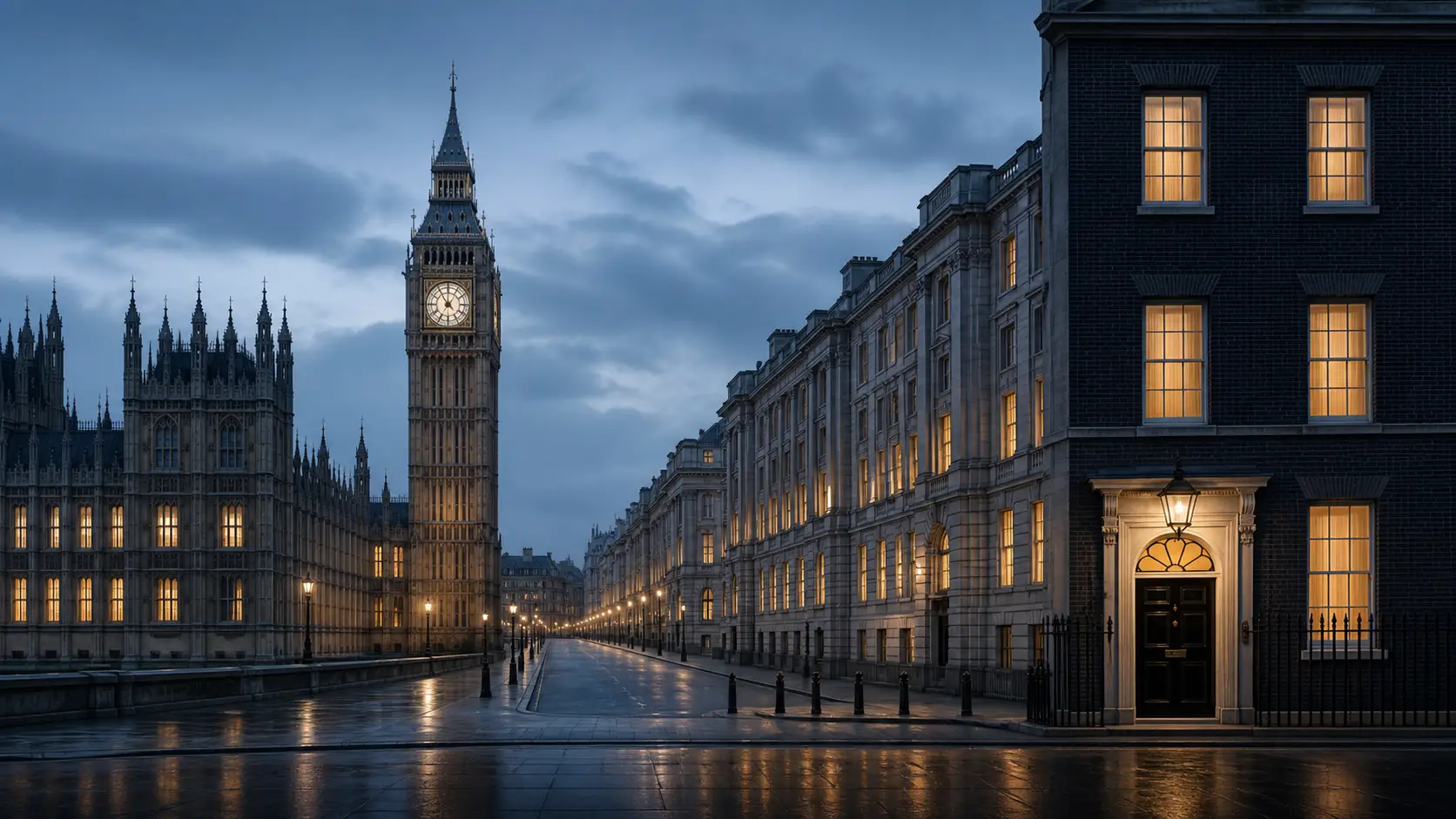
The black door attracts the cameras. The institutions behind it keep the government alive. A Labour majority sits in the House of Commons. Whips count it, the Cabinet depends on it, the civil service works beneath it and the Crown waits for the party holding it to say who can command it. Prime ministers pass through this machinery. The machinery remains.
Andy Burnham became prime minister on July 20, 2026. He will still be prime minister when Britain next votes.
House confidence: 74%. The forecast resolves yes if Burnham is prime minister when polls open at the next United Kingdom general election. If he resigns or is replaced before that moment, it resolves no. Unless an earlier election is called, the present Parliament will dissolve on July 9, 2029, and the last possible polling day is August 15.
This is not a forecast that Burnham's honeymoon will last three years. It will not. It is a forecast that the honeymoon will last through the only period in which removing him could look like renewal. After that, replacing him will look like collapse. Labour has already changed prime minister once. For better or worse, it will not do it twice.
01 — Britain changes the prime minister without stopping the state.
The British constitution does not give a prime minister a presidential term. The Cabinet Manual says prime ministers hold office until they resign. When a governing party has a Commons majority, that party identifies the successor capable of commanding it; the Monarch then formalises a political decision already made elsewhere. The House of Commons Library's account of prime-ministerial appointments is almost mechanical: party, confidence, resignation, Palace, new government.
This flexibility is one of Westminster's great survival devices. A failing leader can be removed while the elected House, the administration and the governing majority continue. The system changes its driver without dismantling the vehicle.
Burnham is himself proof. He entered Number 10 between elections, following Keir Starmer, and the state continued operating before the furniture had settled. The official record describes the transfer in one plain sentence: Burnham became prime minister on July 20, 2026.
That ease can be misunderstood. Britain is good at absorbing one succession. It is far less willing to absorb a second succession by the same governing party in the same Parliament.
02 — Changing prime minister is common. Changing twice is not.
Of the 19 prime ministers who have served since 1945, 12 first entered office between general elections, including Winston Churchill's first premiership. The names are familiar: Eden, Macmillan, Douglas-Home, Callaghan, Major, Brown, May, Johnson, Truss, Sunak and now Burnham all reached Downing Street without first winning a general election as leader. The parliamentary record makes midterm succession look less like an exception than a British habit.
But only one postwar Parliament contained three successive prime ministers from its governing party. The Parliament elected in 2019 began with Boris Johnson, passed through Liz Truss and ended with Rishi Sunak. A second Labour replacement now would reproduce the sequence exactly: Starmer, Burnham, a third Labour premier.
There is an older surface resemblance. The Parliament elected in 1935 saw Stanley Baldwin replaced by Neville Chamberlain and Chamberlain replaced by Churchill. The final change came as Britain formed a wartime coalition during an existential national emergency. It is not a model for peacetime party management.
The arithmetic is therefore severe. Removing Burnham would not be another ordinary British succession. It would make the current Parliament only the second postwar Parliament to be governed by three prime ministers—and the first Labour Parliament ever to do it.
03 — Labour's locked door requires 81 keys.
A Conservative leader can be wounded by confidential letters and removed by a parliamentary confidence ballot. Labour has constructed a slower and more public machine. Its MPs cannot formally hold a binding confidence vote in their leader. A challenger must instead submit written nominations from 20% of all Labour MPs. At the present size of the parliamentary party, that means 81 names. If the threshold is reached, Burnham automatically appears on a ballot of the wider party. Labour's leadership rules turn an attempted execution into an organised civil war.
If pressure first forced Burnham to resign, succession would remain collective. Candidates for the vacancy would need the same 20% parliamentary threshold and support from constituency parties or affiliated organisations before members selected the winner. The National Executive Committee would control the timetable. The Cabinet and NEC would have to arrange interim leadership if the office became unexpectedly vacant. The Institute for Government's procedural guide shows how many parts of Labour must move before Number 10 changes hands.
This is not accidental bureaucracy. Labour is a parliamentary party, a membership organisation and a trade-union movement at once. Its rules force those constituencies to confront one another before a leader can be displaced. A rebellion cannot remain a private opinion whispered in the Palace of Westminster. It needs a candidate, 81 signatures and a willingness to campaign against a sitting Labour prime minister in front of the country.
04 — Burnham begins with 379 signatures.
Burnham did not enter Downing Street at the head of a narrow faction. He received nominations from 379 Labour MPs and 23 affiliated organisations. Labour's official declaration made every other candidacy mathematically impossible. More than 94% of Labour MPs publicly participated in his elevation.
At the moment he was chosen, only 24 Labour MPs had not endorsed him. Even if every one of them immediately backed a challenger, at least 57 MPs who had just nominated Burnham would also have to reverse themselves before a contest could begin. The names and the arithmetic will change before 2029, but the political ownership will remain. Almost the entire parliamentary party placed Burnham in Number 10. Removing him would be a confession about their own judgment.
Burnham understood the protection he had been given. In his acceptance speech, he said Labour would not defeat Britain's new right if it were consumed by infighting. The promise was aimed at the public, but it also set a trap for future rebels. Every move against him can now be presented as a return to the factionalism the party collectively promised to end.
A prime minister survives not because every colleague is loyal. He survives because dissatisfied colleagues cannot agree on the same replacement at the same time. Burnham begins with an unusually large barrier between disappointment and coordination.
05 — The honeymoon only has to cross the killing ground.
Burnham's first Ipsos rating is not a national love affair. Twenty-nine per cent are satisfied with his performance, 30% dissatisfied and 41% have not yet formed a view. Seven in ten remain dissatisfied with the way the country is being governed. Those figures contain the eventual end of the honeymoon.
They also contain exactly enough political shelter. Labour has risen to 28%, three points ahead of Reform and its best Ipsos position for more than a year, though the lead remains within the poll's margin of error. Burnham is preferred as the most capable prime minister by 36%, against 15% for Nigel Farage and 13% for Kemi Badenoch. Half of Britons like Burnham; only 30% like the Labour Party. Ipsos's August survey shows a leader temporarily lending his party more credibility than it possesses on its own.
That advantage will shrink as decisions accumulate. British research using polling from 1971 to 2023 finds that leadership changes often have only a limited effect on party support. Andrew McKenna's study at the University of Strathclyde is a warning against treating a new face as a new electorate.
But Burnham does not need the bounce to carry him to 2029. He needs it to carry him through his first conference, his first fiscal choices and the months in which Labour MPs are deciding whether the new premiership deserves a chance. By the time ordinary disappointment arrives, he will no longer be an experiment. He will be the status quo—and changing the status quo will require Labour to accept responsibility for three governments in one Parliament.
06 — Westminster permits correction and punishes repetition.
British political culture contains a productive contradiction. Constitutionally, voters elect a House of Commons. They do not elect a prime minister separately, and a governing party may change its leader without seeking a new mandate. Culturally, campaigns have become increasingly presidential: a leader's face, temperament and promises stand in for hundreds of constituency contests.
The first replacement can therefore be narrated as parliamentary repair. The governing majority admits that its original leader has failed and supplies another person to carry out the programme for which the House was elected. The state bends and does not break.
A second replacement changes the meaning. The problem can no longer be contained inside one personality. The party itself begins to look incapable of governing, while a third prime minister appears to be borrowing authority from an election fought by two predecessors. The constitution still permits the transfer. The culture begins demanding that voters settle it.
Alan Renwick of UCL's Constitution Unit makes the distinction directly: mid-Parliament changes at Number 10 are normal, but rapid turnover signals deeper political trouble. That is the lesson Labour absorbed from 2022. It can replace Starmer and call the act renewal. It cannot replace Burnham and prevent the word chaos from attaching itself to the party.
This is where Britain's supposedly old-fashioned institutions become the article's real protagonists. The Commons majority provides continuity. Party rules slow panic. The civil service allows a new premier to begin immediately. The Crown remains outside the contest by appointing the person the party has already chosen. Each institution makes one transfer smooth. Together, they make repeated transfers politically shameful.
07 — Labour does not possess a culture of serial regicide.
Before Starmer's fall, no Labour prime minister had been dislodged by a successful internal rebellion. Harold Wilson's resignation produced James Callaghan in 1976. Tony Blair's long departure produced Gordon Brown in 2007. Both were single successions, and both successors remained until the electorate judged the government. During the crisis that ended Starmer's premiership, the Associated Press noted that Labour lacked the Conservatives' institutional muscle memory for removing its own prime ministers.
Starmer's removal broke that history once. Repeating it immediately would transform a rupture into a governing method. Labour MPs know what follows: another summer of manoeuvring, another candidate searching for legitimacy among members and affiliates, another Cabinet assembled from the same parliamentary party, and another prime minister asked why the public was not consulted.
The ideological breadth of Labour makes this harder, not easier. Its left, centre, unions, regional mayors and newer parliamentary intake may all become unhappy with Burnham for different reasons. Those grievances do not naturally produce one challenger. A candidate who satisfies one section can frighten another back into supporting the incumbent.
The party will complain loudly because that is part of Labour culture. It will brief, threaten and negotiate. But it will not cross the final threshold. The same movement that can make Burnham's premiership uncomfortable will keep it alive.
08 — Time changes sides.
In 2026, Burnham is protected by novelty, personal favourability and the 379 MPs who signed his nomination. In 2027, he will be protected by the absence of a challenger capable of uniting 81 MPs around the same alternative. By 2028, he will be protected by the approaching election: any successor would inherit the government's record, the accusation of lacking a mandate and too little time to establish a new one.
The closer Britain moves to polling day, the less a leadership contest can purchase. A challenger cannot become an outsider after serving in the same government. A new Cabinet cannot erase decisions supported by the same Commons majority. The possible electoral benefit of a new leader contracts while the institutional cost of installing one grows.
Unless Burnham requests an earlier dissolution, Parliament will automatically dissolve on July 9, 2029. The last possible election date is August 15, 2029. The parliamentary timetable gives Labour less than three years from Burnham's arrival to the legal end. A serious challenge must mature well before that deadline. His honeymoon is long enough to stop it maturing.
A personal incapacity, a disqualifying scandal or a sudden loss of Commons confidence could still end the premiership. Ordinary unpopularity will not. Low polls create complaints; they do not supply 81 signatures, a consensus successor and a persuasive explanation for Britain's eighth prime minister in little more than a decade.
Burnham will eventually become less popular. His government may become more divided. Labour MPs may conclude that he cannot win. They will still reach the same institutional verdict: replacing him would advertise a failure larger than one man.
For better or worse, Andy Burnham will carry this Labour government to the electorate. The black door will open for voters, not for another Labour coronation.