
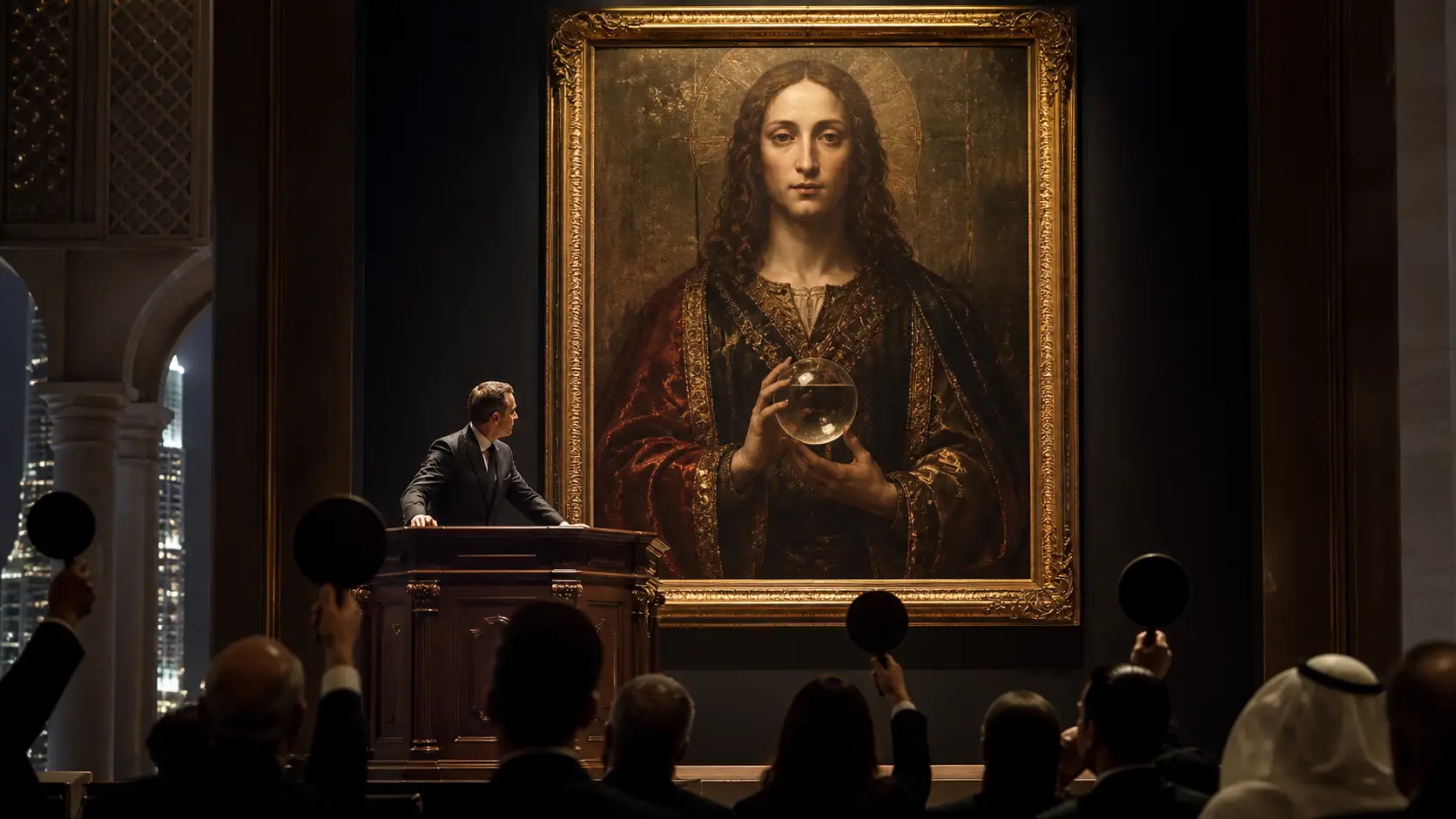
Leonardo da Vinci’s Salvator Mundi sold for $450.31 million at Christie’s New York on November 15, 2017. By the end of 2032, it—or another Leonardo—will become the first physical artwork sold for $1 billion.
The 2017 sale exceeded the previous auction record, Picasso’s Les Femmes d’Alger (Version O), by $270.95 million. It increased the record by 151%. Moving from $450.31 million to $1 billion requires a smaller proportional leap: 122%.
That makes the billion-dollar artwork less a question of market mathematics than of finding the right object.
The painting that broke the scale
Salvator Mundi had been bought for less than $10,000 in 2005, obscured by overpainting and attributed to a follower of Leonardo. Years of restoration and scholarly investigation followed. Its appearance in the National Gallery’s 2011–12 Leonardo exhibition helped transform it into the only generally recognised Leonardo painting still in private hands.
Christie’s presented the work not as another Old Master, but as the last da Vinci. The strategy turned scarcity into spectacle. After 19 minutes of bidding, it sold for $450.31 million.
Fewer than 20 paintings are widely attributed to Leonardo. All the others belong to museums. Their practical market supply is zero.
Debates about restoration and attribution have followed Salvator Mundi, but they have not weakened its position as the market’s supreme trophy. At this level, the buyer is not purchasing unanimity among specialists. The buyer is acquiring the exclusive claim to possess a Leonardo.
A brief history of the auction record
November 2017 — Leonardo, Salvator Mundi — $450.31 million — Christie’s, New York — record increased 151%.
May 2015 — Picasso, Les Femmes d’Alger (Version O) — $179.37 million — Christie’s, New York — record increased 26%.
November 2013 — Bacon, Three Studies of Lucian Freud — $142.41 million — Christie’s, New York — record increased 19%.
May 2012 — Munch, The Scream — $119.92 million — Sotheby’s, New York — record increased 13%.
The record does not advance gradually. Its recent history is a sequence of long waits followed by violent jumps, whenever an object appears that can break the existing scale.
The 2025 sale of Klimt’s Portrait of Elisabeth Lederer for $236.36 million demonstrated that several bidders can already compete above $200 million. Six bidders pursued the painting during a 20-minute contest.
The next exceptional Leonardo will enter a much wealthier market.
The buyers are becoming richer faster than the art
The world’s billionaires held a combined $15.8 trillion in 2025, following a 13% annual increase, according to UBS. The number of people capable of making a billion-dollar cultural purchase is expanding, even while the supply of museum-grade masterpieces remains fixed.
Research has found a long-term relationship between art prices, equity returns and the income of the wealthiest buyers. Another historical study of record prices identified extreme scarcity and competition among newly rich collectors as central forces behind record-breaking sales. The market is built for large jumps whenever new wealth meets an object that cannot be substituted.
The broader art market reached $59.6 billion in 2025. The United States accounted for 78% of worldwide sales above $10 million, and every one of the year’s ten largest auction lots sold in New York, according to the Art Basel and UBS Art Market Report.
A billion-dollar painting would represent less than 0.01% of global billionaire wealth. For the eventual buyer, it would be less a financial stretch than an act of cultural positioning.
The Gulf is building the buyer
The likely purchaser is not a conventional collector. It is a sovereign-backed museum, royal collection or cultural foundation competing for international stature.
Qatar’s Art Mill Museum is scheduled to open in 2030. Guggenheim Abu Dhabi is building a major collection, while Saudi Arabia is undertaking an extensive museum programme. Institutional acquisitions already outpace private collecting in parts of the region, according to Art Basel’s examination of the Gulf art market.
Saudi Arabia has awarded a $490 million construction contract for its new Museum of Contemporary Art. A museum project on this scale eventually requires a work that announces its importance immediately.
A Leonardo does that in any language.
The five routes to $1 billion
Leonardo’s Salvator Mundi — Last sale: $450.31 million. Route: resale between a royal owner and a sovereign-backed museum.
A newly authenticated Leonardo — No previous price. Route: discovery, restoration and competition between national collections.
De Kooning’s Interchange — Last reported price: $300 million. Route: private resale between billionaire collectors.
Klimt’s Portrait of Elisabeth Lederer — Last sale: $236.36 million. Route: provenance, historical importance and institutional competition.
Picasso’s Les Femmes d’Alger (Version O) — Last sale: $179.37 million. Route: a contest between a Gulf museum and a technology billionaire.
How the sale will happen
The first billion-dollar transaction will be negotiated privately.
An auction would make the price public but expose the seller to a failed spectacle. A private sale permits months of negotiation, financing, guarantees and government-level discretion. The final consideration may combine cash with exhibition rights or a long-term loan, but the ownership transfer will place a nominal value of at least $1 billion on one physical work.
The announcement will come after the agreement, when the painting is presented as the centrepiece of a museum opening or a national cultural programme.
The work will not reach $1 billion because paintings have become twice as beautiful. It will reach $1 billion because private fortunes and national cultural ambitions are growing while the supply of universally recognised masterpieces cannot grow with them.
By 2032, that imbalance will produce its inevitable result: a single painting, almost certainly a Leonardo, sold for ten figures.