
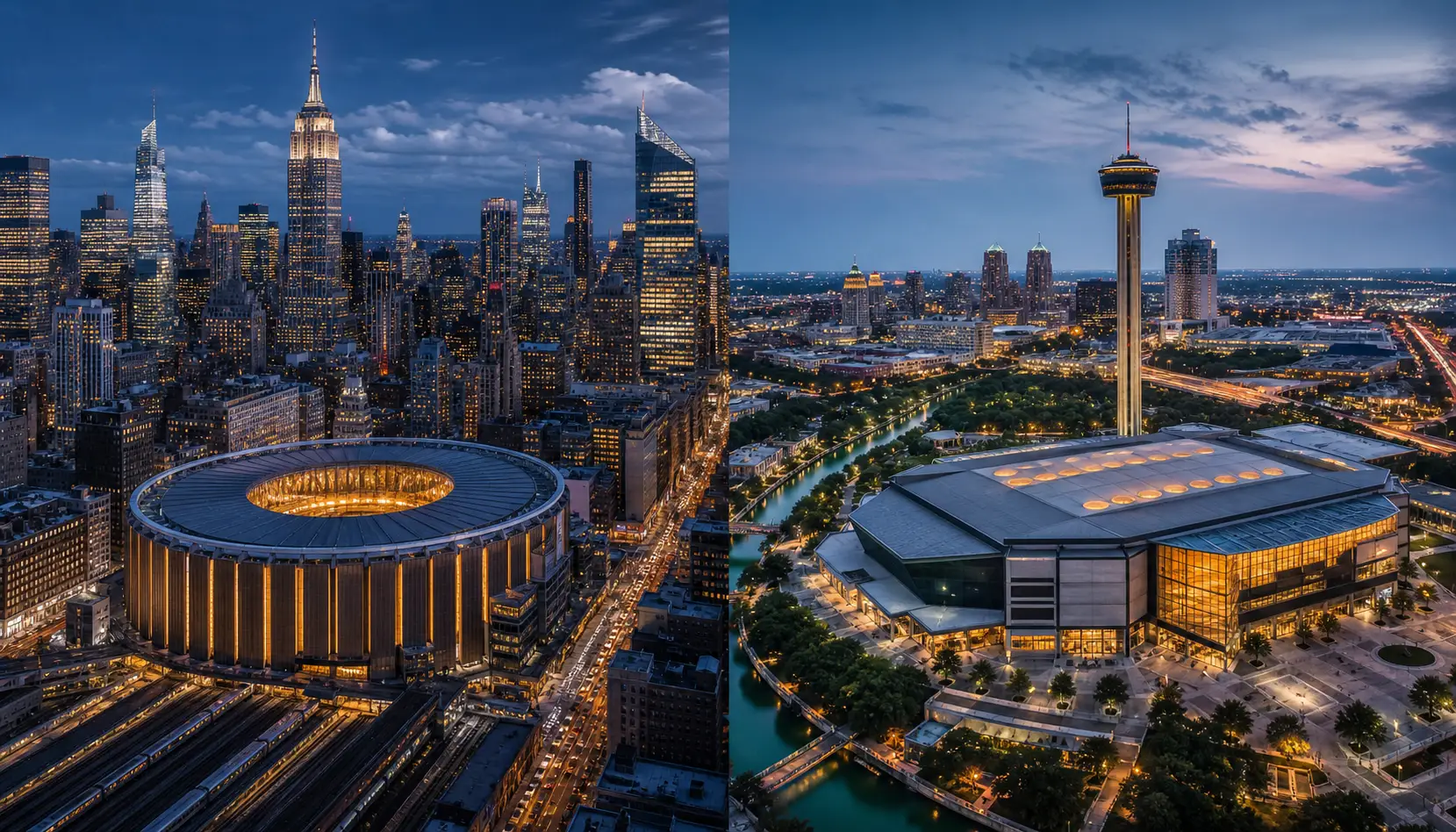
SAN ANTONIO — Thousands of Knicks supporters were still celebrating inside the Spurs’ arena when Jalen Brunson explained why he had chosen New York.
Brunson had scored 45 points, including 13 consecutive Knicks points in the fourth quarter, to complete a 94-90 victory and secure New York’s first NBA championship in 53 years. San Antonio had led by 16. The Knicks had come back, as they had throughout the series.
“It’s why I came to New York,” Brunson said.
The June night looked like the conclusion of a championship season. It was more likely the opening scene of the NBA’s next great era.
The Knicks and Spurs did not merely reach the 2026 Finals. They arrived with the two economic models best suited to control the league through the middle of the next decade.
When every team offers the same salary
The NBA set its 2026-27 salary cap at $164.96 million. The luxury-tax line is $200.43 million, while the second apron begins at $221.69 million.
Crossing that second apron brings more than a tax bill. It restricts trades, exceptions and other methods of repairing an expensive roster. Money alone can no longer rescue poor planning.
But maximum individual salaries create a different distortion. A transcendent player cannot demand his unrestricted economic value from the highest bidder. Several teams may be permitted to offer essentially the same basketball salary.
The contest then moves outside the contract.
Researchers Yupin Yang, Mengze Shi and Avi Goldfarb examined NBA free-agent agreements for a study published in Marketing Science. They found evidence that maximum-salary rules increased the importance of brand spillovers between players and teams.
That is New York’s opening.
New York has an economy outside the cap
New York remains the country’s largest television market. It is simultaneously a centre of finance, fashion, advertising, entertainment, technology and media. A player does not have to leave the arena district to encounter potential sponsors, television producers, investors and restaurant groups.
Research into superstar endorsement earnings has found that exposure and public familiarity have substantial monetary value. Basketball performance establishes the player. New York multiplies the audience.
The Knicks cannot promise a recruit a secret endorsement contract. NBA rules prohibit teams from arranging outside compensation to circumvent the cap, and the league has punished teams for including potential third-party endorsements in recruiting presentations. They do not need to. New York’s independent commercial market performs that work openly.
Local campaigns, appearances, equity partnerships, podcasts and media jobs do not appear on the Knicks’ payroll. Nor do the long-term benefits of becoming a champion in a city that turns its winning athletes into permanent civic figures.
Brunson demonstrated the model
In 2024, Brunson accepted a four-year extension worth $156.5 million rather than wait for eligibility to pursue a five-year contract projected at $269 million. The decision gave New York the flexibility to keep building around him. Two years later, he was a champion and Finals MVP.
Within weeks of the title, the New York-based Just Salad chain announced that Brunson had become a partner and equity owner.
The restaurant agreement did not repay his contractual sacrifice, and it was not arranged by the Knicks. It illustrated the larger mechanism: success in New York creates businesses around a player that the salary cap does not count.
For a superstar, the Knicks can offer the maximum salary plus the league’s most powerful commercial platform. For selected veterans, they can offer a smaller playing contract surrounded by sponsorship, broadcasting and post-career opportunities that are harder to reproduce elsewhere.
The Knicks are not outpaying competitors on the official cap sheet. They are competing with a larger definition of compensation.
San Antonio has different mathematics
The Spurs’ advantage begins with Victor Wembanyama, a player so unusual that he can make a smaller basketball market internationally important.
In his third season, Wembanyama averaged 25 points, 11.5 rebounds and a league-leading 3.08 blocks. He won Defensive Player of the Year, made the All-NBA first team and led San Antonio to 62 victories and the Finals.
Dylan Harper scored 25 points in the deciding Finals game. Stephon Castle was already an accomplished perimeter defender. The Spurs reached the championship round with an average age just above 25, according to the San Antonio Express-News.
Then Wembanyama protected the construction project.
He agreed to an extension that begins at 25 per cent of the salary cap rather than waiting for a possible path to 30 per cent. The contract could exceed $250 million, but another structure might have surpassed $300 million. The difference preserves room for the Spurs’ other young players.
“Spurs family, I’m here to stay,” Wembanyama wrote after signing. “Whatever it takes.”
A global star in a tax-efficient city
Wembanyama can afford to separate his NBA salary from his total value. His commercial identity is already global, with relationships including Nike and Louis Vuitton. San Antonio’s traditional small-market disadvantage shrinks when its central player brings France — and much of the international basketball audience — with him.
Texas supplies the second advantage: no state individual income tax. Academic research using NBA free-agent contracts found that higher marginal tax rates reduced the average quality of free agents moving to a team.
Players still owe taxes for road games in other jurisdictions, so the benefit is not as simple as applying one tax rate to an entire salary. But the difference is real. When two teams offer the same permitted contract, San Antonio can offer more take-home value than New York before another dollar is negotiated.
The Spurs can therefore recruit around three propositions: play with the league’s defining young player, compete for championships immediately and retain more of the salary.
The apron will separate builders from buyers
The second apron is frequently described as a weapon against wealthy teams. Its more consequential effect will be to reward organizations whose stars voluntarily leave room beneath it.
Brunson has already done that in New York. Wembanyama has now done it in San Antonio.
Their decisions allow the Knicks and Spurs to spend more efficiently on the players around them. Every dollar a franchise star declines can become a useful veteran, an extension for a young teammate or enough breathing room to complete a trade.
This is how the new rules will favour New York without simply allowing owner James Dolan to purchase a championship roster. The Knicks can use their market to make a cap-conscious salary more attractive. They can then reserve their formal payroll for the depth that the apron makes difficult to retain.
San Antonio accomplishes the same result through Wembanyama’s global earning power, Texas taxes and a collection of young players whose development schedules overlap.
A rivalry built to outlast its first cast
The teams are positioned at opposite ends of the basketball life cycle. New York’s championship core is mature. San Antonio’s most important players are only beginning. That difference will extend the rivalry rather than shorten it.
Brunson and the current Knicks will control its first phase. As that group ages, New York’s restored reputation will help recruit its successor. Wembanyama, Harper and Castle will enter their primes during the same period.
The Knicks spent decades proving that a large market could be squandered by unstable management. The 2026 championship removed that objection. New York can now offer money, exposure and evidence that the organization works.
San Antonio spent one season proving that its rebuild was already over. After the Spurs won the Western Conference, Wembanyama compared the achievement to the entrance of a castle.
He was more accurate than he knew.
The 2026 Finals were the entrance. The Knicks and Spurs are about to occupy the NBA’s next decade.