
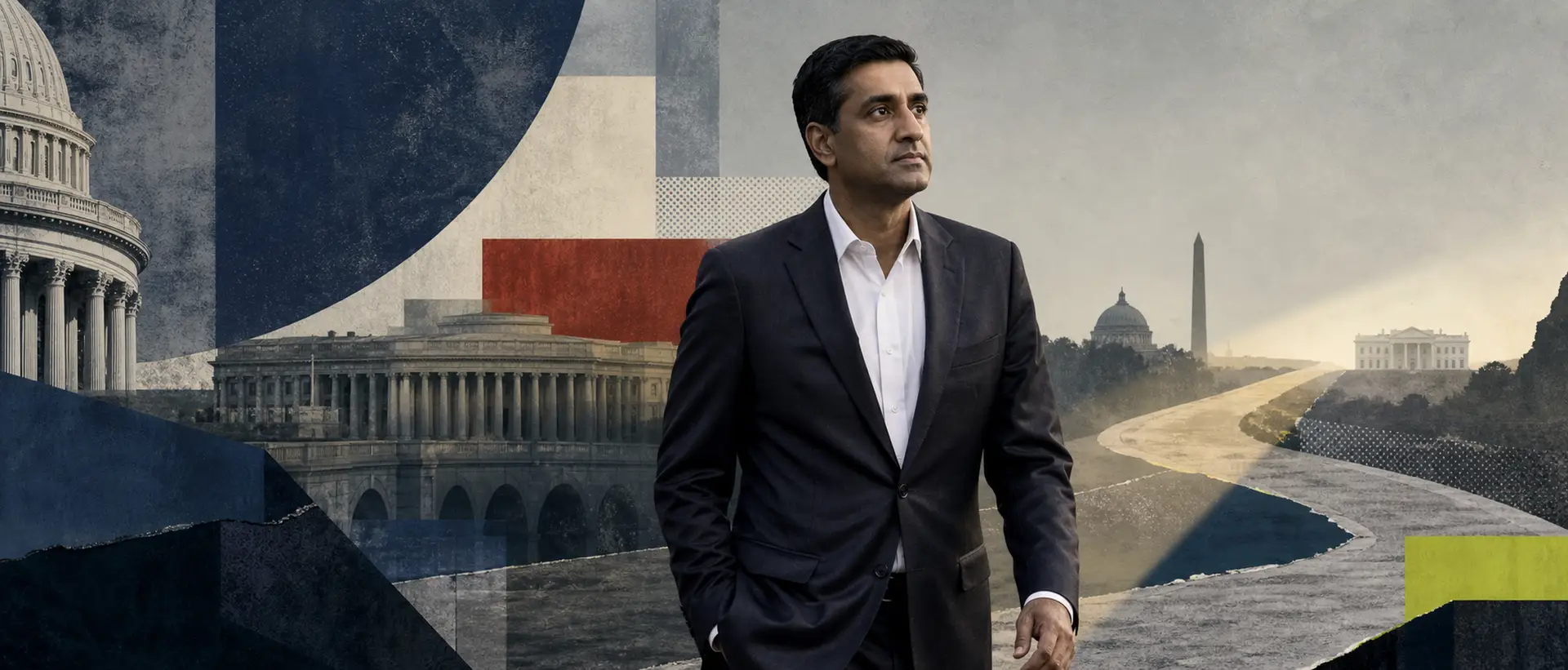
Ro Khanna is behaving like a presidential candidate before calling himself one. The California congressman is visiting early states, recruiting veterans of the Obama and Sanders worlds, and translating a new urban affordability politics into a national pitch. The route is credible. The arrival is not.
House forecast: 4%. This resolves yes only if Khanna is the first person after Donald Trump to take the presidential oath and does so no later than January 20, 2029. A nomination, vice-presidential selection or presidency at a later date does not count.
01 — A candidate, not yet a constituency.
The first clue is not a slogan. It is a travel schedule. Khanna has gone to South Carolina to speak with union members and Black voters, the two constituencies that can turn an exploratory national profile into a Democratic campaign. Associated Press reporting says he has also been in direct contact with Representative Jim Clyburn, whose 2020 endorsement helped transform Joe Biden's failing campaign into the nomination.
That is how a run begins in a party with no incumbent heir: by learning whether anyone important returns the call. Khanna is receiving enough replies to keep walking. He is not receiving enough votes to call the walk a march.
02 — The Obama lineage is real—and widely overstated.
As a University of Chicago student, Khanna worked on Barack Obama's 1996 Illinois state Senate campaign. He later worked for Obama's presidential campaign, entered the Commerce Department in 2009 and served on the White House Business Council. Ron Klain, a senior official in both the Obama and Biden administrations, is now reported to be advising him as he considers 2028.
This is an Obama résumé, not an Obama blessing. In Khanna's 2014 House race, Obama endorsed incumbent Mike Honda against him. Obama withheld that endorsement when Khanna tried again in 2016, but did not switch sides publicly. There is no evidence, as of August 6, 2026, that Obama has chosen Khanna as a political successor.
The distinction matters. A lineage can supply staff, donors and fluency in governing. It cannot transfer the emotional permission that Obama once gave voters to imagine a new coalition.
03 — Mamdani gives him a language.
Khanna endorsed Zohran Mamdani for New York mayor in July 2025 and identified the part of Mamdani's campaign that could travel beyond the city. “He spent a lot of time talking about the cost of living in New York, in this country, and how we address it,” Khanna said.
The lesson is not socialism as an identity. It is affordability as a story. Housing, childcare and household power are concrete enough to survive the trip from a Queens sidewalk to a union hall in Charleston. Khanna's proposals—a plan to add 3.2 million homes, childcare capped at $10 a day for most families, a billionaire wealth tax and employee profit sharing—give him material for that story.
But Mamdani's strength came from being an insurgent who looked unowned by the old order. Khanna is a five-term congressman from Silicon Valley who calls himself a progressive capitalist. He can borrow the grammar. He cannot borrow the biography.
04 — He is assembling a bridge campaign.
Klain offers governing credibility from the Obama-Biden establishment. Jeff Weaver, who managed Bernie Sanders's 2016 campaign, offers the memory of a national small-dollar insurgency. Khanna's own endorsements in the 2026 midterms are a way to build obligations before he needs them. His early-state tours are a way to test whether those networks can inhabit the same room.
The architecture is unusual: Obama-era competence, Sanders-era economics and Mamdani-era communication. It is also unstable. Establishment voters may distrust the economic populism. Progressive voters may see a wealthy-district congressman reverse-engineering a movement that Alexandria Ocasio-Cortez already owns more naturally.
Khanna has said he will not decide on 2028 until after Thanksgiving 2026. That sentence should be read as timing, not reluctance. Serious candidates preserve optionality while their party is still fighting a midterm election.
05 — The numbers are brutal now.
In Emerson College's July 2026 national Democratic primary poll, Khanna drew 2 percent. Pete Buttigieg led with 19 percent, Gavin Newsom had 17 percent, Jon Ossoff and Ocasio-Cortez each had 13 percent, and 13 percent were undecided. Khanna's problem was not merely low recognition in distant states. A March 2026 Berkeley IGS survey put him at 2 percent even among Democratic voters in California, while Newsom had 28 percent and Ocasio-Cortez 14 percent.
Khanna has none of the polling profile normally associated with a future president now. The timestamp matters. Four years before Mamdani's 2025 victory, the relevant public evidence was not mayoral polling at all: he was beginning his first term in the New York State Assembly. He went on to win the 2025 Democratic mayoral primary with 573,169 votes in the final ranked-choice round and took office the following January. His rise is evidence that political demand can be created much closer to an election—not proof that early polls can be ignored.
Early primary polls are weak prophecy. They measure fame before debates, money before mistakes and coalitions before candidates have been forced to choose. They are still evidence. A candidate sitting at 2 percent nationally and at home does not have a hidden majority. He has a hypothesis.
Our 4 percent presidential forecast is higher than his current primary polling because open contests allow sudden climbs. It remains low because he must win two different elections, and has not yet demonstrated the base required to win the first.
06 — His political product is abundance with an antagonist.
Khanna's best message is not simply that government should spend more. It is that America should build more while taxing concentrated fortunes and giving workers a claim on the value they create. That lets him praise technology without becoming its lobbyist, and attack billionaires without making enterprise itself the enemy.
The formulation fits a country angry about prices but wary of ideological labels. It also fits Khanna's contradictions. His district contains some of the world's richest technology companies. His campaign says it rejects money from political action committees and lobbyists. He is close enough to capital to speak its language and close enough to the Sanders movement to prosecute it.
A bridge is valuable only when both banks want to cross. If voters read this combination as synthesis, Khanna becomes interesting. If they read it as calculation, the campaign never leaves the single digits.
07 — His rivals already own the easier versions of his argument.
Ocasio-Cortez has the larger progressive audience, the stronger social-media machinery and the cleaner claim to inherit Sanders's movement. Newsom has executive experience, universal name recognition and a donor operation that Axios reported had already moved money from 74,000 contributors into fourteen state parties. Buttigieg has a prior national campaign and leads the latest Emerson field. Ossoff can sell generational change without Khanna's Silicon Valley baggage.
Khanna therefore cannot win as a slightly more technical version of someone else. His opportunity appears only if the field fractures: Newsom and other governors divide institutional Democrats, Ocasio-Cortez consolidates the left but alarms moderates, and voters begin looking for a figure who can speak to both camps without sounding borrowed.
That is a real opening. It is also the sort of opening analysts invent for candidates who do not yet have voters.
08 — South Carolina is the hinge.
The likely early-state calendar elevates South Carolina and Nevada. For Khanna, South Carolina is especially unforgiving. A campaign built in Northern California must prove it can earn trust among Black Democrats in the South, not merely hire people who know them. Clyburn can open doors, but no surrogate can manufacture familiarity.
Jody Gaulin, the Democratic chair in South Carolina's deep-red Oconee County, told the Associated Press that the influx of presidential prospects could strengthen the local party. “This is exactly what we've been waiting for,” she said. It was a welcome to the field, not an endorsement of Khanna.
The local test is whether union organizers, clergy, county chairs and municipal leaders begin introducing Khanna in their own words. His Mamdani endorsement helps explain the affordability argument. It does not answer the trust question. The decisive quotation will not come from Khanna, Obama or Sanders. It will come from a South Carolinian with something to lose.
09 — The narrow path.
First, Khanna's endorsed 2026 candidates must outperform and leave behind organizers who view him as an ally rather than a visiting patron. Second, he must launch early enough in 2027 to convert political relationships into recurring small-dollar donors. Third, he needs at least one surprising endorsement in South Carolina and a visible labor foothold in Nevada. Fourth, he must reach roughly 8 percent in national primary polling by the summer of 2027, before debates begin fixing the field's hierarchy.
Then he needs a collision among the favorites. A scandal, strategic error or ideological pileup has to create demand for a candidate who is simultaneously younger than the Biden generation, less polarizing than the left's stars and more economically confrontational than the party's governors.
Only after all of that does the general election begin. A Democrat who wins such a primary would have a competitive chance in November 2028. The improbability is concentrated in becoming that Democrat.
10 — The forecast.
We estimate a 70 percent chance that Khanna enters the Democratic presidential primary, an 11 percent chance that he wins the nomination conditional on running, and about a 52 percent chance that he wins the general election conditional on becoming the nominee. Multiplied together and rounded, that produces a 4 percent chance that he is the next president. These are judgmental components, not a polling average.
The forecast rises above 8 percent if Khanna reaches sustained high-single-digit national support, builds a visible recurring-donor base and earns local Black or labor endorsements before the first contests. It falls below 2 percent if he remains near 2 percent after entering, if Ocasio-Cortez consolidates the Sanders-Mamdani lane, or if he declines to run.
Khanna may be the field's most legible bridge candidate. That is not the same as being its likeliest president. For now, the road to the White House exists mostly as a line on a map: visible, continuous and very far away.