
Research update — 29 August 2026: Japan selected Yamagawa, Kagoshima, for new supercritical-resource research and opened applications for up to ¥15.3 billion to drill a test well and characterize supercritical fluid by fiscal 2030. These are research and demonstration steps, not approval or construction of a 100-megawatt plant. The forecast remains at 66%.
Japan found the heat of its energy future in 1995, beneath a mountain in Iwate Prefecture, and sealed the hole.
The government-funded WD-1a well at Kakkonda descended 3,729 metres and reached rock at approximately 500°C. No Japanese geothermal well had entered a hotter formation. The drilling proved that immense energy existed within reach of an industrial borehole. It also revealed the next problem: heat alone cannot turn a turbine. A commercial reservoir needs fractures and fluid capable of carrying that heat continuously to the surface.
Thirty years later, Japan can see the missing reservoir more clearly. Magnetotelluric surveys measure the electrical character of the deep crust. Tiny earthquakes illuminate fractures. Reflected seismic waves reveal boundaries. Artificial intelligence combines old well records with new geophysical data. At Kakkonda, the resulting model indicates a supercritical reservoir near three kilometres deep that could support 100 megawatts for more than 30 years.
ParallaxSee forecasts that by the end of 2045, Japan will place a grid-connected supercritical geothermal plant of at least 100 megawatts into commercial operation. House confidence: 66%.
At the operating assumptions Japan uses for geothermal power, such a plant would deliver about 647 gigawatt-hours of net electricity each year—approximately the annual household consumption of 165,000 Japanese homes. The first plant will be proof that a volcano can serve a city without erupting, burning fuel or waiting for the weather.
01 — Kakkonda has been waiting for its second well.
The Kakkonda geothermal field already produces electricity. Its shallow system stores water around 230°C to 260°C in fractures approximately 1.5 kilometres beneath the surface; a deeper conventional system reaches roughly 350°C near the young Kakkonda granite. JOGMEC's Japanese guide to the Kakkonda field
WD-1a went deeper. Drilled between 1994 and 1995, it passed through the circulating hydrothermal zone, crossed the brittle-plastic boundary and entered hot granite. The reconstructed temperature reached 500°C at 3.7 kilometres. The bottom of the well was conduction-dominated: magnificently hot rock, with too little natural permeability at that exact point to become a production well. The Japanese research team's original Kakkonda drilling paper
That result has aged into an advantage. Japan owns core samples, logs, temperature histories, seismic records and decades of operating experience at the same field. A failed production target became an extraordinary calibration hole. Modern surveys can compare every new signal against a place where the deep temperature is already known.
The candidate has also moved beyond a solitary hot measurement. A NEDO review reports that planners have established realistic well structures, drilling methods, safety management and several test-well plans for Kakkonda. The company already producing steam in the area responded positively to a future investigation well. NEDO's Japanese mid-project assessment
The first commercial plant is therefore most likely to rise at Kakkonda or within the same Hachimantai volcanic province. It can use an experienced workforce, existing roads, transmission and a community that already knows geothermal industry. Japan does not need to build a new energy culture there. It needs to complete the well that 1995 made imaginable.
02 — Above the critical point, water becomes a more powerful machine.
Ordinary geothermal plants separate hot water and steam. Supercritical geothermal reaches a stranger physical regime. Above about 374°C and 22.1 megapascals, water no longer possesses a clear boundary between liquid and gas. It can combine high heat content with fluid-like movement through rock.
That changes the arithmetic of a well. Japanese feasibility work found that a productive supercritical borehole could supply tens of megawatts, several times the electrical output of a conventional geothermal production well. Under favourable reservoir and construction assumptions, the same work estimated mature generating costs of roughly ¥9 to ¥12 per kilowatt-hour. NEDO's Japanese supercritical feasibility results
At a 2025 Japanese geothermal forum, AIST researcher Hiroshi Asanuma described fluids between roughly 400°C and 600°C and said, in translation, “I believe this may be the most hopeful form of generation.” He explained that the fluid could yield more than ten times as much steam and several times as much electricity. JOGMEC's Japanese report on next-generation geothermal power
The advantage is intensity. Every successful well occupies roads, a pad, casing, cement, pumps and surface equipment. Increasing the energy carried through that well multiplies output while keeping the disturbed landscape compact. NEDO explicitly expects supercritical production wells to deliver several times conventional capacity and reduce the land altered per kilowatt. NEDO's 2025 geothermal implementation plan, in Japanese
This is how a volcano becomes urban infrastructure. A narrow engineered connection reaches a natural heat engine. The mountain remains a mountain. Energy travels through steel.
03 — Japan is learning to see kilometres through solid rock.
The expensive decision in geothermal energy is where to drill. A surface hot spring proves that heat and water exist somewhere below; it does not reveal whether a commercial fracture network intersects one chosen borehole several kilometres down.
Japan's modern exploration stack reduces that uncertainty from several directions. Magnetotellurics, or MT, records natural variations in the Earth's electric and magnetic fields. Conductive zones can indicate hot saline fluid or altered rock. Microearthquakes trace active fractures. Seismic reflection searches for boundaries that return an acoustic signal. Rock samples and old wells anchor the interpretation. Reservoir simulations then test whether the inferred structure can sustain production and reinjection.
At Kakkonda, AIST combined MT structure, microseismicity, seismic reflectors and well information into a three-dimensional conceptual model. Its production simulations found development patterns capable of 100 MW for more than 30 years. AIST is also training higher-resolution AI models on historical geothermal data to rank promising drilling areas. AIST's geothermal research programme, in Japanese
A 2024 Japanese geophysics study reported what may be the country's first reflected seismic surface attributable to a supercritical geothermal reservoir at Kakkonda. The researchers tested the image against numerical ray-tracing models rather than relying on a single attractive pattern. Japanese study of Kakkonda's possible supercritical reflector
This is the quiet technological breakthrough beneath the spectacular temperatures. The future plant will begin as an increasingly precise probability map. AI will not invent the reservoir. It will show engineers which expensive question is most worth asking with steel.
04 — One hundred megawatts is a city's domestic life.
Nameplate capacity describes the strongest sustained output a plant is designed to deliver. Annual electricity depends on how often it runs and how much power the plant consumes itself.
Japan's official cost model assumes an 83% capacity factor for geothermal power, a 40-year operating life and an 11% internal-use rate. Applied to a 100-MW station, those assumptions produce 727 gigawatt-hours of gross generation and approximately 647 gigawatt-hours delivered each year. Japan's official geothermal generation-cost assumptions, in Japanese
The Environment Ministry reports average annual household electricity use of 3,911 kilowatt-hours. Dividing the plant's net output by that figure produces about 165,000 homes. Japan's household energy statistics, in Japanese
That comparison concerns household electricity; offices, railways, shops and factories add another urban load. It nevertheless defines the scale correctly. A single volcanic plant can cover the domestic electrical life of a substantial city. Five 100-MW stations—the scale imagined in NEDO's longer supercritical programme—would produce more than three terawatt-hours of net electricity annually.
Geothermal's hours are as valuable as its megawatts. Output continues through a windless winter evening and a humid summer night. Solar and wind can provide enormous volumes of inexpensive energy; a supercritical station provides the deep, steady line beneath them. The city receives volcanic power as something beautifully uneventful: electricity that is already present whenever a switch is touched.
05 — The economics improve each time one borehole carries more heat.
Geothermal spends its money early. Developers survey, negotiate, permit and drill before the reservoir has sold a kilowatt-hour. A dry or weak well is expensive. A productive well then earns for decades without buying coal, gas or uranium.
Supercritical geothermal amplifies the productive side of that bargain. Tens of megawatts from one borehole spread the cost of drilling and surface infrastructure across a much larger stream of electricity. Large plants also share turbines, cooling, grid connections and maintenance more efficiently than scattered small units.
Japan's current public-private roadmap asks next-generation geothermal to reach the cost range of established geothermal as quickly as possible and ultimately compete with firm power at roughly ¥12 to ¥19 per kilowatt-hour. It also sketches as much as 1.4 GW of next-generation geothermal by 2040 and 7.7 GW by 2050, across supercritical, closed-loop and enhanced-geothermal technologies. Japan's next-generation geothermal roadmap, in Japanese
The first plant will cost more than its mature successors because it purchases knowledge as well as electricity. It will establish well specifications, corrosion allowances, insurance assumptions, service intervals and a bankable production history. Every later project can price those facts instead of pricing ignorance.
Japan needs that learning curve. Geothermal supplied only 0.3% of national electricity at the end of fiscal 2024, while the Seventh Strategic Energy Plan expects approximately 1% to 2% by 2040. Officials now call for next-generation geothermal demonstration in the early 2030s. Japan's 2025 geothermal acceleration review, in Japanese
The 2045 plant will be valuable before it is cheap. It will convert an uncertain national resource into an investable class of infrastructure.
06 — Japanese engineers know exactly what must survive.
The borehole is the machine that touches the future first.
At more than 400°C, drilling electronics, seals, lubricants, cement and casing leave their familiar operating range. Cooling fluid must protect tools while the bit advances through hot, hard rock. When production begins, hydrogen sulphide or hydrochloric acid may create a fluid near pH 3. The completed well must contain that chemistry through repeated heating and cooling for a commercial life approaching 40 years.
Akita University drilling specialist Narumi Naganawa describes the requirement as a combined challenge of ultra-high temperature, acid corrosion, well design and long-term integrity. The engineering problem extends beyond stronger hardware to drilling-fluid control, completion design and methods for safely managing any influx of deep fluid. “Drilling Technology Challenges for Supercritical Geothermal Development,” in Japanese
Permeability must survive too. Rock fractures can close as hot granite deforms, while dissolved silica can precipitate and seal pores, pipes or reinjection wells. Japanese laboratory research finds that granite fracture behaviour changes above 400°C, precisely where the best resource begins. Japanese research on fracture slip and permeability at high temperature
The programme is now attacking these obstacles as specifications. NEDO's 2026–2030 project will analyse silica scale at the nanoscale, develop acid-resistant material technology at half the cost of existing high-grade steel, design exploration wells and flow tests, and complete site-specific economics. NEDO's current Geothermal Potential Advanced Utilization programme, in Japanese
Japanese electrochemists are already testing how corrosion should be measured in geothermal fluid approaching 400°C. 2026 Japanese review of geothermal corrosion environments
These are finite engineering tasks with laboratories, budgets and pass-fail tests. By the 2030s, the first flow well will turn them from materials science into operating practice.
07 — The social instrument will be an onsen monitor.
Japan's geothermal resource lies beneath landscapes that already possess economic and spiritual value. Hot-spring inns depend on the temperature, flow and chemistry of water whose underground route cannot be watched directly. A developer may model separation between a deep supercritical reservoir and a shallow spring; an innkeeper lives with the consequence if the model is wrong.
The answer is continuous shared evidence. NEDO and AIST developed an AI-IoT system in Beppu that records spring temperature, flow and electrical conductivity, sends the data to the cloud and distinguishes operating changes from weather and natural variation. More than ten monitoring units were used in the demonstration. NEDO's Japanese report on AI-IoT hot-spring monitoring
At Kakkonda, the deep development model has already been required to show that 100-MW supercritical production would not meaningfully disturb the shallower conventional geothermal system. The eventual agreement should extend that discipline to nearby springs: measure the baseline for years, publish the signals, define intervention thresholds and fund a rapid response before drilling begins.
Japanese planning research shows that local acceptance strengthens when municipalities provide zoning, residents enter the process early and benefits visibly return to the host community. Beppu's geothermal ordinance offers a recent model for making coexistence an operating institution rather than a ceremonial consultation. 2025 Japanese study of geothermal ordinances and coexistence
A 100-MW project can finance durable local benefits: heat networks, greenhouse agriculture, snow melting, public electricity revenues, research employment and long-term monitoring. The plant will earn permission by making the invisible reservoir legible to the people living above it.
08 — Four regions and an industrial coalition are already in rehearsal.
Between 2021 and 2025, NEDO investigated four principal supercritical regions: Kakkonda, Hachimantai, southern Yuzawa and Kuju. The geography spreads the programme across Tohoku and Kyushu and prevents one disappointing well from ending the national effort.
The research network is equally distributed. AIST, Tohoku University, Akita University, Kyushu University, Mitsubishi Materials Techno, Geothermal Engineering, Nittetsu Mining Consultants and West Japan Engineering Consultants have worked on resource models, stress measurement, drilling specifications and plant systems. The supporting programme includes fibre-optic sensing, high-temperature cameras, AI reservoir monitoring, corrosion science and silica control. NEDO's 2025 Japanese programme report
This coalition matters because supercritical geothermal is not one invention. A geophysicist finds the target. A drilling team reaches it. Materials engineers keep the well intact. Reservoir specialists manage production and reinjection. Turbine designers convert an unfamiliar fluid. Environmental scientists watch the surface. A utility operates the system for decades.
Japan already possesses each profession and has manufactured geothermal turbines for projects around the world. The 2045 forecast depends on coordination more than scientific revelation. Its institutional architecture now exists: a public agency absorbs early research risk, universities resolve the physics, industrial specialists design the well and an experienced field operator can inherit the asset.
Kakkonda remains the favourite because its evidence is deepest. The other regions make the forecast resilient. Japan has created four doors into the same geological future. It needs one to open.
09 — The calendar now points towards 2045.
The programme has now moved from a general map to two concrete pathways. On 19 August, NEDO selected West Japan Engineering Consultants to lead supercritical-resource research at Yamagawa in Kagoshima Prefecture. Nine days later, NEDO opened its Green Innovation Fund call for next-generation geothermal technology, offering up to ¥15.3 billion for supercritical work. The 2026–2030 programme requires a community-supported demonstration site, an investigation well, then a test well and physical logging or flow testing to characterize the fluid.
This is not a project award under the new call, permission to build a plant or proof that a reservoir can sustain commercial output. It is a funded route to the decisive early-2030s test. If a selected team reaches and characterizes supercritical fluid by the end of fiscal 2030, the middle of the next decade can establish corrosion protection, pressure management, reinjection and a first generating unit. A commercial project could then grow in modules while using the same reservoir, grid connection and operating organisation.
The national ambition is already larger than one plant. NEDO estimates approximately 11 GW of supercritical geothermal resource and previously set an objective of five 100-MW-class plants around 2040 to 2050. NEDO's Japanese geothermal expansion programme
Japan's 2025 Energy White Paper now places supercritical geothermal beside closed-loop systems as a central next-generation technology and describes the resource at depths of approximately three to six kilometres or more. Japan's 2025 Energy White Paper, in Japanese
The forecast chooses 2045 because it allows one complete industrial cycle after the first new well: discovery, proof, materials qualification, permission, finance, construction and expansion to 100 MW. That is long enough for Japanese infrastructure to move carefully and short enough for the current research generation to finish what it began.
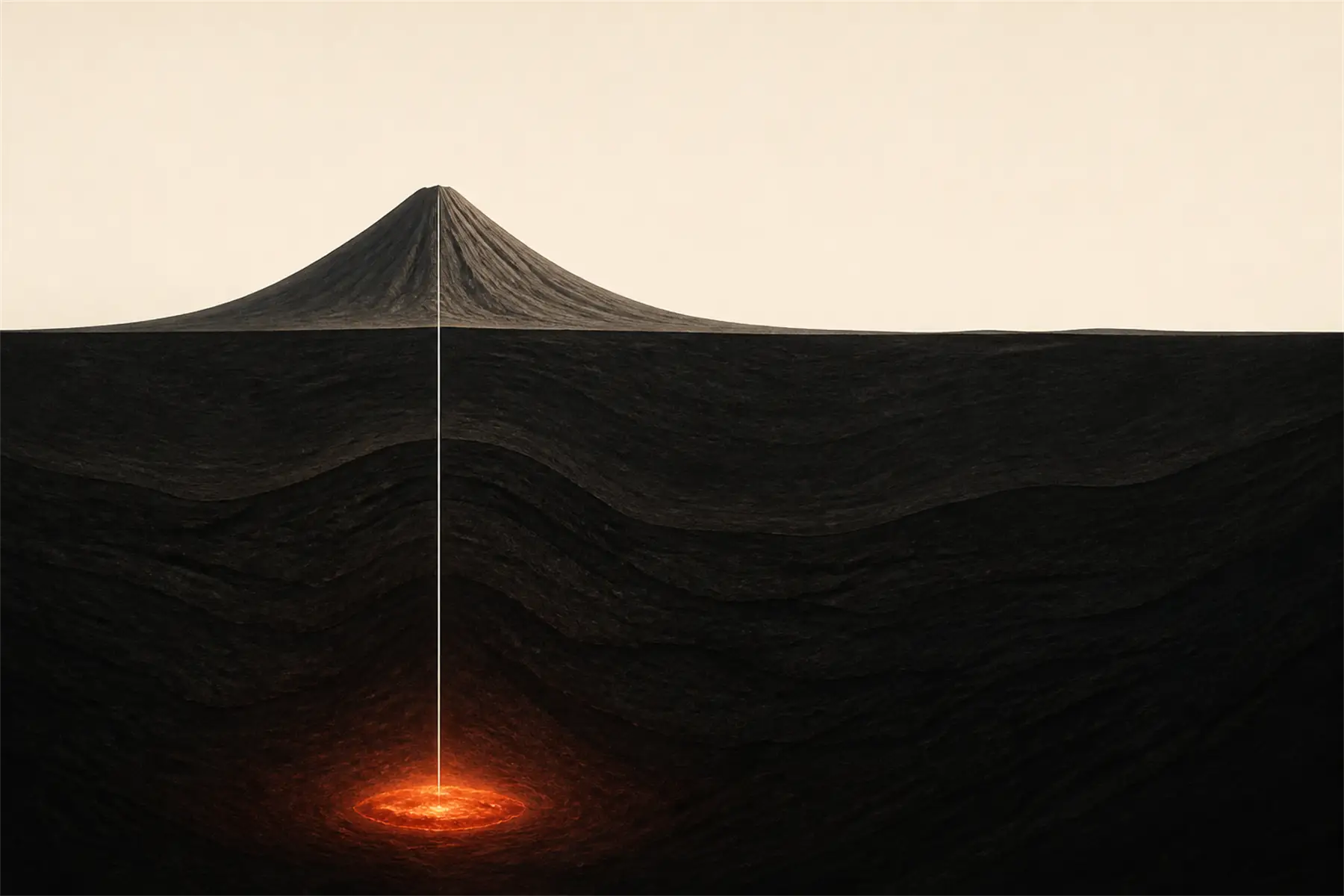
The volcano will never appear on the city's electricity bill. That is the triumph. A violent geological history will become an exceptionally calm public utility, sending power upward through one white line in the rock.