
For more than three-quarters of a century, mathematicians have been unable to settle a question so simple and intuitive that it can be explained with a box of crayons.
Imagine coloring every point on an infinite sheet of paper. There is only one rule: any two points exactly one unit apart must receive different colors.
How many colors do you need?
The question contains no forbidding equations and requires no specialized knowledge to understand. A child can play with it. Yet generations of mathematicians, armed with geometry, graph theory and increasingly powerful computers, still cannot determine whether the answer is five, six or seven.
That is about to change.
By 2028, mathematicians using AI search tools will find a finite arrangement of points that cannot be colored with only five colors. Its coordinates will be exact, its logic independently verifiable and its consequence unavoidable: the infinite plane requires at least six.
A puzzle hiding in plain sight
The problem is known as the Hadwiger–Nelson problem. It asks for the chromatic number of the plane: the smallest number of colors needed to color every point so that points exactly one unit apart never share a color.
Mathematicians transform the plane into an enormous graph. Every point becomes a vertex. Two vertices are connected whenever the squared differences between their coordinates add to one. Coloring the plane now means coloring this graph while ensuring that connected vertices always receive different colors.
Seven colors are sufficient. The plane can be divided into small hexagonal regions and covered with a repeating seven-color pattern. The regions are arranged so that two points exactly one unit apart cannot receive the same color.
Proving that fewer colors are impossible has been far harder.
For decades, mathematicians knew that at least four colors were necessary. Then, in 2018, Aubrey de Grey discovered a finite unit-distance graph that could not be colored with four. His construction contained 1,581 vertices and established that the plane requires at least five colors. Aubrey de Grey’s original paper
The known range became 5 ≤ χ(ℝ²) ≤ 7.
The next great discovery will move the lower bound again.
How infinity fits inside a finite diagram
At first, searching every point in an infinite plane sounds impossible. The escape route is one of mathematics’ most useful pieces of magic: if the obstruction exists across the entire plane, it must also exist inside some finite collection of points.
The de Bruijn–Erdős compactness theorem connects infinite coloring problems to finite graphs. If the plane cannot be colored with five colors, a finite unit-distance graph must exist that cannot be five-colored.
The next breakthrough therefore does not require a map of infinity. It requires one finite constellation.
Its vertices may number in the thousands, millions or far more. Lines will connect pairs separated by exactly one unit. The final diagram may resemble a crystal designed by a spider with a doctorate.
Hidden inside it will be a trap. Try any possible five-color arrangement, and somewhere two connected points must receive the same color.
Converting colors into logic
A graph with thousands of vertices has an unimaginable number of possible colorings. If it contains n vertices, there can be as many as 5ⁿ raw assignments of five colors. Testing them individually would take longer than the age of the universe.
Modern solvers take a different route.
For each vertex, the coloring problem is translated into logical statements. Every vertex must receive one color. No vertex may receive two colors. Two vertices connected by a unit-length edge cannot receive the same color.
These rules form a Boolean satisfiability problem, usually called SAT.
If a SAT solver finds a legal five-coloring, the proposed graph fails. The search system studies that failure, changes the arrangement and tries again.
If no coloring exists, the solver produces an unsatisfiability certificate: a sequence of logical deductions proving that every possible five-coloring ends in contradiction. A separate, much smaller program can check the certificate.
The proof will therefore not ask the public to trust an AI’s judgment. It will present exact coordinates, exact distances and a logical certificate that independent mathematicians and independent software can verify.
The mathematical barrier is already moving
In June 2026, Ákos Dúcz and Dániel Varga constructed a finite unit-distance graph with an independence ratio below one quarter. Their result proves that the fractional chromatic number of the plane is strictly greater than four. Read the 2026 paper
Fractional coloring is a more flexible version of ordinary coloring. Instead of placing one solid color on each vertex, it distributes weighted combinations of compatible color classes. Its value cannot exceed the ordinary chromatic number: χf(G) ≤ χ(G).
Passing four in this fractional setting does not itself prove that six ordinary colors are necessary. It does something almost as important for the search: it reveals new unit-distance structures on the far side of a barrier that previously appeared immovable.
The graph behind the result is enormous but constructive. It provides fresh mathematical material that an AI system can mutate, combine and compress while searching for a true six-color obstruction.
AI has entered the right room
In May 2026, an OpenAI reasoning model overturned another longstanding Erdős conjecture about unit distances in the plane. The model found an infinite family of constructions that improved upon the square-grid behavior mathematicians had expected for decades. Its crucial move was to import ideas from algebraic number theory into an elementary-looking problem in geometry. External mathematicians checked the resulting proof. Read the research report
The significance extends beyond one solved problem. AI has demonstrated that it can search this particular mathematical landscape and notice connections human researchers overlooked.
Formal proof systems are advancing at the same time. A 2026 study reported an AI agent autonomously resolving nine open Erdős problems and proving dozens of conjectures from the Online Encyclopedia of Integer Sequences. Its final arguments were expressed in Lean, where every logical step is checked mechanically. Read the formal proof-search paper
Another research system, Aletheia, has moved from Olympiad exercises to professional mathematics, including autonomous work on open problems and an independently produced research paper in arithmetic geometry. Read the Aletheia paper
The separate pieces of the machine are now assembled: models that propose unexpected structures, evolutionary systems that improve them, SAT solvers that eliminate impossible colorings and proof assistants that certify the result.
How the discovery will happen
The successful search will begin with familiar geometric machinery: triangular lattices, spindle graphs, rotations, reflections and overlapping copies of smaller unit-distance constructions.
An AI system will generate variations and test them. When a graph admits a five-coloring, that coloring will reveal its weak points. The system will add vertices or combine structures to block the remaining possibilities.
Symmetry will reduce the size of the search. Algebraic coordinates will ensure that every important distance equals one exactly rather than approximately. SAT solvers will test the coloring. Formal software will verify the certificate.
Eventually, one candidate will return an answer that cannot be colored away.
Researchers will recompute every coordinate and unit edge. Multiple solvers will test the graph. A small verification program will check the logical certificate. Mathematicians will then search the machine’s enormous construction for a more intelligible pattern.
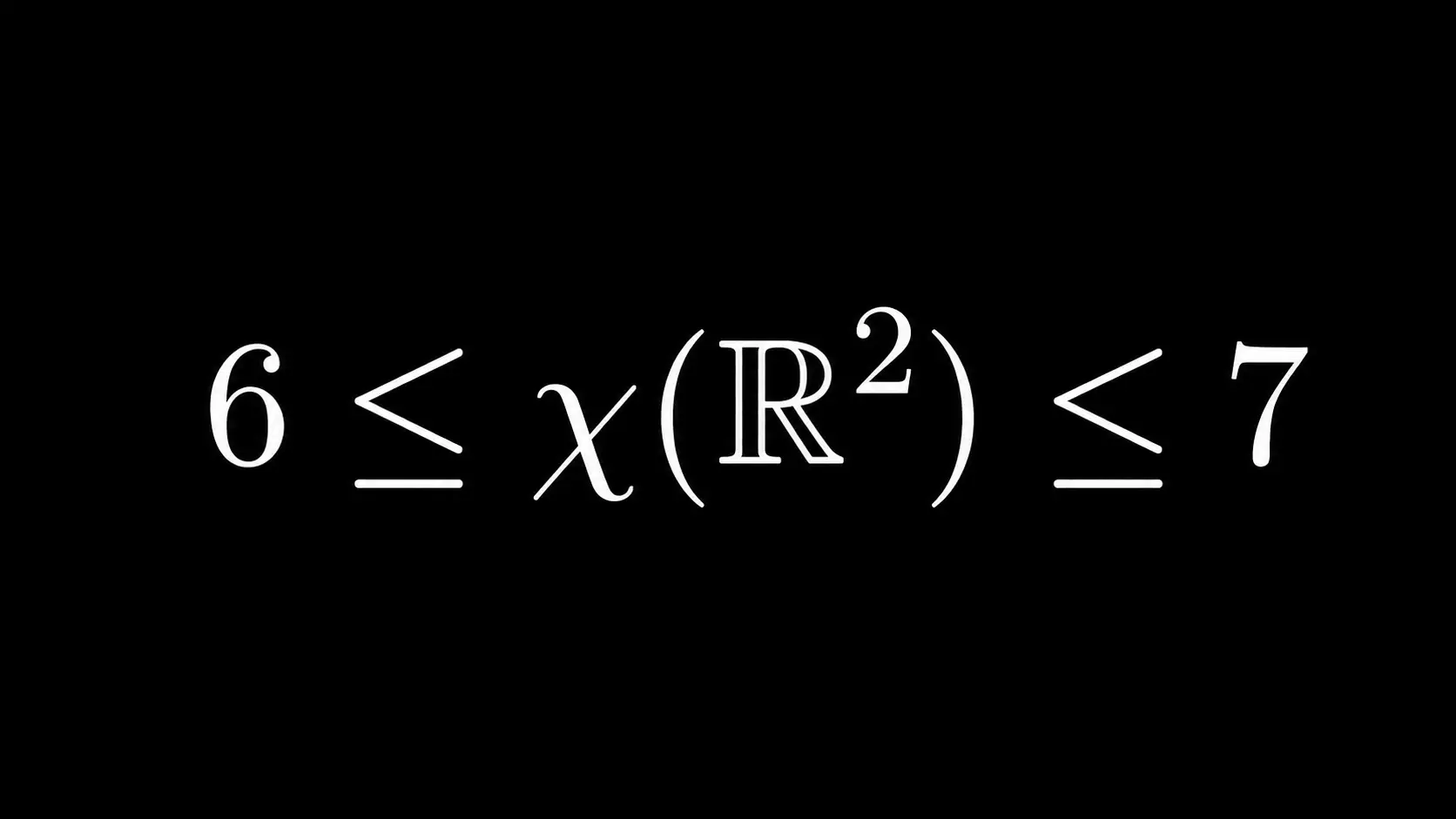
The first proof may be ugly. Its conclusion will be beautiful: 6 ≤ χ(ℝ²) ≤ 7.
The sixth pot of paint
The discovery will deliver the problem’s second historic advance in a decade after nearly 70 years without movement. It will also establish a new model of mathematical discovery.
AI will search more arrangements of points than a human research team could examine, while mathematicians and proof software verify the successful result. The search will be machine-scale; the proof will remain exact and open to inspection.
The plane has hidden its palette since 1950. By 2028, mathematicians using AI search tools will find the finite arrangement that forces mathematics to open the sixth pot of paint.