
Research update — 17 September 2026: Added confirmation that the laboratory's three major systems have substantially completed core-equipment design, hardware construction is under way and a sealing trial is being prepared. The forecast remains at 68%.
The first underwater settlement will not be built because humanity needs somewhere else to live. It will be built because a laboratory two kilometres beneath the sea can become more valuable than the rooms required to keep its scientists alive.
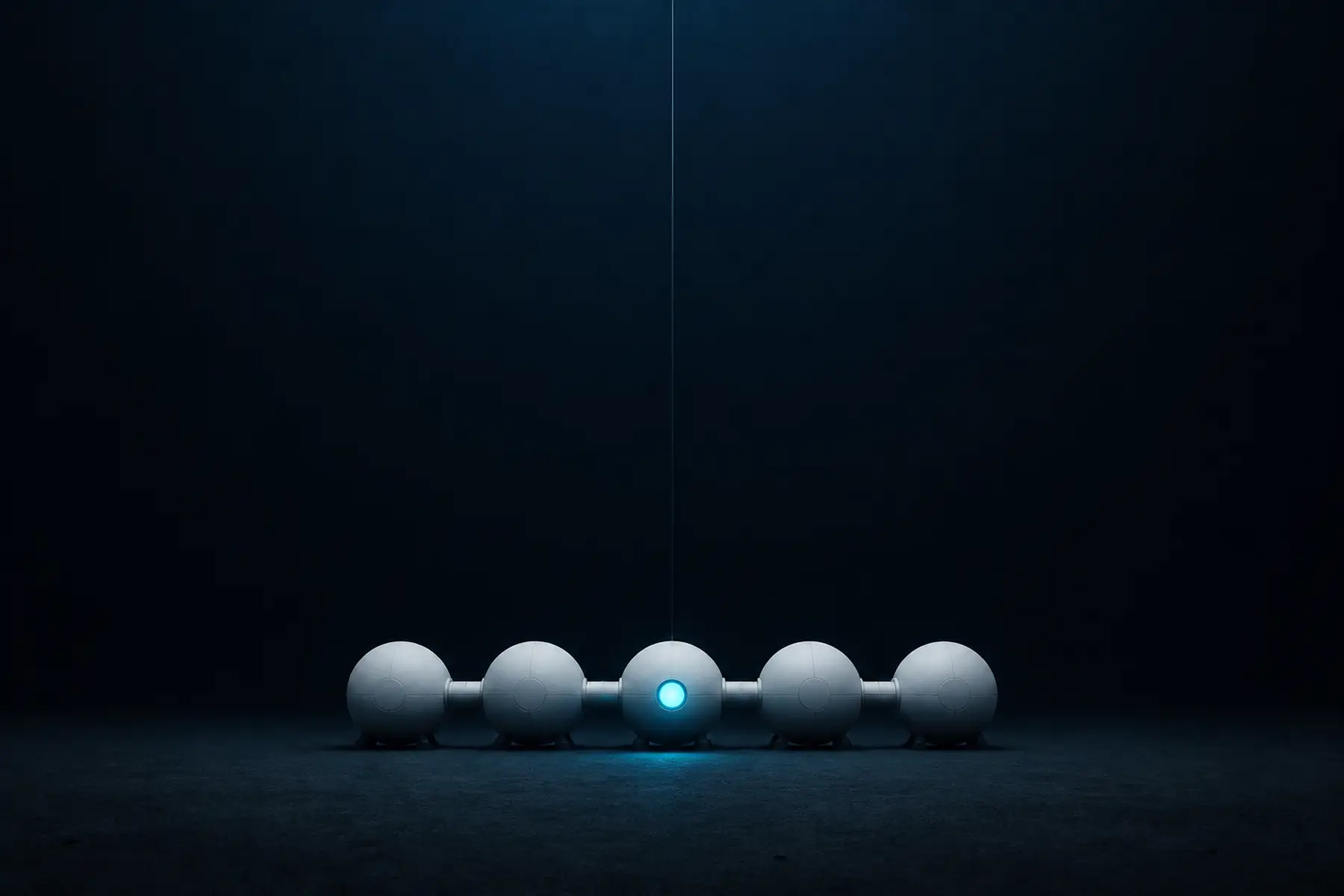
China has already started constructing that laboratory. The Cold-Seep Ecosystem Research Facility will cost ¥2.66 billion—approximately US$390 million at August 2026 exchange rates. Its 33-metre seabed station will connect five pressure spheres into a dwelling and workplace for six people. A dedicated surface ship will deploy and support it. A second facility on land will reproduce the high-pressure, methane-rich environment brought up through its instruments. CCTV's Chinese-language construction announcement
This is not another underwater hotel, record-breaking dive or temporary metal capsule. It is a national scientific installation designed to descend to 2,000 metres, place people there for as long as 30 days, return for replenishment and descend again. People's Daily's Chinese-language interview with the project office
ParallaxSee forecasts that by the end of 2032, six people will complete a 30-day mission inside China's operational deep-sea laboratory, establishing the first modern settlement built for recurring human residence more than 1,000 metres below the surface. House confidence: 68%.
Its residents will not farm the seabed or raise families under glass. They will operate laboratories, maintain autonomous machines and watch an ecosystem that lives without sunlight. The settlement will remain dependent on land, just as Antarctic stations and the International Space Station depend on distant supply chains. Independence is unnecessary. Permanence begins when the expedition ends but the institution remains.
01 — China has begun buying the difficult parts.
Underwater settlements have spent sixty years looking magnificent in illustrations. China has moved beyond procurement into core-hardware construction.
Construction began in Guangzhou's Nansha district in February 2025 under the Chinese Academy of Sciences. The announced programme gives four years to design and manufacture the system and a fifth year to integrate it and conduct sea trials. The project contains three connected pieces: the seabed laboratory, the support system and ship, and a high-fidelity experimental facility on land. The Chinese Academy of Sciences' original construction notice, in Chinese
The purchasing record shows what the polished renderings conceal. China Ship Scientific Research Center has won the contract to build and pressure-test the laboratory's inhabited structures. The itemised equipment includes observation, experiment, control, detection, living and machinery compartments, together with batteries, a docking structure and a chamber for transferring between wet and dry environments. Chinese government procurement award for the pressure structures, in Chinese
In 2026 the institute budgeted another ¥30.32 million for a pressure-gradient subsystem able to control pressure and methane concentration while reproducing conditions associated with a depth of 2,000 metres. Separate contracts have continued for current profilers, sampling equipment and other instruments. Chinese government procurement notice for the pressure-gradient system, in Chinese
These purchases matter more than an announced opening year. Pressure vessels, transfer chambers and methane-control systems have named suppliers, budgets and acceptance tests. A direct project-site report published on 27 August says the core-equipment designs for all three major systems are substantially complete and hardware construction is under way. It retains the same engineering scale—five 5.2-metre titanium spheres in a 33.8-metre, 600-tonne seabed laboratory for six people—and says preparation for a sealing trial has begun, with formal operation still targeted for the end of 2029. The detailed report from Yangcheng Evening News quotes the facility project office directly. An official Guangdong account on 11 September independently describes the national facility as having entered full construction. Guangdong's official forum report confirms the milestone without establishing that the pressure tests, sea trials or 30-day occupied mission have yet occurred.
The project can still be delayed, redesigned or fail during commissioning. It can no longer be dismissed as a fantasy waiting for finance.
The first underwater settlement is being assembled as industrial hardware.
02 — Six people will live inside a scientific machine.
At 2,000 metres, the water outside presses with approximately 200 times the atmosphere at sea level. People cannot inhabit that pressure. China's residents will live inside sealed spheres that preserve an ordinary human environment while the ocean attempts to crush the structure from every direction.
The station will contain the domestic minimum of a real settlement: a living compartment, power and auxiliary machinery, experimental rooms, an operations centre, emergency systems and a transfer route connecting the inhabitants with vehicles outside. The pressure hull becomes wall, roof and foundation at once. Every bed, meal, toilet, exercise period and medical procedure takes place inside the larger life-support machine.
The official plan allows six people to remain for 30 days before the laboratory rises for replenishment. China's reporting compares the internal volume with three Chinese space stations, but the more revealing comparison is an Antarctic field station. Both exist to place skilled people beside a scientific subject that cannot be brought conveniently home. Both are small, intensely serviced and permanently dependent on a larger civilisation. People's Daily on the six-person, 30-day design, in Chinese
A 30-day design does not yet promise unbroken occupation through every day of the year. ParallaxSee's use of settlement means a durable institution built for repeated habitation, not a claim that the first six residents will stay indefinitely. The laboratory may return to the surface for maintenance just as a ship enters dry dock. It remains a settlement if successive crews repeatedly make it their temporary home and the infrastructure exists primarily to support life and work below the sea.
The distinction protects the forecast from spectacle. A submarine passing through the deep does not count. A hotel room reached for a weekend does not count. A diving bell does not count. Six people eating, sleeping and conducting a full month of work inside a station designed to return does.
03 — The settlement's first product will be time.
A surface expedition repeatedly pays to reach the same place. The ship sails, equipment descends, divers or submersibles receive a few working hours, weather interrupts the schedule and the entire temporary workplace is dismantled. A habitat moves the beginning of the working day to the seabed.
DEEP's newly installed Vanguard habitat in Florida provides a useful contemporary price signal. Its first grant programme combines $935,000 in public funding with $1.5 million of in-kind support for six anticipated five-day missions. Two scientists and two support specialists will live aboard each mission, with almost ten times the bottom time available from ordinary surface-based no-decompression diving. DEEP's Vanguard research programme
If the combined programme value is divided evenly, each mission represents approximately $406,000, or $81,000 per habitat-day. A modern regional research vessel was expected by the US National Science Foundation to cost about $35,000 per operating day, before some specialised services. NSF's regional research-vessel operating estimate
The habitat-day is therefore more expensive than the ship-day. It also purchases close to ten times as much submerged working time. On that simple comparison, present habitat access could already deliver roughly four times as much bottom time per dollar. It becomes more valuable when an experiment needs continuous observation rather than ten disconnected visits.
China's deep station will not eliminate ships. Its 9,000-tonne-class support vessel will carry the laboratory, rotate people, supply material and stand behind emergencies. The economic gain comes from concentrating the expensive voyage around a workplace that is already at the subject. Scientists will watch methane flow change over days, preserve organisms under pressure and respond to an event while it is still happening.
The station does not sell square metres. It sells uninterrupted attention.
04 — Four hundred million dollars is a small wager inside China's ocean economy.
The price sounds extravagant when divided among six residents. It becomes modest when measured against the industries the laboratory is meant to serve.
Guangzhou reported ¥523.1 billion in marine economic output during 2025, equal to 16.3% of the city's economy. Its proposed 2030 plan aims to exceed ¥730 billion, with ocean engineering, electronic systems, new materials, pharmaceuticals and biological products among the intended growth sectors. Guangzhou's marine-economy plan, in Chinese
The complete ¥2.66-billion cold-seep programme therefore costs approximately 0.5% of one year of Guangzhou's marine economy and 0.36% of the city's 2030 target. Nationally, China's marine economy reached ¥11.018 trillion in 2025. The station equals about 0.024% of that annual output. China's 2025 marine-economy statistical release, in Chinese
China is not asking six scientists to personally earn back $390 million. It is purchasing an enabling platform for an economy already measured in trillions of yuan.
Guangzhou's government uses a wonderfully physical Chinese phrase for the expected result: 沿途下蛋, literally lay eggs along the way. The natural translation is generate industrial spin-offs throughout the programme. Officials name natural-gas-hydrate research, use of marine biological resources and ocean-equipment manufacturing as the principal beneficiaries. They also describe a local cluster building remotely operated vehicles, optical autonomous vehicles and seabed cable machines. Guangzhou government's Chinese-language account of the project's industrial role
The settlement can produce value before its first scientific discovery. Its hull creates pressure-vessel expertise. Its docking system advances subsea connection standards. Its life support creates operating data. Its robots become exportable products. Its ship sustains skilled maritime employment. The construction budget is also an industrial policy.
05 — Research contracts can keep the lights on.
The first settlement will not operate like profitable housing. Its financial model will resemble a national observatory: government pays for the capital asset, while a mixture of research appropriations and external customers covers much of its annual use.
A reasonable operating range for a six-person station is $25 million to $40 million a year. The lower end follows the current value of a highly occupied Vanguard mission calendar. The upper end allows for China's dedicated ship, deep-water logistics, replacement equipment and emergency readiness. This is a ParallaxSee estimate; China has not published an operating budget or a price list.
The corresponding revenue model is visible. Government science, climate and energy programmes could supply $15 million to $25 million annually. Commercial biological and materials research could add $4 million to $8 million. Hosted instruments, autonomous-vehicle docking and data services could contribute $3 million to $6 million. Training, engineering trials, broadcasting and a small number of sponsored missions could provide another $2 million to $5 million. The resulting range—approximately $24 million to $44 million a year—can support operations after commissioning. It does not make the construction capital disappear.
Public research institutions already purchase observation at this scale without putting people underwater. Ocean Networks Canada described an annual operating budget of approximately C$27 million for its cabled observatories and thousands of sensors. Sixty percent came from federal research infrastructure funding; the rest came from government data products and services. Ocean Networks Canada's evidence to the Canadian Parliament
On a simple 20-year straight-line calculation, China's $390-million construction bill alone represents another $19.5 million each year before interest. A fully private operator would therefore need annual revenue approaching $45 million to $60 million to operate and recover the initial investment. That is possible only with high utilisation and premium contracts. It is unnecessary for a state laboratory whose patents, equipment companies and scientific knowledge earn their returns elsewhere.
The commercial customers will pay for missions. China will pay for the option of owning the future those missions discover.
06 — One useful molecule could outweigh decades of operating cost.
Cold seeps are dark ecosystems powered by chemistry rather than sunlight. Microorganisms consume methane and sulphur compounds. Larger organisms build their lives around those microbial partnerships. High pressure, low temperature and unusual chemical energy force life to invent molecular solutions rarely encountered on land.
The Chinese Academy of Sciences says these extreme organisms can produce metabolic compounds unlike those from shallow-water or terrestrial life. Its researchers are building collections and looking specifically for molecules with antitumour, antibacterial, antiviral and antifouling activity. The Chinese Academy's deep-sea bioactive-substances programme, in Chinese
The industry is real. Five medicines derived from or inspired by marine organisms generated more than $12.1 billion between 2011 and 2020. They did not require a permanent undersea settlement to be discovered, and a new cold-seep sample is far more likely to produce an interesting paper than an approved drug. Drug development can consume a decade and enormous capital. PNAS Nexus review of marine biomimetics and economic value
That uncertainty is exactly why persistent access matters. A ship expedition collects whatever happens to be present during a brief visit. A resident laboratory can observe organisms through changing methane flows, run experiments in their natural pressure and return to the same colony after an intervention. The linked land simulator then repeats the conditions with larger instruments and research teams.
The station should not book hypothetical medicines as revenue. It should sell pharmaceutical groups access to a stream of characterised organisms, genetic sequences and pressure-preserved material. Most will fail. A few may become enzymes, coatings, diagnostic tools or lead compounds. One success can be worth more than the building that found it.
The settlement is an option on biology that humanity has barely met.
07 — The inhabitants will command a population of machines.
The first deep settlement will employ more robots than people. Autonomous vehicles will map the surrounding seabed, measure methane, carry sensors and patrol infrastructure. Remotely operated machines will manipulate heavy equipment and enter spaces where a person could never survive. Smaller drones will leave those vehicles to inspect cracks, sample fluid and film biological communities.
This does not remove the case for human residence. It changes it. Robots need charging, calibration, cleaning and repair. Instruments fail in unexpected combinations. A manipulator encounters a specimen nobody anticipated. A scientist watching from a room a few metres away can redesign the next observation while a team operating from land waits for data, communications and the next voyage.
A 2026 engineering review expects autonomous underwater vehicles with subsea stations to take over frequent and long-range inspection work as offshore wind, pipelines and other energy infrastructure expand. It identifies resident machines as an important route to reducing ship use and maintenance costs. Academic review of automation in subsea inspection and maintenance
China's design deliberately combines inhabited and uninhabited systems. Guangzhou already describes the cold-seep facility as a natural test range for its underwater-robot industry. A laboratory that can dock, service and supervise machines becomes useful beyond biology: cable inspection, offshore-energy maintenance, seafloor mapping and emergency response can all purchase time from the same platform.
The settlement will therefore invert the old vision of underwater living. People will not occupy a glass city while machines serve them. Six people will inhabit a compact workshop so that dozens of machines can remain outside, working across an area no human body could reach.
The residents are not the labour force. They are the intelligence and repair layer of a robotic province.
08 — Methane gives China a second return: knowledge before extraction.
Cold seeps sit where methane and other fluids escape through the seabed. They reveal how carbon moves through deep sediments, how much methane is consumed by organisms and how disturbances might release it into the ocean. They also occur alongside natural-gas hydrates—ice-like structures that trap methane under pressure.
China's project language openly connects the station to the greener and safer development of these resources. The facility will control pressure and methane concentration, observe hydrate formation and decomposition, and study the environmental effects of extracting what Chinese reporting calls combustible ice. The Chinese Academy describes that knowledge as indispensable support for safe development rather than a promise that commercial production is imminent. Chinese Academy progress report from April 2026, in Chinese
The article's financial model should assign no direct gas revenue to the settlement. Hydrate extraction remains technically difficult and environmentally contentious. The value lies in converting a poorly understood resource into a measurable option. The station may identify a safe route to production. It may also demonstrate that disturbing a particular deposit would release too much methane or destroy a unique ecosystem. Avoiding a disastrous investment is an economic return too.
Continuous measurements will also improve carbon accounting. A single expedition can mistake a pulse for a permanent flow or a quiet week for a stable system. Thirty days of inhabited work, repeated across seasons and combined with resident sensors, begins to reveal the rhythm. The land facility can then recreate selected pressure and methane changes without gambling on the natural site.
China is building the right to make future decisions with evidence collected at the place where the carbon moves. That right has strategic value even if no cubic metre of hydrate gas is ever sold.
09 — The five-year construction clock points to a first month underwater by 2032.
China's official timetable begins with four years of design and construction followed by one year of integration and sea trials. That points towards 2030. A project this novel will probably use the next two years to repair discoveries made during pressure testing, rehearse rescue procedures, qualify life support and complete progressively longer occupied missions.
The engineering risk is real. Five large pressure spheres must behave as one structure. Docking and transfer must remain reliable in darkness beneath kilometres of water. A failure in power, atmosphere control, fire response or the support ship can threaten every resident. The station must also survive repeated deployment, recovery and maintenance without turning its scientific calendar into an endless shipyard visit.
The institutional evidence is stronger. The project has national-infrastructure status, an approved budget, a lead institute, pressure-hull contracts, active 2026 procurement and an engineering committee still reviewing construction. It is tied to Guangzhou's economic plan and China's broader ambition to move from following to leading in deep-ocean technology. A private habitat can vanish when finance tightens. This station has become an item in the machinery of the state.
The forecast resolves true if, by 31 December 2032, a Chinese-operated habitat designed for recurring scientific residence is deployed on the seabed at a depth of at least 1,000 metres and at least six people complete 30 consecutive days living and working inside it. The habitat must contain operational living, sanitation, life-support and laboratory spaces and be intended for further occupied missions. Short demonstration dives, tourist visits, submarines passing through the water and uninhabited observatories do not count. The station may surface for scheduled servicing and replenishment; continuous year-round occupancy is not required.
The six inhabitants will eventually return to daylight. Their laboratory will be prepared to descend again. That repetition is the event history has been waiting for.
Humanity learned to survive underwater in the twentieth century. By 2032, China will turn survival into an institution—and the deep sea will acquire its first working address.