
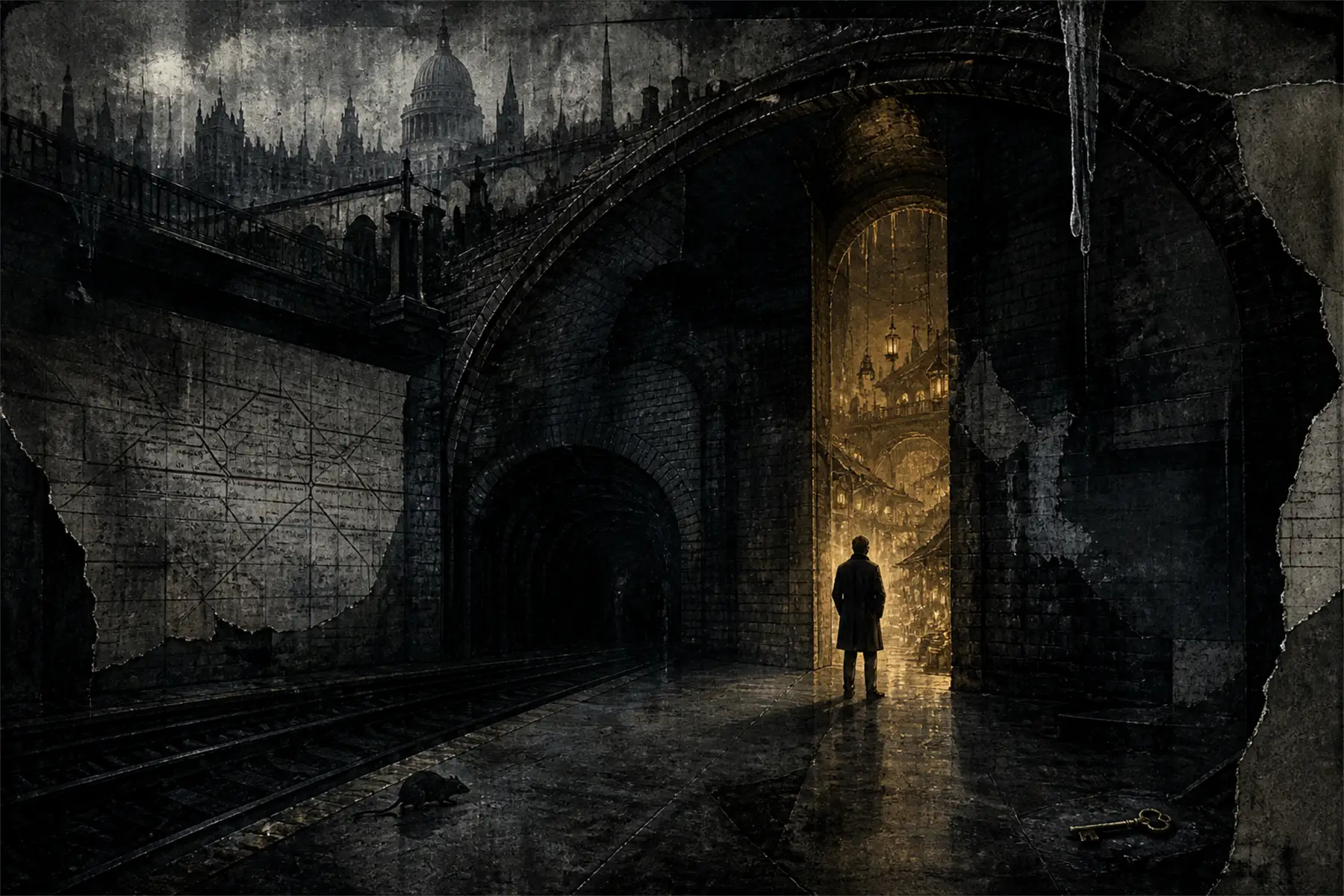
At first, London Below does not feel like somewhere worth saving. It is wet, rank and badly lit. Its rats conduct diplomacy. Its assassins have antique manners. Its markets appear in places where no market should be, and the names on the Tube map have acquired teeth.
Then the geography reverses. The bright offices and clean pavements of London Above begin to look bloodless. The darkness underneath becomes a kingdom. By the time Neverwhere sends Richard Mayhew home, the reader no longer wants to go with him. When Richard finds his way back, the door closes on us.
ParallaxSee forecasts that The Seven Sisters will be commercially published in English by the end of 2029 as a novel-length sequel to Neverwhere. A preorder page, a publisher announcement or an unfinished manuscript will not resolve the forecast; a trade print or ebook edition must reach readers.
House confidence: 30%.
There is no official publication date, and the distance between a long-promised manuscript and a finished book is now complicated by serious sexual-assault allegations against Neil Gaiman, which he denies. Yet the literary evidence is unusually persistent: the sequel grew from three chapters to six, its principal men have already been placed back beneath London, and the original story left an ache shaped precisely like a second book.
Before 01Speculative fiction / clearly labelledThe Seven Sisters: PrologueNot by Neil Gaiman
THE SEVEN SISTERS
A speculative first page — not by Neil Gaiman
Prologue
There are seven of them, and they have not spoken to one another for thirty years.
This is not, whatever you may have heard, because of the man. There was a man, of course; there always is. But the silence was never about him. The silence was about a door, and what came through it, and which of them had left it open.
On the green at Page Green, in the part of London that borrowed the sisters' name and never gave it back, there stood seven elm trees, planted in a ring. When one of the elms died, which they did, the people of Tottenham would plant another in its place, and so the ring of seven was always seven, though not one tree in it was the tree it had been. The people who did the planting could not have told you why it mattered. It simply did, the way it matters that you do not step on the cracks in the pavement, the way it matters that you hold your breath going past a graveyard. The last elms are gone now. There are hornbeams there today, and a plaque, and the plaque is wrong about nearly everything.
The girl who came to the green thirty years ago, on an October night, had crossed three borders, one mountain range, and a sea that had done his very best to keep her at bay. She carried the name of a brother she had not seen since the water, and a stick she had sharpened against the rocks above the swamp, in case the swamp had anything in it. By the time she reached the ring of trees she could no longer have said whether she had found it or it had found her.
She sat down on the wet grass in the middle of the ring, because there was nowhere else she was meant to go.
Which was when the trees began, very politely, to argue about her.
"She's mine," said the first tree. "She came to me."
"She walked down the road," said the second. "The road comes to me."
"She's bleeding," said the third. "Whoever has the blood has the girl."
"She's a child," said the fourth. "Children belong to their parents, or to no one at all."
"She's armed," said the fifth. "The way the monkeys were armed, when the skies were still bright." And for a moment none of them said anything, because none of them had thought to look at the stick.
"She's late," said the sixth.
The oldest tree said nothing.
Then, when the others had finished, it bent one branch toward the girl, extending it as far as it could.
"Hello, young hunter."
01 — The city that first refuses us.
Richard Mayhew enters Neverwhere by performing one small act of decency. He stops to help Door, a bleeding young woman whom everyone else has learned not to see. For this he is not punished with violence. He is punished with erasure. His bank cards fail. His desk is occupied. His landlord rents out his home. His fiancée looks through him. London Above continues perfectly well after deleting him.
London Below is hardly more welcoming. It is governed by favours, names, debts and old violence. Richard stumbles through it in the manner of a man who has arrived late to a conversation conducted in a language everyone assumes he knows. Door is hunted. The Marquis de Carabas is never merely helping. Hunter is too magnificent to be safe. Mr Croup and Mr Vandemar speak with the ceremony of gentlemen and kill with the appetite of wolves.
This initial estrangement is the book's great confidence trick. The underworld is not arranged for Richard's comfort, or ours. Its customs precede us. Its stations and sewers imply histories that will not stop for explanation. We are allowed to be lost long enough for curiosity to become attachment.
By the end, ordinary London has become the unreal place. Richard recovers his office, salary and apartment, but restoration feels like exile. The life he wanted at the beginning is intolerably small once he knows another kingdom exists beneath it. When the Marquis finally opens the way back, Richard steps through. We remain on the wrong side of the wall.
02 — The first doorway flickered on British television.
Before Neverwhere was a beloved novel, it was a six-part BBC Two serial broadcast in September and October 1996. Gaiman devised it with Lenny Henry, whose stories about homeless people living in tribes around London suggested the original world. Fantasy provided a way to make the invisible visible without pretending that real homelessness was a picturesque adventure. Neil Gaiman's official account still describes the series as the beginning of the work rather than an adaptation of it.
The production's technical misfortune became part of its atmosphere. It was shot on video but lit with the expectation that it would later be processed to look like film. That conversion was abandoned. What remained was a shadowy image in which darkness sometimes collapsed into grain and colour bled at the edges. Gaiman remembered fights over regional accents and a Beast of London represented, with glorious BBC practicality, by a Highland cow. His later recollection is affectionate and bruised at once.
Yet the serial was rich in faces. Gary Bakewell gave Richard the baffled kindness on which the story depends. Laura Fraser's Door seemed both young and older than the city. Tanya Moodie made Hunter severe, beautiful and doomed. Peter Capaldi's Islington was all wounded grace. Paterson Joseph played the Marquis as though charm were a weapon he had invented. Hywel Bennett and Clive Russell made Croup and Vandemar horribly funny. Freddie Jones presided over Earl's Court as if a Tube carriage had always been the natural location for a medieval court.
Its visible seams now make the series feel less like conventional television than an illicit transmission from Below. Real stations, tunnels and London streets hold the fantasy close to the municipal world. A production history records that the BBC wanted another series, but with a smaller budget; Gaiman declined. The kingdom vanished after six half-hours, which may be why some viewers remember it with the intensity of a place seen only once.
03 — The novel rebuilt what television could not afford.
Gaiman wrote the novel while the serial was being made. The second form let him restore ideas that schedules, money and cameras had compressed. The Floating Market could occupy Harrods after closing. The darkness could be made immense without being made visible. Richard's disappearance from ordinary life could become slower and more intimate. Poets & Writers describes the book as neither a simple novelisation nor an ordinary adaptation, but a second construction of the same imagined city.
Later editions kept changing. The British and American texts had diverged; an author's preferred text combined them and returned material that had been cut. Neverwhere therefore became a work with several entrances: the imperfect television original, the novel that outgrew it, the revised text, illustrated editions and a 2013 BBC radio drama with James McAvoy as Richard, Natalie Dormer as Door, David Harewood as the Marquis and Benedict Cumberbatch as Islington.
That radio cast was not merely prestigious decoration. Voices are architecture in London Below. A station name can become a person, a title or a threat simply by being spoken differently. The first radio episode drew roughly 147,000 requests and became the BBC's most requested radio programme that month, according to the corporation's March 2013 performance report. Seventeen years after the screen went dark, listeners were still looking for the door.
The story survived because no single version exhausted it. Each return supplied a little more of the city and renewed the suspicion that most of it remained unseen.
04 — We were sent home too soon.
Nostalgia for Neverwhere is not simply nostalgia for its creatures, jokes or map. It is longing produced by the shape of the ending.
Richard's first wish is to recover normality. His final horror is that he has recovered it. He eats, works and tries to resume conversation, but London Above has become a theatre set whose walls he can now see. The transformation is complete when he abandons a restaurant table and searches desperately for a mark, a crack, any means of return.
Then the Marquis appears. The impossible friend is alive; the passage is real; Richard chooses Below. It is a joyful ending for him and an eviction notice for the reader. We have spent the whole book learning how to inhabit a hostile world, and the instant it becomes home we are removed from it.
The best sequel would not imitate that first descent. Richard is no longer the apologetic visitor whose ignorance explains the kingdom to us. He has chosen this life. A second novel must discover what happens when wonder becomes citizenship: what a hero does after surviving the story that named him one, what debts the Marquis has accumulated, and what Door finds when the murder of her family is no longer the only question she knows how to ask.
That is why The Seven Sisters matters before it exists. It promises not another tour but the return of people whose lives continued after ours was interrupted.
05 — Seven women are waiting under Tottenham.
The title begins on an ordinary patch of North London ground. Seven Sisters takes its name from seven trees that once stood at Page Green, probably planted by a family of seven local sisters. The trees have repeatedly died, moved and been replanted; the present ring of hornbeams dates from 1996, the same year Neverwhere appeared. Haringey's local history turns the name into exactly the kind of fact Gaiman's underworld favours: municipal on the surface, ritual underneath.
Three of the sisters have already left traces. Serpentine, the oldest of the Seven Sisters, appears in Neverwhere. Olympia belongs to the same hidden family. Victoria is central to the later Marquis story, How the Marquis Got His Coat Back. Four remain beyond the light.
The sequel can make them more than a clever conversion of a station into characters. Seven women linked to vanished and replanted trees suggest endurance, rivalry and succession. They could control passages that London Above believes are merely platforms and roads. They could preserve fugitives, demand impossible prices for sanctuary or remember earlier versions of the city. A title about sisters also turns Door's unresolved family history toward a larger mirror: another powerful household, another arrangement of loyalty, another argument about who may pass and who must remain outside.
London has changed violently since 1996. Property became a sorting machine. Public rooms contracted. Rough sleeping became harder to ignore. Migration and refuge became central political struggles. In 2017, Gaiman said work with refugees for the UNHCR had helped force him back toward London Below. The Guardian reported that he had written three chapters. The new kingdom was being built to receive people the upper city had again decided not to see.
06 — Richard and the Marquis are coming back.
The fragments of plot revealed over the years are small, but they point in the right direction. An early idea for a second television series imagined Richard becoming recognised as a hero without understanding what he had done to earn the title. The Marquis would have a larger part, and the mystery of Door's absent sister would reopen her family story. Gaiman's retrospective preserves the outline of a sequel about consequences rather than repetition.
The manuscript has also moved. Three chapters existed publicly in 2017. By an October 2023 conversation at Harvard, Gaiman said he had six. The Harvard Crimson recorded a book still unfinished but no longer imaginary.
The most compelling plot is already implicit in those clues. Richard, now at home Below, is burdened with the reputation of a hero and sent toward a deed he does not remember. The Marquis accompanies him because every disaster is also a market. Door follows the surviving line of her family toward the Seven Sisters, women who know more about passages and disappearances than even she does. Serpentine, Olympia and Victoria become relatives, rivals or judges; the remaining sisters emerge from stations, estates and buried watercourses.
Old Bailey deserves to cross their path. So do the Rat-Speakers and Earl's wandering court. Hunter should remain an absence sharp enough to guide Richard. Croup and Vandemar are better left at the bottom of the world; bringing them back would make their defeat smaller. London Below can produce new monsters. Its dead need not be treated as franchise assets.
What should return is the grammar: place-names made literal, kindness made costly, jokes told beside genuine danger, and the sensation that London is only pretending to be one city.
07 — Why 2029 remains possible.
There was once a recognisable publishing path. Headline acquired UK and Commonwealth rights and publicly announced The Seven Sisters in 2017. The Bookseller described it as a major new novel intended to follow Neverwhere. Six years later, the author said the manuscript had doubled from three chapters to six.
There is still no release listing on Gaiman's official site. That absence matters. Six chapters are evidence of intention, not proximity to publication. A book can remain alive in notes for decades. It can also move quickly once a complete manuscript reaches an editor. A finished draft during 2027 or early 2028 would leave a plausible window for editing, legal review, design, printing and a 2029 release.
The larger uncertainty is no longer literary. Multiple women have accused Gaiman of sexual assault and abuse in reporting and civil complaints; he has denied non-consensual sexual activity. In 2025, publishers and production partners halted or reconsidered projects, and the commercial route for any new book became uncertain. The Associated Press reported both the allegations and his denial. This forecast does not adjudicate those claims or assume that an earlier rights announcement guarantees publication.
Thirty percent is nevertheless more than wishful thinking. The sequel has a title, a contracted publishing history, an identifiable premise and chapters written across widely separated years. Neverwhere remains one of the author's most durable worlds, renewed on screen, page, radio and stage. If another long work reaches the market, this is the manuscript with the clearest waiting readership.
The date is bold because the evidence is unfinished. It is not arbitrary.
08 — The door should not open too easily.
A return to London Below must preserve the first book's refusal to flatter its visitor. The city should have moved on without us. Some markets should have closed. New courts should occupy old stations. Richard should possess loyalties we did not witness and wounds the narrative is not obliged to explain at once. Door should be more formidable. The Marquis should have made several decisions that can only be called betrayals until their prices come due.
Most of all, the sequel should understand that nostalgia is not restoration. The London of 2029 cannot be the London of 1996 with cleaner prose and a larger budget. The underworld must have absorbed the people, languages, technology, wealth and abandonment of the intervening years. Smartphones may lose their signals beneath the streets, but the powers that made them indispensable should reach even there. Luxury towers must cast shadows downward. The refugees who helped inspire the return should not become decoration for Richard's adventure; they should change what the kingdom is.
Yet there are things one may still hope to hear: the scratching diplomacy of rats, the approaching cry of the Floating Market, the Marquis talking himself out of a death he has richly earned, a station announcement that means something entirely different below ground. Perhaps Richard will once again stand before an impossible opening. This time he will know enough to be afraid.
The first Neverwhere made us feel estranged from London Below, then taught us its laws, then expelled us at the moment of belonging. For three decades the wall has remained blank.
By 2029, it will show a door.