
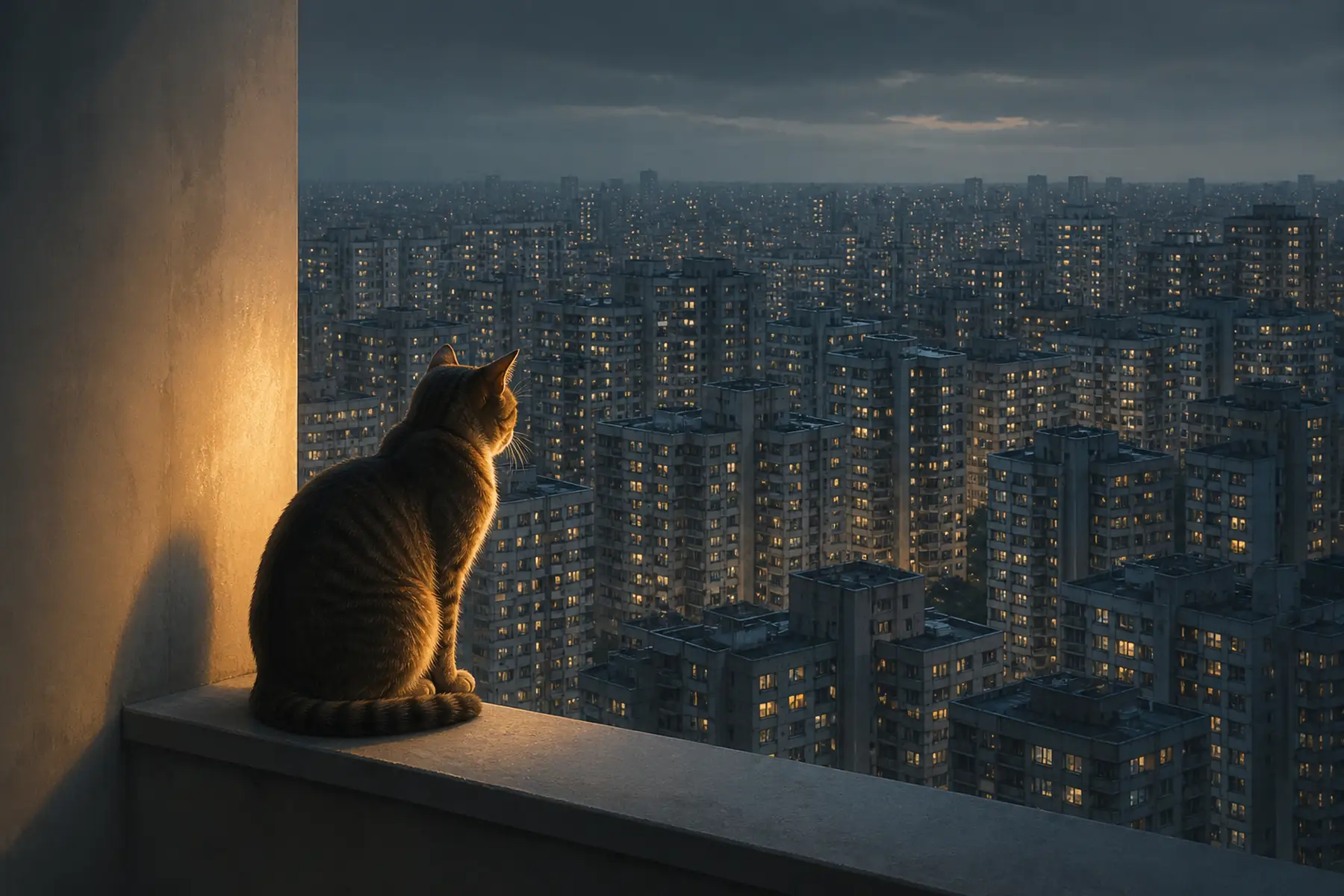
The pet of the future will not be waiting at the front door with a leash. It will be watching the city from a windowsill.
By 2050, cats will replace dogs as the world’s favorite pet. They will become the most numerous owned companion mammal on Earth and the default choice of the urban household.
House forecast: 72%.
Dogs were the great companion of the suburban century: energetic, social and perfectly matched to the detached house, the family car, the garden and the predictable working day. The century now being constructed has different dimensions. Its home is smaller. Its residents live alone more often, work irregular hours and buy convenience by the month. Most of its population growth will be absorbed by cities.
This future does not dislike dogs. It is simply being built to fit cats.
01 — The cat century has already begun.
The takeover is not a theory awaiting its first evidence. Across several of the world’s largest pet markets, cats are already ahead.
Europe counted 111 million cats in 2024, against approximately 91 million dogs. Cats were the continent’s largest pet category. FEDIAF changed the countries included in its latest census, which makes comparisons with older editions hazardous. It does not change the result: Europe is already a cat continent.
Urban China contained 72.89 million cats and 53.43 million dogs in 2025. The cat population grew faster. Total expenditure on cats grew faster. Spending per cat grew faster. The official American agricultural report on the market described the rise as a product of urban lifestyle changes and evolving consumer preferences. USDA Foreign Agricultural Service
Japan offers the mature version of the same story. Its 2025 survey estimated 8.85 million cats and 6.82 million dogs. The dog population had fallen from approximately 8.7 million in 2013, while the cat population remained close to nine million. Japan Pet Food Association
America remains the great dog holdout. It had 87.3 million owned dogs and 76.3 million cats in 2025. But the movement inside those numbers is feline. Since 2016, America added 18 million cats and 10.5 million dogs. The gap narrowed from 18.5 million animals to 11 million in nine years. American Veterinary Medical Association
A separate American industry survey counted 49 million cat-owning households in 2024 and found strong growth in homes keeping two, three or more cats. American Pet Products Association Different surveys use different methods, so their totals should not be stitched into a false global census. Their direction is harder to dismiss.
The cat is not approaching. It has taken Europe and East Asia and is closing the largest remaining gap.
02 — The decisive pet election will be held in cities.
A forecast about pets is also a forecast about housing.
The United Nations expects 6.5 billion people to live in urban areas by 2050, approximately 67% of humanity. Eastern and South-Eastern Asia will be more than 82% urban. Almost two-thirds of the population in less-developed regions will live in cities. World Urbanization Prospects 2025
Most of these people will not inherit a garden, a mudroom and an empty afternoon. They will occupy apartments in towers and dense neighbourhoods where private outdoor space is expensive. They will share lifts, corridors and thin walls. Their working lives will not reliably end at five.
A dog can live happily in an apartment, but the building must repeatedly release it. Every day requires walks, toilet trips, exercise, training and negotiations with neighbours. A cat converts the apartment itself into a territory. The litter tray replaces the garden. Vertical furniture replaces distance. A window supplies hours of observation.
The preference already follows the map. In a recent study of pet owners, cat preference was significantly associated with urban residence, dog preference with rural residence, and the suburbs stood between them. Animals
China makes the mechanism unusually visible. Its cats outnumber dogs by almost 20 million precisely where space is restricted, working hours are long and the youngest consumers are building new pet habits. The countries creating the next great expansion of pet ownership will not repeat the American backyard. They will repeat the Asian apartment.
The city will choose the animal that can remain inside it.
03 — A dog occupies a schedule. A cat occupies space.
The difference will become more important as care becomes more expensive.
In China, annual spending averaged $418 per dog in 2025 and $290 per cat. The cat figure was rising more quickly, but the practical advantage remained: a smaller animal consumes less food, requires less physical equipment and can be left alone for longer portions of the working day.
Technology will widen that advantage. Automatic feeders, circulating water fountains, cameras and self-cleaning litter boxes can remove much of the repetitive labour of keeping a cat. The same devices can feed a dog. They cannot walk it, exercise it or provide the outdoor social contact on which its welfare depends.
This will turn dog ownership into a stronger declaration of resources. The future dog household will need time, flexible work, paid walkers or access to outdoor space. The cat household will need a room, a window and a reliable food delivery.
Dogs will retain one formidable advantage. They force their owners into the world. An objective study of older adults found dog owners walked 22 minutes more and took 2,760 additional steps per day than matched non-owners. BMC Public Health The dog is exercise, public ritual and neighbourhood introduction attached to an animal.
That is a genuine virtue. It is also a demand.
As households become smaller, older and more irregular, the mass market will move toward the companion that can offer presence without organizing the day. Dogs will become the high-participation pet. Cats will become the universal one.
04 — Cats are precisely social enough.
The old case against cats was that they merely tolerated people. Behavioural science has dismantled it.
Domestic cats can distinguish their names from ordinary words, including when the speaker is unfamiliar. Their response may be no more than a movement of the ears or head, but the recognition is present. Scientific Reports
They also appear to maintain a mental map of an unseen owner. In an experiment using two separated speakers, cats showed greater surprise when the owner’s voice seemed to move impossibly across the room. The animal was not ignoring the person. It was tracking where the person ought to be. PLOS One
Even the celebrated slow blink has survived an experiment. Cats were more likely to narrow their eyes after a person slowly blinked at them and were more willing to approach afterward. Scientific Reports
This is not the public enthusiasm of a dog. It is low-bandwidth intimacy: names, voices, gaze, proximity and repeated quiet signals. It asks less from the human while still constructing a relationship.
That emotional economy is exceptionally well suited to the future household. A person working from a small apartment does not always need another source of stimulation. A person returning late does not want to discover that affection has been waiting with an urgent bladder. The cat can share solitude without constantly breaking it.
Its supposed aloofness will be reinterpreted as compatibility.
05 — The animal itself is stranger than its internet image.
The cat’s popularity is often explained with cuteness. Its biology is much more interesting.
Cats are effectively blind to sweetness. An essential component of their sweet receptor is encoded by a non-functioning gene, an evolutionary signature of life as an obligate carnivore. A cake that attracts a dog belongs to a sensory category the cat barely possesses. PLOS Genetics
The spines on a cat’s tongue are not solid hooks. They contain hollow channels that draw saliva deep into the coat. High-speed filming and computed tomography showed that the tongue operates as a flexible brush and fluid-delivery system; researchers used the mechanism to build a new grooming tool. Proceedings of the National Academy of Sciences
Catnip contains another piece of hidden engineering. Experiments found that cats rubbing against catnip and silver vine transferred plant chemicals onto their fur. One of those compounds repelled mosquitoes. The performance that looks like intoxication may also be an ancient insect defence. Science Advances
Even purring remained partly mysterious until recently. A 2023 experiment found that isolated cat larynges could produce low purr-like frequencies without active muscle contractions. Pads of connective tissue in the vocal folds appear to help a small animal generate an unexpectedly deep vibration. Current Biology
The cat is not a reduced dog. It is a highly specialized domestic machine: self-grooming, spatially compact, quietly communicative and capable of turning a room into a complete world.
06 — Cats have conquered the human world before.
The first expansion followed grain. Early farming settlements attracted rodents; rodents attracted wildcats; people tolerated the hunter that protected the harvest.
An ancient-DNA study of more than 200 specimens traced one great feline movement from the farming societies of the Near East and a later expansion associated with Egypt. Cats then travelled with people along land routes and aboard ships. Nature Ecology & Evolution
The bargain required unusually little reconstruction of the animal. Humans bred dogs into radically different bodies and assigned them work: hunting, guarding, herding, hauling and companionship. The cat entered the household while retaining much of the shape, movement and independence of its wild ancestor.
Its first global conquest was logistical. Wherever people stored food, moved cargo and built settlements, cats found a role. Its second conquest will be domestic. Wherever people construct dense housing, automate household labour and spend more of life indoors, cats will find an advantage.
The rat made the first cat civilization possible. The apartment will create the second.
07 — The future cat will remain indoors.
Feline expansion creates an ecological problem. Free-ranging cats prey on wildlife, transmit disease and alter the behaviour of native species. Those effects are especially dangerous on islands and near sensitive habitats. Frontiers in Ecology and Evolution
The result will not be the defeat of the cat. It will be the defeat of unsupervised roaming.
By 2050, the standard urban cat will be sterilized, microchipped and kept indoors or given controlled access through an enclosed balcony, courtyard or harness. Apartment design will absorb climbing walls, screened openings and concealed litter ventilation. Cat welfare will become an architectural category.
This transition strengthens the larger forecast. A cat prevented from roaming becomes even more closely integrated with the home. The pet, the furniture and the building form a single domestic system.
Dogs will keep the park, pavement and countryside. Cats will inherit the interior.
08 — The forecast.
During the 2030s, the cat economy will become the centre of the global pet industry. Food, insurance, veterinary care, furniture and domestic technology will increasingly be designed around multi-cat urban homes. Europe and East Asia will widen their existing feline lead.
During the 2040s, cats will overtake dogs by owned population in the United States. Dogs may continue to appear in more American households for a time because cats cluster in pairs and groups. The cultural result will arrive before every statistic agrees: acquiring a pet without specifying the species will increasingly mean acquiring a cat.
By 2050, the world will contain more owned cats than dogs. Cats will be the default companion of the urban household and the largest pet economy on Earth.
Dogs will not disappear. Their loyalty, usefulness and appetite for shared activity are too powerful. But the very qualities that make a dog extraordinary also make it expensive in time, movement and space. The dog will become the companion people choose when they can organize life around an animal. The cat will be the companion that fits the life they already have.
The twentieth century belonged to the dog.
The twenty-first will belong to the cat.