
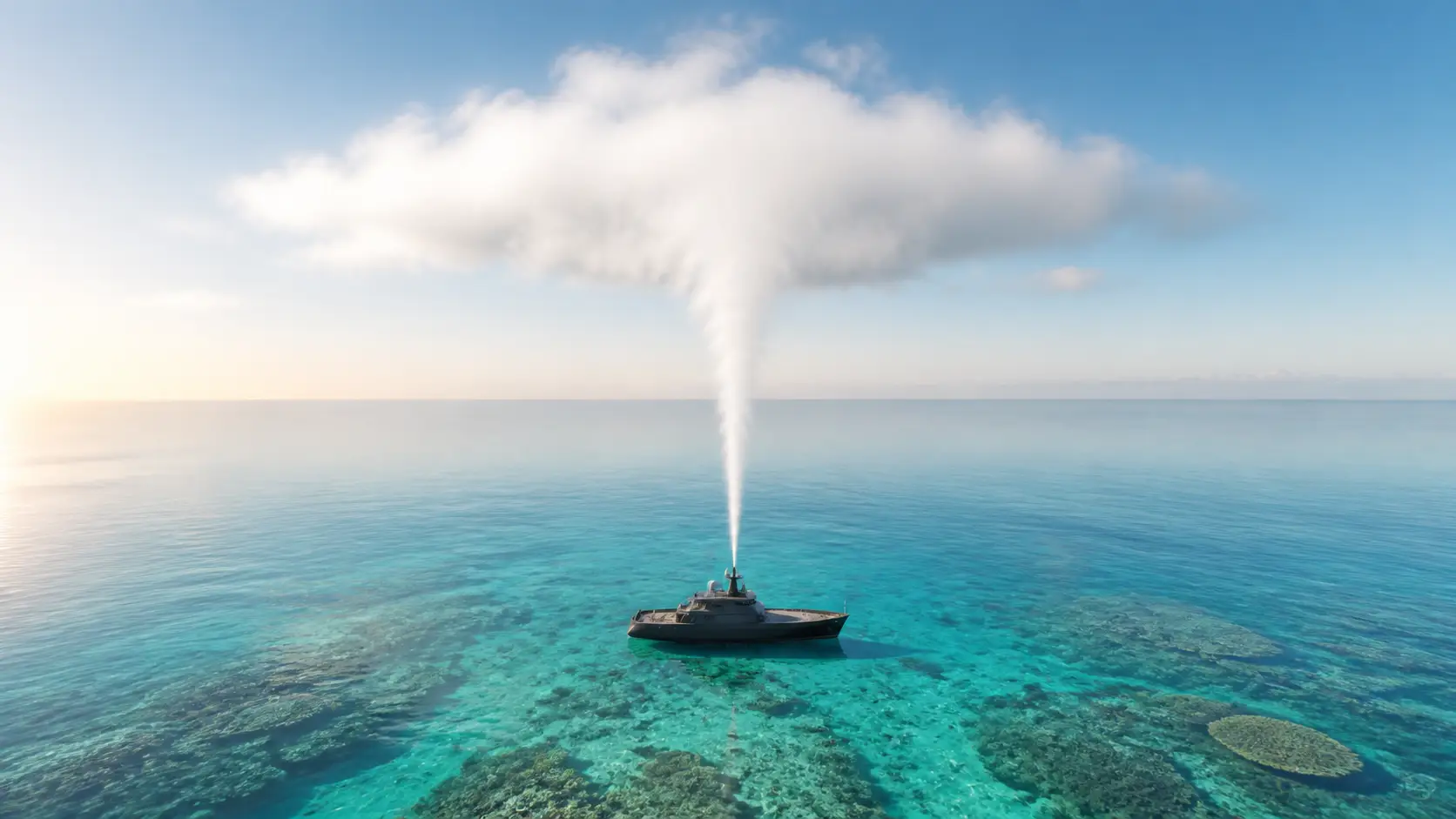
At first light off Cairns, a work vessel turns its bow into the summer wind. Seven compressors wake below deck. Seawater rushes through thousands of nozzles and leaves the ship as a white column too fine to fall. The droplets evaporate. Salt crystals continue upward. A weather model tells the captain where the plume will travel; drones and satellites watch what happens when it reaches the clouds.
The ship is making shade for a continent-sized living structure.
ParallaxSee forecasts that by the end of 2035, the Australian government will fund an operational marine-cloud-brightening fleet over multiple regions of the Great Barrier Reef. The central cost will be approximately A$250 million for an active summer in 2026 dollars. House confidence: 64%.
Australia will make this investment because the expected return is already positive and substantial. The government's reef-restoration analysis calculates that solar-radiation management could produce A$2.9 billion in net present benefit after costs. The technology is already approaching its durable industrial price: better forecasting and automation will make each ship more productive, while vessels, compressors, energy, monitoring and skilled crews will keep the operation valuable rather than vanishingly cheap. Above the spray fleet lies an engineering project. Beneath it lies a reef economy contributing more than A$9 billion every year.
01 - A cloud is a mirror made from droplets.
A warm cloud contains countless liquid droplets floating around microscopic particles. Those particles are called cloud-condensation nuclei. Water vapour gathers around them because it needs a surface on which to condense. Dust, smoke and sea salt can all provide that beginning.
Marine cloud brightening supplies more beginnings. A spray system breaks seawater into extremely small droplets. Much of the water evaporates during the climb, leaving airborne salt particles. When the plume reaches a suitable low marine cloud, more cloud droplets form. The available water is divided among a larger number of droplets, so the average droplet becomes smaller.
Imagine taking one glass sphere and replacing it with a box of tiny glass beads made from the same amount of material. Together, the beads present more reflective surface. A cloud behaves in a similar way: many small droplets usually return more sunlight to space than fewer large ones containing the same water. Atmospheric scientists call this the Twomey effect.
The cooling transaction is simple. More sunlight leaves upward; less solar energy reaches the ocean; the sea surface heats more slowly during the hours when coral is accumulating thermal and light stress. The system is intended to run during the dangerous part of summer, guided by forecasts rather than operated indiscriminately throughout the year.
The difficult step has always been moving enough particles from a ship into the lower atmosphere. A 2023 field study of the Australian spray system measured the plume directly and found that evaporative cooling did not prevent its vertical dispersion. In ordinary language: the salt continued to rise. A 2024 airborne-research paper then documented the aircraft, instruments and cloud measurements needed to observe the aerosol-sensitive atmosphere above the Reef. Australia is turning a famous effect from cloud physics into an instrumented marine operation.
02 - Australia already has the machine in the water.
The forecast begins with hardware, not a computer animation. Australian researchers have conducted marine-cloud-brightening trials over the Great Barrier Reef since 2020. The first vessels carried a prototype turbine and spray equipment. Later campaigns added particle instruments, research aircraft, drones, weather stations and satellite observation.
The Reef Restoration and Adaptation Program's 2025 field report records a world-first large-scale marine-cloud-brightening prototype tested outdoors from research vessels. The same program also ran a marine-fogging experiment during calm, high-stress conditions. These are still scientific campaigns, but they have already crossed the line between a laboratory proposal and machinery working at sea.
The experiment now has three connected layers. The spray machine controls how many salt particles enter the air and how large they are. The weather system predicts where the plume will rise and drift. The observing system measures whether cloud-droplet numbers, cloud brightness and incoming sunlight change. Each layer feeds the next campaign.
The latest atmospheric modelling makes the fleet look more, rather than less, engineerable. A 2026 convection-permitting Great Barrier Reef study found that the spacing of aerosol sources can change the cloud response even when total emissions remain the same. Densely arranged sources produced more uniform aerosol enhancement and a stronger microphysical response than widely separated sources. The message is practical: fleet geometry matters. A cloud-brightening operation will position ships as a coordinated array, using weather data to place salt where the atmosphere can use it.
This is the point at which an intervention becomes infrastructure. The individual nozzle is only the smallest component. The real machine is a moving network of ships, compressors, forecasts, sensors and cloud models spread along the coast.
03 - The operational price will settle near A$250 million because the physical work is already mature.
The most useful Australian costing begins with a fleet rather than a price per gram of salt. The official RRAP deployment study modelled protection across 300,000 square kilometres of the Great Barrier Reef Marine Park for 90 days a year. Its base case used 50 relocatable work vessels and cost A$158 million annually in the report's dollars. The low and high cases required 34 and 109 vessels and cost A$107 million and A$338 million.
Each modelled vessel was a substantial 40-metre workboat. Its deck carried 20 spray cannons containing 7,000 nozzles, powered by seven screw compressors. The ship sprayed for eight hours and repositioned for the following day's wind. The study calculated an average annual cost of approximately A$3.1 million for every vessel in the cloud-brightening fleet.
ParallaxSee's A$250 million central estimate carries that concept into 2026 dollars and allows for modern atmospheric instrumentation, low-emission power, program management and operational contingency. It sits inside the official engineering range instead of depending on a promotional price from a supplier.
The technology is already close to its durable cost floor. Nozzle design will improve. Automated routing will place vessels more efficiently. Better forecasts will identify the hours and cloud fields that produce the most cooling for every tonne of seawater processed. Those advances can reduce the number of wasted operating days and expand the area protected by each ship.
The dominant bill, however, remains maritime. Forty-metre vessels require construction or charter, maintenance, energy, certified crews, ports, insurance and repair. Compressing air requires power. A credible environmental program also requires atmospheric sampling, coral monitoring and independent verification. The original costing study explicitly found that vessel costs dominated many interventions.
Cloud brightening therefore follows the economics of offshore engineering, not consumer electronics. Its productivity will rise while each active summer retains a permanent fleet cost. Prices can improve by useful percentages; they will not collapse by orders of magnitude. Australia will invest on the strength of the return available at the industrial price already in view.
04 - The break-even line is only 2.8 per cent of the Reef's annual economy.
The Great Barrier Reef is an ecosystem with an income statement. The Australian government's 2025 valuation places its broader economic, social and cultural value at A$95 billion. It contributes more than A$9 billion to the national economy each year and supports 77,000 full-time-equivalent jobs. Tourism is the most visible stream, but the asset also supports fisheries, scientific activity, regional businesses and the international identity of Australia itself.
Against that annual contribution, an A$250 million cloud-brightening season equals about 2.8 per cent. That is the economic threshold. If an operational season preserves even three cents of every dollar that the Reef would otherwise lose to heat damage, the same-year economic value protected matches the program's cost. Benefits that continue into later years make the return larger.
The comparison becomes even stronger when the intervention is deployed selectively. Australia does not need to spray the entire Reef every day. A seasonal system can follow the heat. Ocean forecasts identify where thermal stress is accumulating; atmospheric forecasts identify cloud fields receptive to added sea salt; reef managers identify ecologically and economically important regions. The fleet concentrates its work where the expected avoided loss is greatest.
This is portfolio management conducted with clouds. A northern bleaching emergency, a central tourism corridor and a southern recovery zone need not receive identical treatment. Each ship can be moved. Each spray day can be measured. Each summer adds evidence about which weather patterns return the most cooling.
The national budget already recognizes the scale of the asset. Federal reef protection and management commitments reached A$1.2 billion by 2025. A recurring A$250 million summer operation would extend that established investment logic into direct heat protection. The question facing Treasury will be familiar: how much public capital should be placed in front of a much larger stream of exposed national income? The arithmetic points to action.
05 - The government's own economic model already produces a positive return.
Australia has already run the long calculation. The official RRAP cost-benefit analysis connected intervention costs to ecological models and then to the economic benefits created by a healthier Reef. It assessed capital expenditure, annual operation and changes in reef condition over a 59-year intervention period.
In the base case, implementing solar-radiation management by itself produced approximately A$2.9 billion in net present benefit, expressed in 2016 Australian dollars and discounted at 3.5 per cent. The undiscounted net benefit was A$12.8 billion. Net benefit is the important phrase: the modeled operating and capital costs have already been paid before that positive number appears.
This is the expected return Australia will buy. The nation spends hundreds of millions through a seasonal fleet and retains billions more in reef-derived value over time. The calculation was performed before the latest official valuation lifted the Reef's annual contribution above A$9 billion and its broader value to A$95 billion. The economic asset beneath the proposed cloud fleet has grown larger since the intervention case was first assembled.
The return also includes something conventional balance sheets handle poorly: time. Coral that survives one severe summer remains available to spawn, rebuild damaged areas and support the next season of tourism and fishing. Protecting living cover during a concentrated heat event preserves ecological capital capable of reproducing itself. A bridge must be maintained forever. A surviving reef conducts part of its own repair.
Marine cloud brightening cannot remove carbon dioxide from the atmosphere, and its public value does not depend on pretending that it can. Its economic job is narrower and immediately legible: reduce peak solar heating during dangerous weeks, lower bleaching stress and purchase survival time while emissions fall and corals adapt. That limited mission is exactly what makes a seasonal investment governable and valuable.
06 - Australia has a history of placing the public dollar before the market can see the return.
The most famous precedent began in 1949, when Australia had a population of only eight million and approved the Snowy Mountains Hydro-electric Scheme. The country built dams, power stations and 145 kilometres of tunnels through difficult alpine country. The National Archives of Australia records that the A$820 million scheme was completed on time and on budget. It produced electricity, redirected water toward inland agriculture, developed engineering capability and helped turn post-war migration into national growth.
Australia's later science investments provide a measured return. An independent 2022 assessment of CSIRO calculated a benefit-cost ratio of 8.4 to one across 68 case studies. In other words, every public dollar invested produced an estimated A$8.40 in economic, social and environmental value.
The Cooperative Research Centres program tells the same story through partnerships between government, universities and industry. An Australian Government impact evaluation estimated that national GDP rose by A$5.61 for every dollar of government CRC funding since 2005. Completed CRC Projects generated an estimated A$7.73 in economic benefit for every public dollar.
Then there is Wi-Fi. CSIRO scientists searching for signals from evaporating black holes developed techniques for separating a useful radio signal from echoes. Public research became patented wireless-network technology. The invention now sits inside more than 15 billion devices and has produced approximately A$430 million in licensing revenue. The original research question and the eventual economic return lived in different worlds; public institutions provided the bridge.
Australia is using the same national muscle in clean energy. During the 2024-25 financial year, A$4.7 billion in Clean Energy Finance Corporation commitments led to A$25.7 billion in new investment. Since the corporation's creation, its capital has attracted an additional A$65 billion from private and third-party investors.
The instruments differ: a hydroelectric authority, a public laboratory, research partnerships and a government-owned investment corporation. The national habit is consistent. Australia accepts an early technical risk when the eventual economic capacity belongs to the whole country. A cloud-brightening fleet fits that tradition perfectly. It joins Australian marine science, Queensland ports, vessel operators, atmospheric forecasting and public finance around an asset whose return cannot be captured by one private company.
07 - By 2035, cloud cover will become seasonal public infrastructure.
The pathway from the current research program to an operational fleet is unusually direct. Australia already possesses the prototype sprayers, the research vessels, the cloud instruments and the reef-monitoring institutions. The next phase enlarges the plume, improves the forecast and proves that a measured change in cloud properties can deliver useful reductions in sunlight at the sea surface. After that comes a regional demonstration across multiple reefs, followed by a standing fleet activated by a marine-heatwave forecast.
Governance will grow alongside the machinery. Australia's intervention program already evaluates ecological, atmospheric, social and regulatory risk through AIMS and the Reef Restoration and Adaptation Program. A seasonal fleet can operate under defined geographic boundaries, public measurement and a stop rule. Salt emissions end when the compressors stop; the fleet returns to port; the observing system continues to measure the sea and sky.
By 2035, the control room will resemble a cross between a weather service and an emergency agency. A digital map will show accumulated coral heat stress, receptive clouds, wind direction, vessel positions and expected shade. Managers will dispatch ships toward the narrow intersection where vulnerable reefs sit beneath useful air. The operation will be judged in sunlight avoided, heat stress reduced and living coral carried into the next season.
The budget will look large because the ocean is large. It will also look rational. Around A$250 million will purchase an active fleet, a national observing network and direct protection for an ecosystem producing more than A$9 billion each year. The official economic model already places the expected net return in the billions. Australian public research has repeatedly returned several dollars of value for every dollar committed.
Australia will manufacture clouds because it expects to earn more by preserving the living economy beneath them. The spray fleet will be expensive enough to be real, mature enough to cost, and valuable enough to fund. Above the Great Barrier Reef, climate adaptation will cease to be an abstract promise. It will become a line of ships turning seawater into shade.