
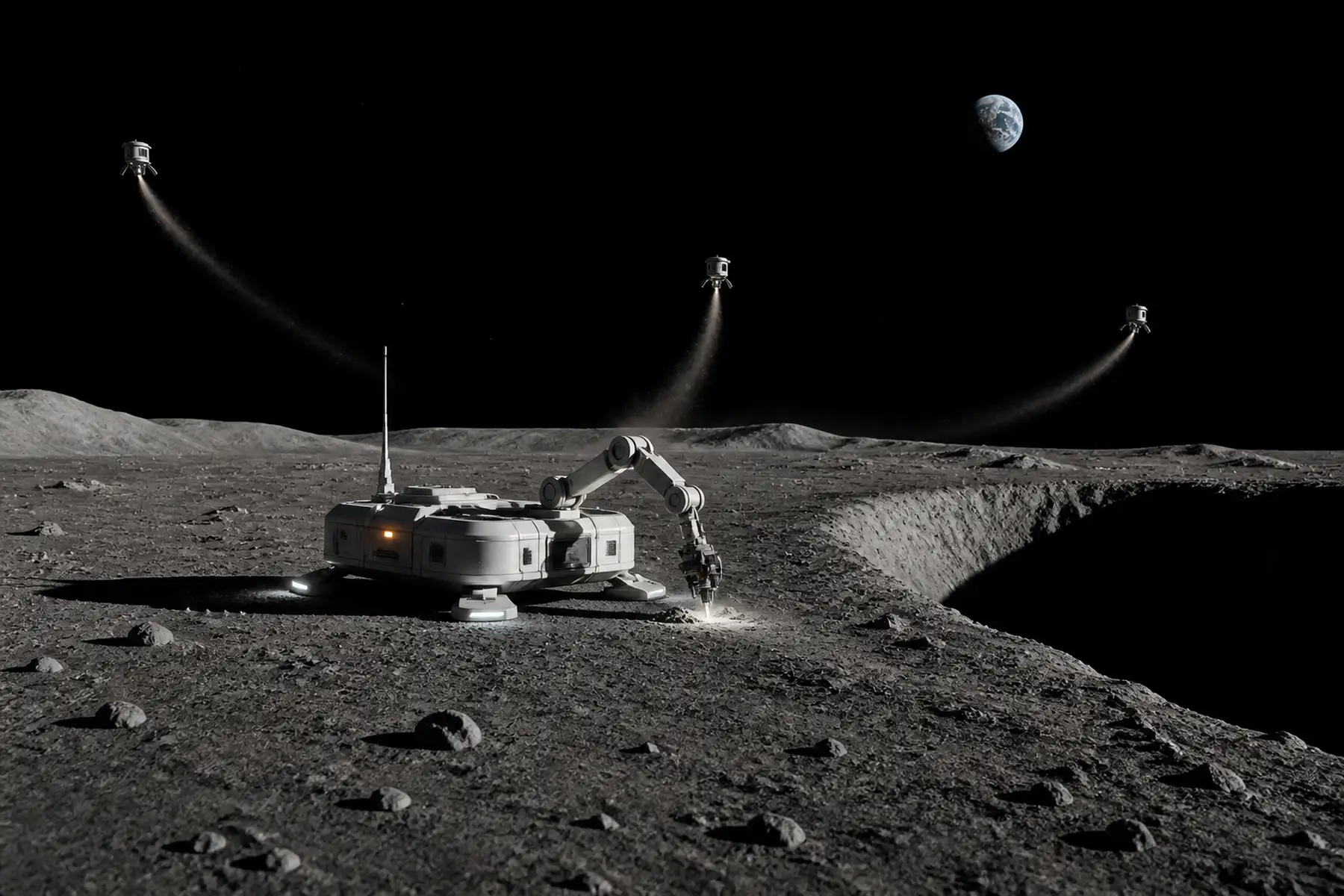
An autonomous lunar station stands beside a permanently shadowed crater. It never wakes, because it never sleeps.
Its central bot dispatches small rocket-powered drones across the darkness. One maps the surface with ground-penetrating radar. Another lowers a spectrometer into a fissure. Excavators carry regolith back to an automated laboratory. When the station identifies something unusual, it sends another drone to confirm the reading.
The system works continuously. It does not eat, breathe or become lonely. It can spend years searching for the rare deposit valuable enough to justify the expensive journey back to Earth. Between discoveries, it produces geological, astronomical and environmental data that would make any Earth-based scientist envious.
ParallaxSee forecasts that no self-sustaining human colony will exist on the Moon by 2050. House confidence: 88%.
Astronauts will land. Some may remain for months. Governments will describe rotating bases as permanent human presences. But a station that dies when deliveries from Earth stop is not a colony.
The Moon's first enduring intelligence will be artificial.
01 — A base is not a colony.
A colony must be more than an occupied room.
It must produce air and water, grow most of its food, manufacture replacement components and survive a prolonged interruption in deliveries. Eventually, it must care for pregnancies, children, illness and ageing residents. It must reproduce not only its population, but the industrial system keeping that population alive.
Nothing presently planned approaches that definition.
NASA's architecture instead anticipates autonomous and remotely operated systems working between human expeditions. Its Lunar Utility Rover is expected to move cargo, manipulate equipment and service other assets while the astronauts are absent. The people visit. The autonomous bots remain. NASA's Moon-to-Mars architecture
That is an excellent exploration model. It is not the beginning of a city.
A genuinely independent colony would require mines, furnaces, chemical plants, agriculture, hospitals, machine tools and semiconductor manufacturing. Lunar soil may provide oxygen, water and construction material. It does not provide finished bearings, antibiotics, pressure seals, computer chips or replacement laboratory sensors.
A colony unable to manufacture one indispensable valve is independent only until that valve breaks.
02 — One colonist costs at least a billion dollars.
Current lunar plans make the true price of a human resident difficult to hide.
NASA's inspector general projected that Artemis spending would reach $93 billion through the 2025 financial year. The SLS and Orion system was estimated to cost $4.1 billion for each early launch. Divided among four astronauts, that is more than $1 billion per person merely to reach lunar orbit. The lunar lander, surface habitat and supplies are additional. NASA Office of Inspector General
Robotic cargo is cheaper, but not cheap. NASA's commercial lunar-delivery programme estimated approximately $1.2 million per kilogram for its newer small robotic missions. NASA's CLPS audit
The most optimistic public price now comes from SpaceX. Its advertised Starship service offers cargo delivery to the lunar surface at $100 million per metric tonne, or $100,000 per kilogram. That assumes reusable vehicles, orbital refuelling and a functioning high-volume service. SpaceX lunar transport
Use that extraordinarily favourable price and the colony remains ruinous.
Habitat, airlock and radiation-protected living space: an optimistic 2.5 to 3.5 tonnes per resident, costing $250 million to $350 million to deliver.
Water and oxygen recycling hardware: published engineering estimates place the equipment at roughly 1.1 to 2.6 tonnes per resident, costing $110 million to $260 million.
Underground farm, lighting and thermal equipment: at least 0.7 to 1.5 tonnes per resident, costing $70 million to $150 million.
Power, communications, medical equipment, mobility and emergency stores: a restrained shared allocation of another two to three tonnes, costing $200 million to $300 million.
Add an extremely optimistic $200 million allocation for the human-rated journey and return capacity. The total is approximately $830 million to $1.26 billion for every colonist established on the Moon.
These are transportation and allocated hardware costs—not the research programme, landing pads, mining plant, mission control or development of a human-rated lunar vehicle. Using current systems rather than the advertised mature Starship price pushes the figure into many billions.
The honest conclusion is simple: even in the favourable scenario, one permanent colonist costs approximately $1 billion before the first annual supply bill arrives.
03 — An underground mini-farm does not make the resident independent.
The most favourable colony design buries the habitat beneath lunar soil and places a compact farm beside it. The regolith supplies radiation shielding. Artificial lighting removes dependence on the lunar day. Plants recycle carbon dioxide and contribute oxygen, water and food.
Even this miniature underground Eden is an industrial machine.
A recent controlled-ecological life-support design calculated approximately 17.5 square metres of growing area per resident. Earlier models attempting to supply roughly 90% of a person's food required around 40 square metres. At the upper figure, between 10 and 12 kilowatts of photosynthetic light must reach the crops during operation. The electrical system must generate more because lamps, wiring and thermal control are not perfectly efficient. Lunar life-support material-flow design, biological lunar-base model
A four-person mini-farm therefore occupies the floor area of a substantial house and requires the power of a small industrial installation. Its heat must be removed into a vacuum. Failed lamps, pumps, nutrient sensors and water lines must be replaced immediately.
One detailed lunar-settlement study estimated that advanced recycling would still require 343 to 467 kilograms of resupply per person every year. That includes food, incomplete recycling, consumables and replacement support. Low-cost lunar-settlement study
An underground farm supplying 90% of dry food could reduce that figure. ParallaxSee's deliberately optimistic calculation begins with the study's 343 to 467 kilograms of annual support. Dry food accounts for approximately 226 kilograms a year. Producing 90% locally removes about 203 kilograms from the shipment. Seeds, nutrients, medicines, hygiene supplies, filters, seals and an emergency margin then bring the best-case resupply back to approximately 170 to 330 kilograms per person annually.
At $100,000 per kilogram, that is $17 million to $33 million per colonist every year. Rounded for irregular equipment replacements, the defensible floor is $20 million to $40 million annually.
That still excludes the occasional catastrophic invoice: a replacement spacesuit, greenhouse lighting bank, habitat pump, battery module or reactor component.
NASA's nearer-term estimate is much higher. Its current planning example requires approximately eight tonnes of carriers, consumables and equipment for four astronauts spending 28 days on the surface. That is two tonnes per astronaut for a single month. Even at SpaceX's proposed mature price, the freight equals $200 million per person-month. NASA Moon-base logistics
The farm lowers the invoice. It does not end it.
04 — The colony has no product capable of paying its residents' bills.
The Moon possesses potentially valuable resources: water ice, oxygen-bearing minerals, rare-earth elements, platinum-group metals and helium-3.
But possessing a material is not the same as possessing an economic deposit.
The ore must be found, measured, excavated, concentrated and launched towards Earth. Each kilogram must be valuable enough to pay for the equipment sent outward and the return vehicle coming home.
The United States Geological Survey concludes that the viability of lunar rare-earth mining depends upon discoveries still to be made and transportation infrastructure still to be built. USGS assessment of lunar rare-earth elements
Helium-3 is attached to an energy market that does not yet exist. Commercial fusion has not established a demand for lunar fuel, while extracting helium-3 would require processing enormous quantities of regolith. Ordinary iron, aluminium or titanium cannot compete with terrestrial mines operating beside roads, ports, air and an existing workforce.
An autonomous bot needs only an occasional extraordinary discovery. It can spend a decade searching for a small concentration of platinum-group metals, a scientifically unique sample or an isotope worth hundreds of thousands of dollars per kilogram. It can return a few kilograms and justify the mission.
A human colony needs continuous income sufficient to support every resident at tens of millions of dollars a year.
That is the difference between prospecting and settlement. The bots need to find a jewel. The colony needs to find an entire economy.
05 — A shrinking Earth will not export the workers it needs.
Space colonisation was imagined during an era terrified of overpopulation. Humanity appeared destined to multiply until Earth could no longer contain it.
The demographic future is reversing.
ParallaxSee forecasts that the world population will begin declining around 2050. Fertility is already below replacement across most advanced economies and has reached that threshold in India. China is losing millions of residents. Ageing societies will compete for workers, carers, scientists and taxpayers.
Those societies will not relieve population pressure by spending a billion dollars to remove one highly trained citizen from Earth.
A million lunar settlers would barely affect global population. Establishing them at the optimistic cost calculated above would require roughly $1 quadrillion before annual support began.
The Moon also fails as a civilisational lifeboat. A settlement dependent on terrestrial medicines, electronics, specialist components and genetic material would not survive Earth's collapse. When the supply ships stopped, the supposedly protected lunar population would become the first to die.
A backup civilisation must be able to reproduce civilisation. A buried habitat containing vegetables is not enough.
06 — The missing propulsion revolution is not on the horizon.
Reusable chemical rockets could make lunar transportation substantially cheaper. They will not make it cheap in the ordinary meaning of the word.
A colony needs a container-shipping revolution: reliable movement of enormous quantities of equipment at a cost low enough to make ordinary economic activity possible. The funded programmes approaching operation remain chemical. Nuclear thermal propulsion could use propellant more efficiently, but NASA describes it primarily as a technology for faster journeys towards Mars and the outer Solar System—not as a system that removes the cost of lifting mass from Earth or sustaining people after arrival. NASA's space nuclear propulsion programme
NASA's 2026 budget documentation provided no funding for nuclear thermal or nuclear electric propulsion projects. The promising systems remain studies and component programmes rather than a transportation network capable of changing lunar economics by orders of magnitude. NASA FY2026 technical supplement
Even revolutionary propulsion would solve only transportation. It would not create a lunar biosphere, semiconductor industry or pharmaceutical supply chain.
Until movement between Earth and the Moon becomes routine freight rather than a sequence of missions, permanent human settlement will remain a spectacle maintained by governments—not an independent society.
07 — Autonomous bots can perform the useful work.
The Moon is almost perfectly designed for autonomous exploration.
A radio command takes only a little over a second to reach it from Earth. Scientists can set research priorities while local software makes the immediate decisions necessary to avoid rocks, select routes and protect equipment.
NASA's CADRE programme is developing several small rovers that cooperate without receiving individual driving commands from Earth. They can divide territory, collect simultaneous measurements and combine their observations into a three-dimensional subsurface map. NASA's CADRE autonomous rovers
NASA's MoonFall mission advances the idea further. It will send four rocket-powered lunar drones into difficult terrain around the south pole. Unlike terrestrial drones, they do not use propellers—the Moon has no air. They make controlled ballistic jumps, landing and launching again to cross slopes and enter permanently shadowed regions. Each is intended to cover as much as 50 kilometres. NASA's MoonFall drones
The enduring lunar installation will combine these ideas.
A large autonomous bot will serve as laboratory, power station, communications hub and repair depot. It will dispatch wheeled scouts across gentle terrain and hopping drones into craters. Excavators will carry samples home. Robotic arms will divide them among microscopes, spectrometers and chemical instruments. The system will compare new readings with orbital maps and send its most promising discoveries to laboratories on Earth.
It will conduct seismic experiments through the lunar night. It will monitor radiation, dust and electrostatic charging for years. Its drones will enter places no astronaut could safely reach. Hundreds of instruments will observe simultaneously instead of waiting for a four-person crew to finish maintaining its habitat.
A terrestrial scientist receives only selected hours on a major telescope or expensive laboratory instrument. The lunar network will produce an uninterrupted river of measurements from an entire world.
It will make Earth's scientists envious because it possesses the one resource every research programme lacks: time.
08 — The bots will stay after the footprints disappear.
The Moon of the 2040s will not be empty.
Astronauts will arrive for prestigious expeditions. They may occupy buried habitats and eat salad grown beneath artificial light. Their presence will demonstrate extraordinary engineering and human bravery.
Then their rotation will end.
Outside, the autonomous station will continue. It never wakes because it never sleeps. When one drone fails, another takes its territory. When one generation of bots becomes obsolete, a cargo lander delivers the next. The old system transfers its maps, experiments and unfinished questions to its successor.
The bots will prospect until they find a resource rare enough to justify the return journey. They will construct landing areas, deploy radio telescopes and turn permanently dark craters into the most intensively measured geological sites beyond Earth.
Humans will visit the Moon because it is magnificent.
Autonomous bots will remain because only they make economic sense.
By 2050, there will be no self-sustaining human lunar colony. The first enduring intelligence on the Moon will be an autonomous one—sending out drones, gathering impossible quantities of data and forever toiling beneath a sky in which the Earth never moves.