
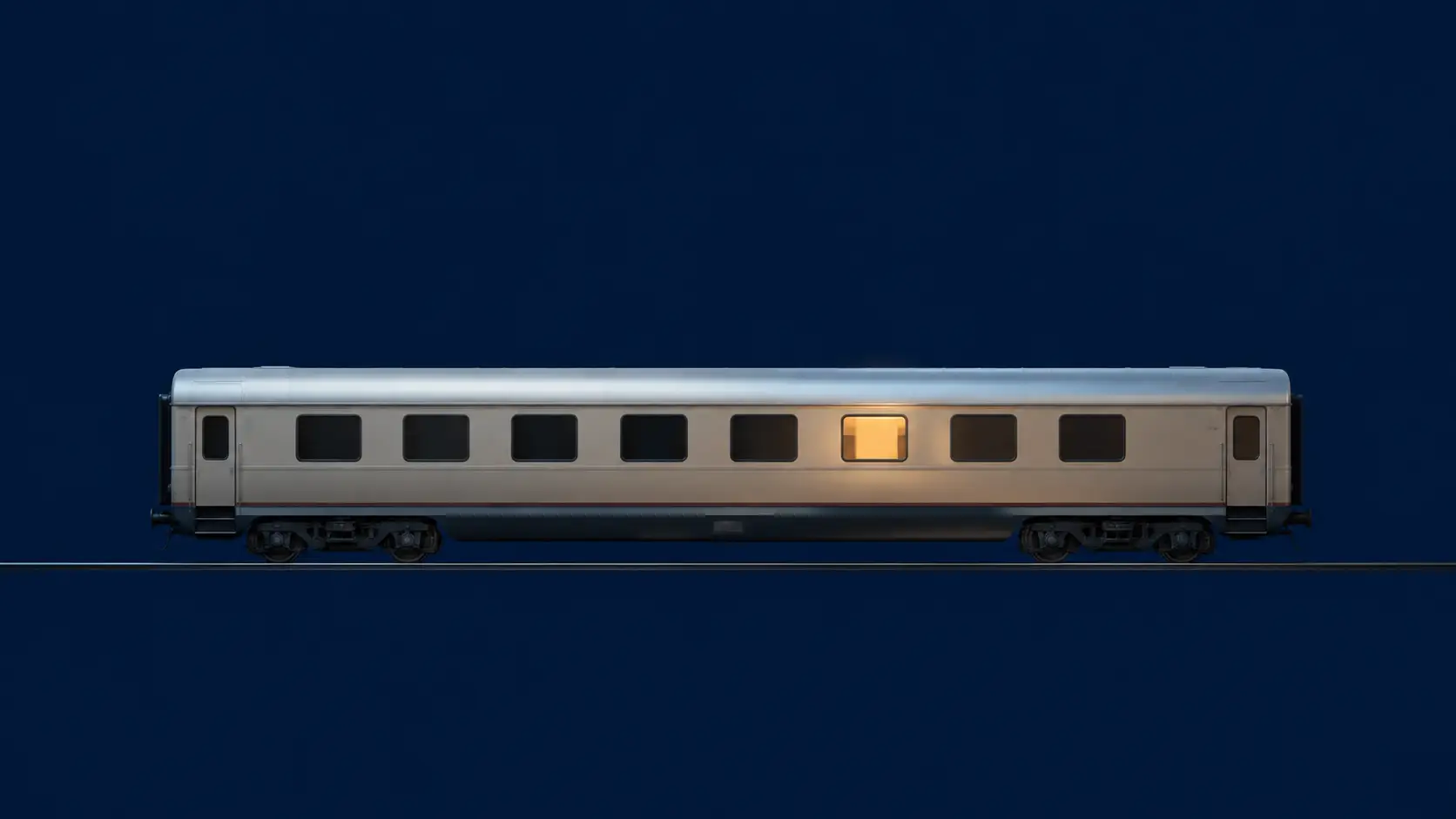
The most persuasive advertisement for Europe’s next transport revolution may be a cup of coffee beside a train window.
Outside, another city is waking up. Inside, a passenger has crossed a border, slept and reached the centre of a place they wanted to visit. The journey has occupied the hours between yesterday’s dinner and today’s breakfast.
By 2035, ParallaxSee estimates that night trains will carry one in ten air-and-night-train passenger journeys across a fixed European basket of major routes suitable for overnight rail. Our forecast confidence is 55%.
Private sleeping spaces are already entering service. Researchers have identified a substantial potential audience. The next stage is an industrial undertaking: enough carriages, reliable international paths and tickets that make the whole journey easy to buy.
The prize is a distinctive kind of speed: reaching the destination with more of the day still available.
01 — The sleeper sells a morning.
Imagine a traveller who needs to be in another city early. Flying the previous evening means buying a flight, travelling between airports and city centres, and paying for a hotel. A well-timed sleeper can combine those purchases.
Consider an illustrative budget: a €90 flight, €30 in airport transfers and a €100 hotel room total €220. A €150 sleeping berth plus €10 of local travel totals €160. The €60 difference buys a useful argument before carbon enters the conversation. These are example assumptions, not sampled fares. A morning flight or a shared hotel room could change the calculation.
The comparison also includes attention. Checking into a cabin once can be more appealing than managing successive transfers, queues and check-ins. A traveller willing to spend an evening reading can arrive with the following day intact.
Brian Buh and Stefanie Peer’s Vienna research helps explain that appeal. Their 2024 study associated intentions to use night trains with getting sleep, city-centre stations and morning arrival. Price, cabin sharing and perceived security were barriers. The convenience sample cannot establish a European market share, but it identifies features operators can improve. Research on night-train preferences
02 — A private bed is a transport technology.
The sleeper’s most important redesign is happening inside the carriage.
ÖBB’s new-generation Nightjet offers individual Mini Cabins: compact sleeping spaces with a reading light, a folding table and adjacent luggage storage. Its sleeping-car compartments have their own toilets and showers. Electronic access cards help separate personal space from the shared train. Inside the new Nightjet
Privacy changes the proposition. A passenger can buy a place to retreat, read and sleep without booking an entire conventional compartment. The design brings a more individual product into the dimensions of a railway carriage.
These trains are already carrying passengers. SBB confirms new-generation operation between Zurich and Hamburg from December 2025, and between Zurich and Vienna from June 2026. SBB’s deployment record
Our expectation is that privacy will become part of the standard competitive offer. Operators will have to make the sleep itself dependable: comfortable bedding, appropriate temperature, discreet service and a timetable that leaves enough uninterrupted hours.
The engineering objective is a passenger who wakes up wanting to book the return journey.
03 — The potential passengers are already identifiable.
A Chalmers University study by Riccardo Curtale, Jörgen Larsson and Jonas Nässén surveyed 1,691 Swedish residents. In its favourable scenarios, improved services could persuade 20–30% of air travellers to Central Europe to switch to night trains. The estimates for Southern Europe were 6–10%.
The strongest package combined easier booking, new comfortable trains, direct services and shorter journeys, including the assumed Fehmarnbelt connection. These were modelled choices, not observed ticket purchases. Sweden’s respondents also cannot stand in for every European traveller. The Chalmers study
For our forecast, the useful finding is the response to the whole package. A good bed becomes more valuable when it comes with a direct train. A direct train becomes easier to choose when its ticket is easy to find.
The commercial task is to make those advantages arrive together. A traveller should be able to compare the cabin, understand the complete price and book with the same confidence they bring to a familiar flight.
04 — Europe can put a price on the fleet.
Simon Blainey and Bradley Hare’s 2025 study identified 93 European city pairs with more than 500,000 annual air-passenger journeys and potential rail journeys of 7–16 hours.
At 60% occupancy, accommodating 10% of that historical aviation volume required approximately 169 additional daily one-way trains, using 260-place sets. Their rolling-stock estimate was €4.05 billion. These are aggregate capacity calculations, not a complete timetable or project budget. European capacity and investment study
Our future combined-market denominator differs from that historical aviation baseline. Growth, spare trains and passengers arriving from other transport modes would alter the requirement. Infrastructure and operating costs need separate provision.
Even so, the benchmark makes the opportunity tangible. Governments and operators can debate a fleet, a financing arrangement and a delivery schedule.
A shared leasing pool is one possible route: a financing institution purchases compatible trains, then operators lease them. That spreads the initial capital burden and creates the possibility of moving equipment between services. Commercial risk remains, but it becomes a problem with an identifiable asset behind it.
05 — The ticket must hold the journey together.
A European railway journey is assembled from organisations whose commercial systems have developed separately. The passenger experiences the result as one trip and reasonably expects someone to take responsibility for it.
In May 2026, the European Commission proposed measures enabling passengers to combine different rail operators into a single ticket, alongside stronger protection for connecting journeys. The package aims to make services easier to find, compare and purchase across booking platforms. It is a legislative proposal, not a guarantee already delivered throughout Europe. The Commission’s booking package
For sleepers, better distribution can widen the catchment of every departure. A city with a night train can serve surrounding towns through an evening connection. The return journey becomes more attractive when passengers understand their options if an earlier service runs late.
This is part of the infrastructure the forecast requires. A carriage creates physical capacity; a coherent booking and protection system helps turn that capacity into a journey someone will purchase.
06 — Paris shows how the business will have to evolve.
The previous Paris–Vienna/Berlin Nightjet operation averaged 70% occupancy in 2024, according to SNCF. It nevertheless ended in December 2025 after France withdrew its subsidy.
SNCF’s explanation described the burden of overnight staffing, international infrastructure charges and limited daily utilisation. A sleeping place generally earns its revenue from one overnight journey; aircraft and daytime trains can complete successive revenue trips. High occupancy alone did not make that operation financially viable. SNCF’s explanation, in French
European Sleeper returned Paris–Berlin to service on 26 March 2026, initially three times a week. Its launch offer advertised a couchette bed from €59.99, a starting price rather than a representative fare.
At the launch, co-founder Chris Engelsman said: “Building a network doesn’t happen overnight.” European Sleeper’s launch statement
The sequence captures the next decade’s challenge. Passenger interest gives a service an audience; commercial organisation determines whether the train keeps running. Our forecast depends on operators developing a durable combination of fares, utilisation, financing and public support where justified.
Europe can learn from each relaunch, including the ones that fail. The valuable outcome is a service passengers can trust to exist next year.
07 — Climate policy has a practical passenger product to support.
The environmental case becomes strongest when a rail booking actually replaces flying.
Johannes Morfeldt and colleagues examined that question through a prospective lifecycle model of Swedish tourism. Their policy scenario produced a 9% lower cumulative travel carbon footprint over 2025–2050 than the baseline. That figure describes the modelled tourism system, not the saving from an individual journey. The analysis also builds on the Chalmers preference research, so it provides an emissions calculation rather than an independent confirmation of demand. Lifecycle study in the Journal of Cleaner Production
Our proposed expansion would need to measure where passengers come from. Switching from a flight has a different consequence from switching from a daytime electric train. Filling an additional sleeper with entirely new holidays has another consequence again.
That makes targeted support more useful than indiscriminate expansion. Governments can ask which services attract former flyers, which prices sustain demand and which departures connect useful markets.
The passenger receives something concrete in exchange for that policy: an affordable bed travelling towards tomorrow’s destination.
08 — Nine years is the opportunity to industrialise the revival.
The forecast’s strongest opponent is the calendar.
The Fehmarnbelt tunnel illustrates the risk. Its May 2026 update envisages road traffic opening first, with railway operation following when the required German infrastructure is ready. A revised schedule remains pending.
Sund & Bælt chief executive Mikkel Hemmingsen described the delay as, in translation, “regrettable for the green transition and for train passengers.” The developer’s Danish update
That matters because the favourable Swedish research scenarios assumed the rail shortcut. The infrastructure calendar has already weakened a simple 2030 extrapolation.
Our 2035 date gives procurement, manufacturing and operating agreements a longer runway. We expect the first gains to come from improving existing routes, followed by additional departures and a larger supply of modern sleeping accommodation. That sequence is our forecast, rather than an announced European delivery programme.
The 55% confidence reflects three successive requirements: enough financed trains, a workable international operating network, and sufficient demand relative to aviation. It is an editorial judgement with a substantial risk of delay. A Europe filled with attractive sleeper announcements could still fall short if passengers cannot buy a dependable journey.
09 — How we will assess the estimate.
We will assess the forecast over calendar year 2035, using the fixed 93-city-pair cohort in the European capacity study. The test is night-train journeys divided by combined air-and-night-train journeys, summed across the entire cohort. The threshold is 10%.
The 10% figure is ParallaxSee’s forward-looking editorial estimate, not a market-share prediction made by the cited study. The paper identifies 93 city pairs; we have not independently reconstructed its complete route list. Final assessment will require confirmation of that original cohort and comparable passenger counts. If those records remain insufficient, the forecast will remain unresolved.
An unserved route contributes zero night-train passengers. Daytime rail, road travel and luxury charter-only trains are excluded. We count one-way journeys, including seated passengers on scheduled sleeper services, rather than unique people. Operator records and transport statistics must establish the result; a booking does not by itself prove a flight was displaced.
This is a forecast about a substantial new competitor. A successful network will give travel agents another product, employers another way to move staff and holidaymakers another way to begin a trip.
The first evening of a holiday could happen behind a small cabin door. A traveller puts away their bag, opens a book and watches the last familiar lights recede.
By morning, the city outside has changed. The day ahead is still theirs.
That is the advantage Europe’s night trains will sell.