
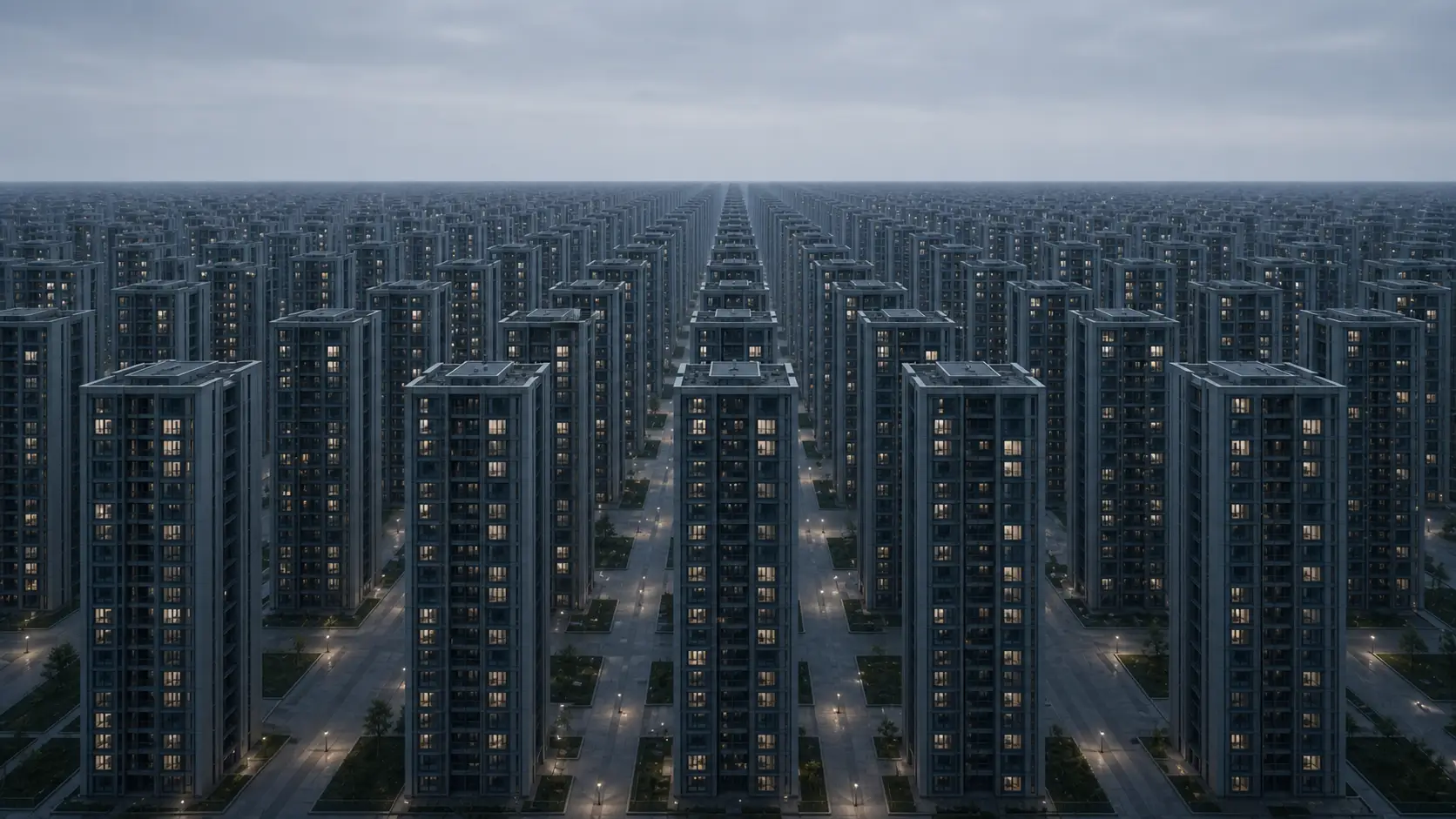
At eight in the morning, the apartment tower wakes without emptying. Breakfast enters through the lobby. A pharmacy order waits in the parcel room. Meetings begin behind closed doors. Exercise, entertainment and shopping are already inside the building.
The street below is not empty. It is crowded with the people whose movement allows everyone else to remain still: couriers, nurses, cleaners, technicians, dog walkers and drivers carrying meals, groceries and returns.
House forecast: 72%. By 2035, major cities will divide between a home-centred majority that receives the world at its door and a smaller archipelago of neighbourhoods where people deliberately organize life around direct human contact.
The future city will not stop moving. It will outsource movement.
01 - The retreat began before the pandemic.
Americans are not necessarily becoming introverts. They are becoming home-centred. The distinction matters. Introversion is a personality trait. Home-centred life is a system in which work, food, shopping, exercise and entertainment can reach a person without that person crossing the front door.
Sociologist Patrick Sharkey found that American adults spent 99 more minutes at home each day in 2022 than they did in 2003. Every population group he studied spent at least an additional hour at home. The movement was already under way before COVID-19; the pandemic accelerated it. Sociological Science
Face-to-face life has weakened alongside it. In 2024, 30% of Americans socialized or communicated with other people on an average day, down from 38% in 2014. The average time devoted to it fell from 43 minutes to 35. U.S. Bureau of Labor Statistics
This is not a temporary quarantine habit. It is a twenty-year migration of daily life into the home. COVID gave that migration better tools, wider permission and a generation of practice.
02 - COVID turned the home into a full-service address.
The office was the last institution capable of forcing millions of people out of the house at the same hour. It has lost that power.
The academic evidence no longer describes remote work as an emergency interruption. A 2023 review in the Journal of Economic Perspectives found that full days worked at home accounted for 28% of paid workdays among Americans aged 20 to 64 - four times the 2019 rate. The authors argued that improving technology, new management practices and investments already made by workers and firms make the change durable. American Economic Association
This freedom is distributed by class. Research in the Journal of Public Economics estimated that 37% of American jobs could be performed entirely at home, but those jobs accounted for 46% of wages. Work capable of becoming immobile is disproportionately well paid. Journal of Public Economics
The home-centred city will therefore rest on an unequal exchange. Knowledge workers will avoid journeys while nurses, cleaners, drivers, cooks, carers and technicians continue to travel. The people most able to remain at home will pay other people to move through the city for them.
By 2035, routine departure from home will become optional for much of the professional class. Solitude will no longer require sacrifice. It will arrive with same-day shipping, high-speed communication and a monthly subscription.
03 - Traffic will spread instead of disappearing.
The first remote-work forecasts imagined quiet highways. Transport research describes a more complicated substitution.
A 2024 American panel study combined surveys with passively recorded mobility data. On a day spent working remotely, a worker generated approximately one additional non-commute trip. The new journey was shorter than the avoided commute, but it replaced part of the expected reduction. Transportation Research Part A
A separate study using the Swiss Mobility and Transport Microcensus found that part-time teleworkers commuted less but increased non-work travel enough to leave their total distance travelled unchanged. Only the much smaller group working completely remotely showed a clear reduction in total mobility. Journal of Transport Geography
The result is not the end of traffic but its fragmentation. American drivers lost an average of 63 hours to delays in 2024, 17% more than in 2019. Midday and weekend congestion increased, while Tuesday through Thursday became the heaviest hybrid-work days. American Society of Civil Engineers
Goods add another layer. A 2024 systematic review of last-mile e-commerce research found that home delivery can increase vehicle kilometres, congestion, emissions and pressure on urban space when small shipments are dispatched through fragmented fleets. International Journal of Urban Sciences
Cities will respond by turning curbs, parking structures and vacant shops into loading areas, parcel depots and neighbourhood logistics hubs. The International Transport Forum identifies such hubs as a way to consolidate freight and shorten the final journey.
By 2035, the defining traffic conflict will not be commuter against commuter. It will be resident against the vans, bikes and service workers required to maintain residential stillness.
04 - Real estate will acquire two premiums.
The home-centred city rewards space behind the front door. Research into the housing boom after 2019 found that remote work explained more than half of the 18.9% increase in real American house prices through 2023. The estimated effect was strongest for larger homes, while commercial rents moved in the opposite direction. National Bureau of Economic Research
The movement has already rearranged entire metropolitan areas. A peer-reviewed study in the Proceedings of the National Academy of Sciences combined spending, commuting, migration and housing data from cities around the world. It found a persistent donut effect: economic activity moved out of large city centres but remained within the broader metropolitan region, particularly where remote work was common. Three-fifths of the American households leaving the centres of large cities moved to suburbs of the same city. Proceedings of the National Academy of Sciences
By 2035, successful residential buildings will follow one of two models. The first will be the sealed service building: generous work rooms, refrigerated deliveries, package elevators, private gyms, telehealth rooms and staff who can arrange daily life without the resident entering the street.
The second will be the human neighbourhood: smaller private homes compensated by markets, parks, schools, cafés, workshops and familiar faces within a short walk. Residents will buy less private space because the surrounding district functions as a shared living room.
Single-use office districts will be stranded between them. Research published in the American Economic Review estimates that remote work cut the long-run value of New York office buildings by 46% and destroyed $556.8 billion in value across American office markets. Higher-quality buildings were partly protected; lower-quality offices risk becoming stranded assets. American Economic Review
The office tower without housing, culture or street life will be the obsolete property of the next decade.
05 - Business will split between removing contact and selling it.
The commercial middle will be squeezed. Businesses that merely accompany the commute - the ordinary lunch counter, office dry cleaner, parking garage and convenience shop - will lose the repeated journey on which they depend.
This transfer has already been measured. Research in Regional Science and Urban Economics found that high-skill business-service workers are both unusually concentrated in large cities and unusually able to work remotely. When their spending withdrew from city centres, lower-paid consumer-service workers absorbed a disproportionate share of the economic damage. Federal Reserve Bank of Minneapolis
One group of winners will eliminate reasons to leave home. Fulfilment centres, prepared-food kitchens, home healthcare, maintenance subscriptions, private fitness services, residential concierges and building logistics systems will grow around the delivery metropolis. They will sell completed tasks rather than places.
The other winners will make leaving home worth the effort. Restaurants with a public identity, live performance, markets, libraries, clubs, gyms, adult education and workshops will concentrate inside the human islands. They will sell presence, recognition and participation - qualities that cannot be left in a parcel locker.
Urban economics already detects a price for this experience. A Journal of Urban Economics study found that both the quantity and quality of nearby restaurants were capitalized into housing values in Washington, D.C. Journal of Urban Economics A more recent working paper found that the arrival of a neighbourhood café increased business formation in places that previously lacked one. National Bureau of Economic Research
Retail will divide into frictionless fulfilment and memorable experience. The undistinguished shop between those poles will disappear.
06 - Human neighbourhoods will become a scarce resource.
The counter-city will not exist only in picturesque small towns. It will appear in old urban neighbourhoods, university districts, immigrant commercial streets, suburban main streets and new communities built around shared courtyards, schools and workshops.
These places will not reject technology. They will reject its power to make other people unnecessary.
The social mechanism is older and better established than the language of the 15-minute city. A study in the American Journal of Public Health found that residents of walkable, mixed-use neighbourhoods were more likely than residents of car-dependent suburbs to know their neighbours, trust other people, participate politically and be socially engaged. American Journal of Public Health Walkability does not manufacture friendship, but it repeatedly creates the low-stakes encounters from which familiarity can grow.
New mobility research supplies the larger scale. A Nature Human Behaviour study using data from 40 million American devices found that access to nearby amenities explained much of the variation in local consumption trips. It also uncovered the danger: intensely local life can increase the segregation experienced by low-income residents. Nature Human Behaviour
The human islands will therefore be valuable and vulnerable. Their street life will attract residents, investment and visitors. Unless they build abundant housing, that popularity will price out the people who created it. Unless they connect to the larger city, local intimacy will harden into social separation.
Direct human contact will survive. But it will cease to be the accidental by-product of urban density. It will become something neighbourhoods must design, finance and defend.
07 - The forecast.
By 2035, the most important division in major cities will no longer be centre against suburb. It will be delivery territory against human territory.
Across much of the metropolis, residents will work, shop, eat and entertain themselves at home. The roads beneath them will remain busy because their stillness depends on the continuous movement of goods and service workers. Buildings will become private service platforms. Shops that once relied on habitual foot traffic will vanish.
Against that system, a smaller archipelago of intensely social places will grow inside and outside the great cities. Their residents will accept smaller homes, shared space and a degree of inconvenience in exchange for recognition, spontaneity and trust. Their strongest businesses will not compete with delivery on speed. They will offer reasons to appear in person.
This will be the bipolar city: convenience without contact across most of its territory, and expensive, deliberately maintained human connection in the surviving islands.
The city will not empty. It will divide between people who receive the world at home and people who continue to build a world outside it.