
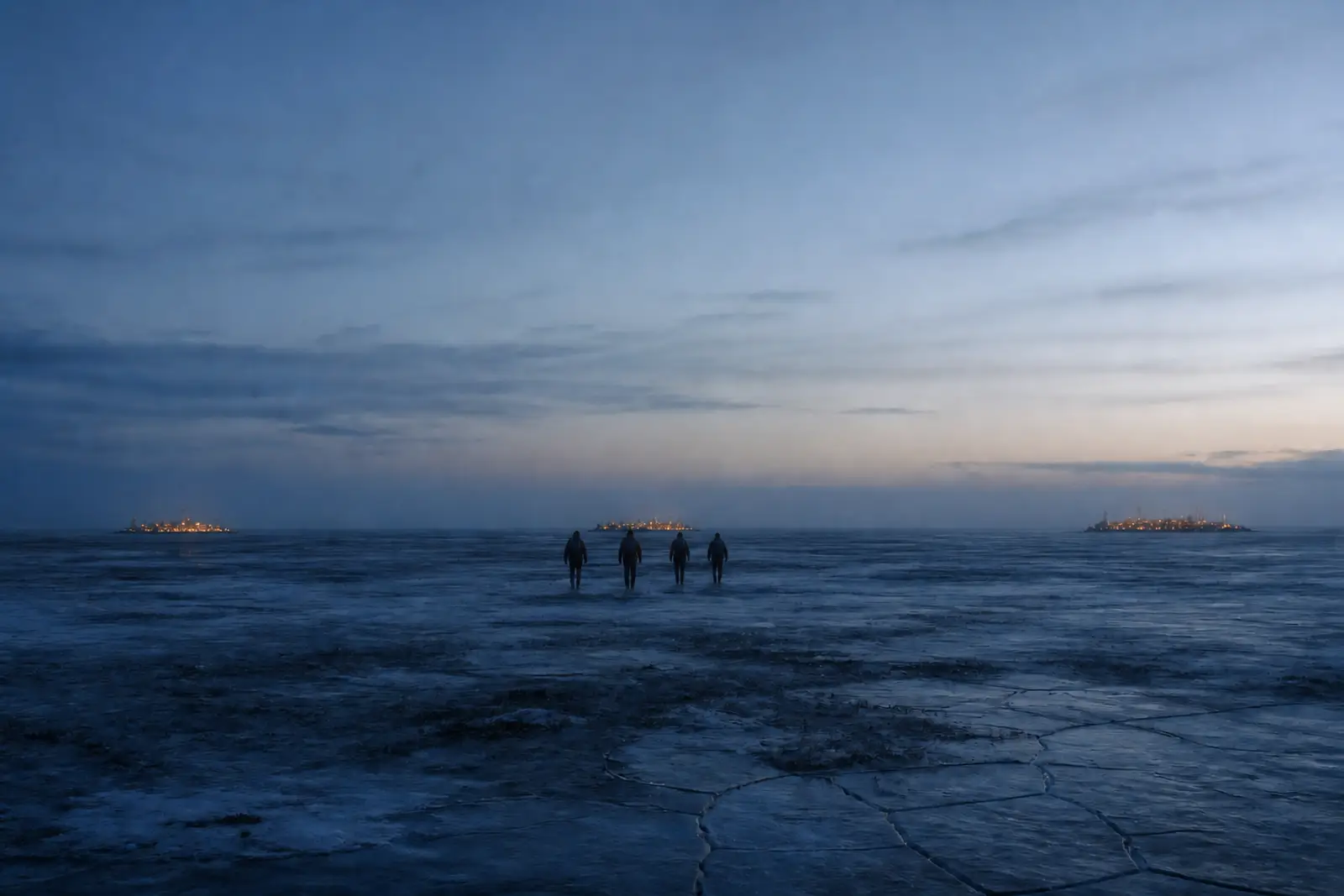
The Russian north is becoming easier to survive and harder to settle at exactly the same time.
By mid-century, climate models expect fewer days of severe cold stress across much of northern and eastern Russia. The old thermal boundary is moving. Yet the population behind that boundary is shrinking, ageing and drifting westward. Beneath its feet, permafrost is weakening roads, foundations and pipelines. Warmer weather will not summon millions of Russian homesteaders into the tundra. It will make a few existing cities more tolerable while making the infrastructure connecting them more expensive.
The people who decide which of those cities endure will increasingly come from somewhere warmer: Uzbekistan, Tajikistan and Kyrgyzstan. Their populations are young and growing. Russia's is old and contracting. Migration that once looked temporary is already becoming family settlement, and field research from Kamchatka shows that high wages and legal access can pull Central Asian workers to the edge of the Pacific.
ParallaxSee forecasts that by 2060, migration from Muslim-majority Central Asia will be indispensable to the survival of selected cities across Russia's north and east. It will not repopulate the tundra. It will produce an archipelago: defended urban and industrial hubs with durable Central Asian communities, separated by a widening expanse of abandoned settlements and autonomous infrastructure. House confidence: 81%.
The climate will open the door. Demography will decide who walks through it.
01 — The air will become kinder. The ground will not.
A warmer Arctic is often illustrated as a new green frontier. That image confuses temperature with habitability.
Researchers at the Russian Academy of Sciences modelled thermal comfort across Russia for 2040–2059 using three CMIP6 climate models and the Universal Thermal Climate Index, which combines air temperature, wind, humidity and radiation into the stress experienced by a human body. Their result is unambiguous: most of Russia gains more days without heat or cold stress, with some of the largest improvements in the north and east. Winter cold stress nevertheless continues across almost the entire country. Russian Academy of Sciences thermal-climate forecast
A person may therefore find a July afternoon in Yakutia less punishing in 2060. That does not mean the apartment block, airport or gas pipeline beneath that person has become easier to maintain. Permafrost is not useful because it is cold. It is useful because it is solid. Warming turns a dependable foundation into moving soil.
A Russian research team estimated that permafrost degradation could inflict ₽5 trillion to ₽7 trillion in damage on buildings and engineering structures by the middle of this century, including about ₽700 billion in residential damage. Mid-century Russian permafrost damage assessment A broader Nature Communications assessment found that by 2050 nearly 70% of present infrastructure in the permafrost domain could sit in areas at high risk of near-surface thaw; 45% of Russian Arctic oil and gas fields were placed in the high-hazard category. Degrading permafrost puts Arctic infrastructure at risk
This is the paradox that will shape settlement. The climate above ground invites more human activity. The ground sends a larger invoice for every permanent building.
02 — Russia will run short of Russians before it runs out of cold.
The demographic map is moving faster than the settlement map.
The UN's central projection places Russia's population at about 132.9 million in 2060, with more than a quarter of the country aged 65 or older. UN World Population Prospects data for Russia That is not merely a smaller country. It is a country with fewer construction workers, nurses, drivers, mechanics and taxpayers available to maintain its most expensive territory.
The north is already showing what comes next. An analysis of Russia's 2010 and 2021 census rounds found that the population of the Far North fell to 92.7% of its earlier level, while the Arctic zone fell to 86.8%. Large cities resisted the decline better than small and peripheral settlements. The researchers described a concentration of population and a compression of developed, inhabited space. Population dynamics of the Far North and Arctic
Climate does not automatically reverse that direction. A Russian climate-and-population assessment expects natural conditions to improve most in the sparsely populated north and east by 2050, yet it also expects Russia's long western drift and concentration into major cities to continue. Climate Change and the Population of Russia
People do not migrate to an isotherm. They migrate to wages, housing, schools, hospitals and other people. By 2060, Russia's warmer land and Russia's inhabited land will be two different maps.
03 — The north will survive as an archipelago.
A continental frontier suggests a broad wave of settlement. Russia will get something narrower: a chain of islands.
The surviving islands will be regional capitals, ports, military-logistics centres, mining cities and energy hubs whose output is valuable enough to justify redesigned foundations, protected roads and subsidised air links. Between them, small settlements will lose residents, public services and eventually their economic reason to exist. Remote monitoring, autonomous maintenance and seasonal work camps will replace part of the permanent population.
This pattern is already visible. The census research finds large northern cities proving more resilient than the periphery. The permafrost bill will intensify the selection. A government or company can defend a crucial port, mine or processing centre. It cannot economically rebuild every declining town across eleven time zones.
Warming will reinforce this urban concentration rather than reverse it. Longer workable seasons and less murderous cold will improve the daily economics of construction, logistics and outdoor labour in selected hubs. At the same time, thaw damage will demand dense investment. The cheapest way to deliver heat, healthcare and repaired foundations to the north is to concentrate people.
The warmer north will therefore contain more activity without containing many more permanent residents. It may extract, measure and ship more while inhabiting less.
04 — Central Asia contains the workers Russia is losing.
The demographic complement is startling.
The five Central Asian republics are projected to grow from about 83.6 million people in 2025 to 113.6 million in 2050. Uzbekistan, Tajikistan and Kyrgyzstan alone account for more than 22 million of that increase. Generation 2050 in Central Asia These are the three countries already most deeply connected to Russia's labour market through language, transport routes, family networks and the legal advantages Kyrgyz citizens receive inside the Eurasian Economic Union.
Russia's need is equally plain. A Higher School of Economics replacement-migration model finds that even from the 2040s, a medium demographic scenario would require roughly 450,000 to 500,000 net migrants every year to compensate for natural decrease. The authors regard that range as achievable, but the upper demands generated by worse fertility and mortality assumptions as practically impossible. Long-term forecast of replacement migration in Russia
Migration cannot make Russia young forever; migrants also age. It can do something more immediate and more important to the north: supply working-age adults during the decades when infrastructure has to be rebuilt and resource cities have to choose between expansion and closure.
Russia will compete for these people. Central Asian governments are already developing routes towards South Korea, the Gulf, Turkey and Europe, while a weak rouble and hostile enforcement reduce Russia's attraction. New directions of Central Asian labour migration But distance, language and existing networks remain powerful. Northern employers will answer the competition in the oldest frontier currency: wages, housing and legal status.
05 — Kamchatka has already run the experiment.
Petropavlovsk-Kamchatsky is almost the perfect test of this forecast. It is remote, expensive, climatically severe and separated from Russia's main population belt. If Central Asian migration were confined to Moscow taxis and construction sites, Kamchatka should be close to the end of the route.
Field research by the Higher School of Economics found the opposite. Migrants from Uzbekistan and Kyrgyzstan were increasingly selecting Kamchatka because of higher wages, relatively manageable housing and food costs, and easier legalisation. They worked in trade, construction, utilities and transport. Most importantly, researchers found that Kamchatka was becoming a final destination rather than a temporary step towards somewhere else. Central Asian migrants in Kamchatka
The mechanism is simple. Harsh weather discourages workers, which raises the wage needed to attract them. A resource economy creates jobs that cannot be moved to Moscow. Once a migrant network reaches sufficient size, it lowers the next newcomer's risk: somebody knows an employer, a landlord, a school and the paperwork.
Research across Siberia and the Russian Far East reaches the same broad conclusion. Climate matters, but jobs, income, housing and infrastructure usually matter more. Settlement factors for Central Asian migrants in Siberia and the Far East
By 2060, the successful northern city will not wait for migrants to appear. It will recruit families deliberately, provide a path to residence and make itself cheaper to enter than the labour markets competing with it. Kamchatka is not an exception. It is an early draft.
06 — The decisive migration will arrive with families.
A rotating workforce can operate a construction site. It cannot sustain a city. Cities require pupils, shopkeepers, carers, bus passengers and adults who expect to remain long enough to repair a kitchen.
Russian migration policy has long imagined the Central Asian worker as temporary: one job, one dormitory bed, one remittance and a journey home. The social evidence is moving in the other direction. A 2025 study based on 98 expert interviews found temporary male labour migration evolving into long-term residence, family accompaniment, citizenship and new family formation in Russia. Children became one of the strongest routes into durable local life. Central Asian migrant families in Russia
This is where the forecast becomes visibly Muslim. Islam is not new to Russia; Tatars, Bashkirs and many peoples of the North Caucasus have shaped the country for centuries. Central Asian settlement will add a different layer of institutions and everyday commerce. Ethnographic work in Chelyabinsk, Magnitogorsk and Troitsk already records migrants helping to create prayer rooms, mosques, halal cafés, clothing shops and new organisational networks. Central Asian migration and the Islamic space of Ural cities
These are not decorative signs of diversity. They are settlement infrastructure. A worker who can eat, worship, marry, raise children and find familiar social help is more likely to become a resident. A city that accepts those institutions gains a self-reinforcing labour network. A city that blocks them must continuously pay a premium to import temporary workers.
The north's future will be decided as much by whether it can build an ordinary family life as by whether it can build on thawing soil.
07 — This migration will slow decline. It will not refill Russia.
Central Asian migration is large enough to keep strategically valuable cities working. It is not large enough to populate an empty continent.
First, Moscow and the western metropolitan belt remain the strongest magnets. A mobile-phone-data study estimated roughly 1.8 million foreign migrants in the Moscow agglomeration in 2021–2022, with nearly two-thirds coming from Tajikistan, Uzbekistan and Kyrgyzstan. Migrants settled near work and affordable housing—the same economic logic that will govern the north, but backed by a far larger labour market. Foreign migrants in the Moscow agglomeration
Second, migration does not create a permanent fertility rescue. A Russian demographic study found births to foreign citizens accounted for only about 2% of births between 2011 and 2023, while the fertility behaviour of migrant populations tends to converge towards that of the host country. Central Asian migration and Russia's birth rate
Third, climate pressure in Central Asia will not simply push everybody north. Research from the Russian Academy of Sciences finds land degradation can contribute to migration when it destroys livelihoods, but present movement remains driven more strongly by demographic, economic and political forces. Land degradation and migration from Central Asia Migrants will choose among destinations. Russia must remain worth choosing.
The result is not a demographic conquest of the tundra. It is selective reinforcement. Central Asian workers and families will become disproportionately important precisely because the total northern population remains small. Ten thousand permanent residents can transform a declining city of 100,000. They disappear statistically inside Moscow.
08 — The frontier will be built inward.
Russia has spent centuries imagining the east as space awaiting settlers. The twenty-first century will reverse the direction of construction. The essential work will be to pull scattered systems inward: fewer settlements, stronger hubs, shorter utility networks and more valuable links between them.
In those hubs, adaptation will become a labour-intensive industry. Buildings will need adjustable or refrigerated foundations. Roads and pipelines will need continuous sensing. Fire seasons will demand larger emergency forces. Mines, ports and energy systems will need operators even as the towns around them contract. Autonomous equipment will reduce the number of humans required in the field, but it will increase the premium on technicians capable of keeping the equipment alive.
Central Asian migration fits this urban frontier better than the old image of agricultural colonisation. New residents will not arrive to claim empty plots of thawing tundra. They will arrive for salaries in construction, transport, utilities, services and resource processing. Their children will encounter Russian schools and cities, not pioneer villages.
Some hubs will become more Central Asian in language, food, family life and religious provision. Others will reject that change and pay for their refusal through chronic vacancies, higher wages, rotating work camps and deteriorating services. Climate warming will not erase politics. It will make the price of bad politics easier to count.
09 — By 2060, the map will look fuller from space and emptier on the ground.
Satellites will see longer shipping seasons, wider fire scars, new mines, brighter logistics corridors and a necklace of defended cities. A traveller between those lights will see closed settlements, automated installations and long distances with fewer permanent neighbours than Russia's north has today.
This is not a contradiction. It is the economic shape of a warming, shrinking country.
Russia will have enough money and strategic need to preserve selected northern nodes. It will not have enough people or capital to preserve the inherited settlement grid. Central Asia will supply part of the missing workforce, and family settlement will turn that labour flow into durable communities. The process will be visible first in ordinary details: a school adding language support, a utility hiring through a Kyrgyz network, a halal café becoming a permanent institution, a regional government quietly making residence easier because the buses need drivers.
The cities that understand this will survive. The cities that demand labour while refusing labourers a home will continue to shrink.
By 2060, climate change will have made Russia's north less cold. It will not have made it Russianly populous. The new north will be an archipelago held together by capital, machines and Central Asian families—or it will be empty.