
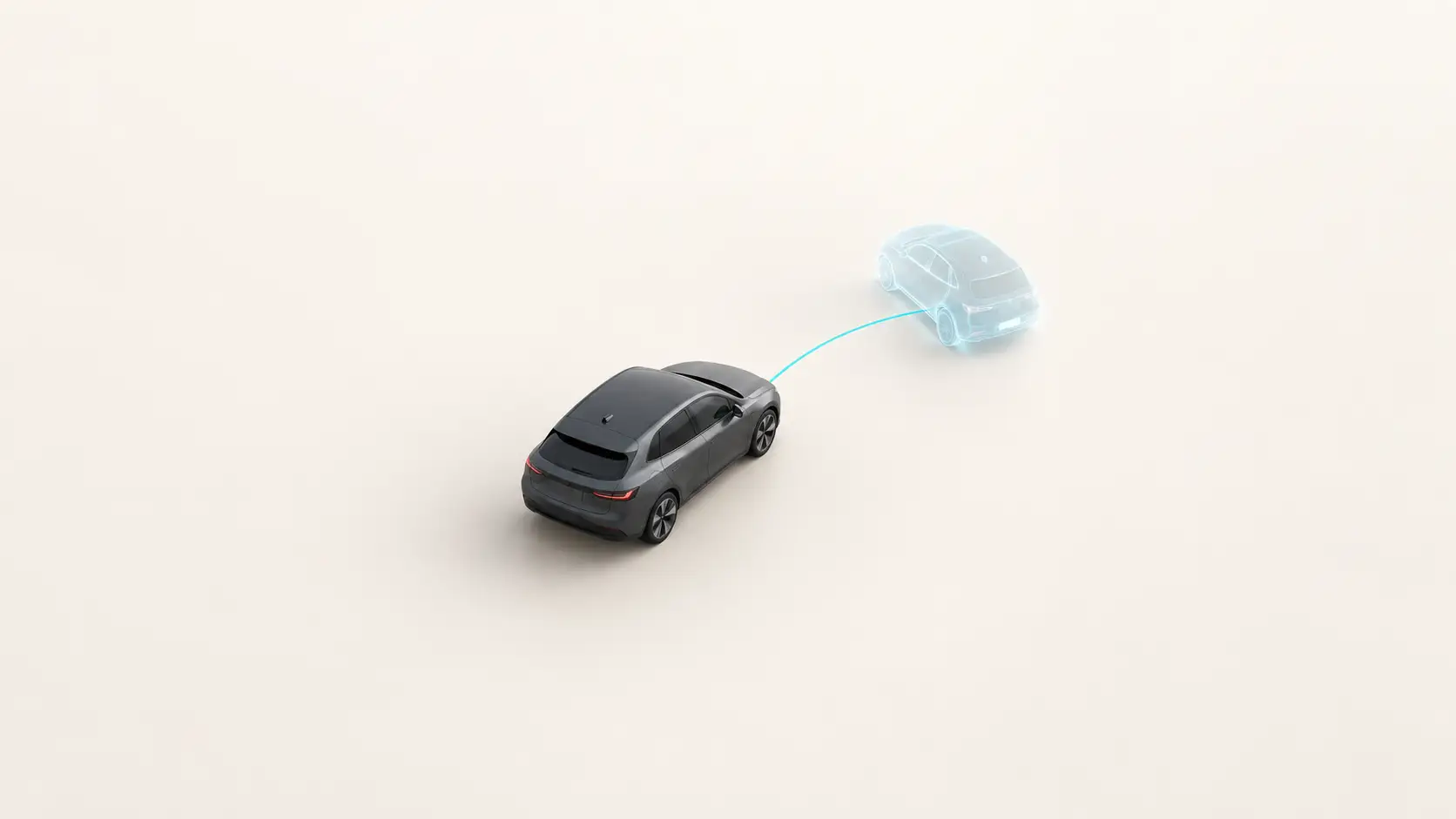
The van ahead slows beside an empty parking space. A cyclist approaches from behind. Your car eases off, leaving room for either to cross its path.
Inside its computer, possible versions of the next few seconds have already influenced the decision.
That is the experience we expect to spread by 2029. The car will build a working prediction of its surroundings, connect that prediction to its own movement and revise its plan as fresh information arrives. Anticipation will become a feature people can buy.
ParallaxSee assigns a 70% probability to a concrete threshold: at the end of 2029, at least ten passenger-car model families from at least five independent Chinese automotive groups will offer qualifying onboard predictive world models in mainland China, with an equipped configuration priced at RMB 300,000 or less, including the battery and required hardware and activation.
The wider consequences reach beyond driving assistance. The same research movement is changing vehicle shapes, energy control, battery diagnostics and the relationship between a car and its owner.
The road becomes a prediction problem
A camera records light. Radar measures distance and relative motion. A driving system must turn those observations into a useful account of what is happening and what could happen next.
The difficult part is interaction. Your decision to accelerate changes the gap another driver sees. Your decision to yield may encourage a pedestrian to cross. A useful prediction therefore connects the changing scene with the car's prospective actions.
Chinese researchers call the learned representation behind this process a world model: 世界模型. In a Chinese-language review, Beihang University's Yin Hongbo and Tian Daxin describe its ability to carry out “内在建模、推演与预测”—translated, “internal modelling, simulation and prediction.” Their review connects this capability with future-scene generation, driving-policy learning and testing. Beihang researchers' review
The engineering ambition is appealingly simple: give the car a way to examine the consequences of moving before it commits to the movement.
Four seconds can change the next decision
Uni-World VLA, a 2026 preprint from Fudan University and collaborators, offers a concrete example. Its model takes two seconds of observations and predicts eight future images, together with driving trajectories, over a four-second horizon. Future frames and actions are generated in an alternating sequence, keeping planning connected to the imagined scene.
The reported NAVSIM planning score rose from 88.2 for a pretrained version without future-frame generation to 89.2 with it, and 89.4 with additional depth information. That isolates a contribution from forecasting within a larger system. NAVSIM is a driving benchmark; its scores measure performance under its evaluation conditions. Uni-World VLA
Another 2026 paper, VLA-World, starts with a feasible trajectory, generates an imagined next image and uses reasoning about that image to refine the trajectory. Its training combines pretraining, supervised examples and reinforcement learning. The model learns to connect a proposed movement with its expected consequences. VLA-World
For passengers, we expect the benefit to feel ordinary: a smoother approach to a crowded junction, earlier preparation for a narrowing gap, fewer abrupt corrections when a situation develops as anticipated. Those are the experiences the forecast points towards, rather than measured outcomes of these two experiments.
The car's intelligence will have several speeds
A driving computer has to explain an unfamiliar situation and respond quickly to a familiar danger. These tasks need different amounts of computation.
Tsinghua University and Li Auto's DriveVLM research addressed that problem with a paired architecture. A vision-language model interprets the scene while a faster driving system maintains timely planning. The tested model used Qwen-VL as its foundation. On the experiment's NVIDIA Orin platform, the large model took approximately 1.5 seconds per scene; the dual system's fast branch took approximately 0.3 seconds. DriveVLM
This division gives engineers a practical route to bringing richer reasoning into a moving vehicle. The immediate driving process can continue while a more demanding interpretation is prepared.
Generative AI also takes several forms inside automotive research. Language models help interpret instructions and situations. Models trained on visual sequences predict changing scenes. Specialized control policies translate vehicle state into action. Each component has a job, an operating speed and a boundary.
By 2029, the quality of their coordination will matter as much as the size of any individual model.
Chinese cars are already entering this transition
The first commercial signals are visible now.
In its September 2026 Chinese announcement, XPeng described X-Foresight as an onboard predictive world model capable of anticipating possible traffic behaviour six seconds ahead. The announcement linked it to the new XOS 6.3.0 version and described the use of longer observation history. These are the manufacturer's product claims, which establish its proposed direction rather than an independently measured safety gain. XPeng's Chinese announcement
NIO's April 2026 product announcement placed its NIO WorldModel alongside the company's computing chip and operating system in the ONVO L90. Huawei's Chinese technical announcement described a combination of cloud world-model training and an onboard world-behaviour model for driving decisions. Both illustrate routes towards consumer deployment. Their terminology and publicity require product-level examination before a particular configuration can count towards our forecast. NIO's product announcement, Huawei's Chinese technical announcement
The next three years give these approaches time to spread across product families, hardware platforms and prices. Our prediction concerns that expansion into a broader choice of purchasable cars.
China already has considerable infrastructure for distributing driving software. Its industry ministry reported that more than 70% of new passenger cars sold in the first half of 2026 had L2 driver-assistance functions. That figure describes supervised assistance; it provides a measure of the market into which more capable models can arrive. MIIT's September 2026 briefing
AI will shape the car before anyone drives it
The transformation begins on the engineer's workstation.
Air flowing around a vehicle creates drag, and accurately calculating that flow can consume substantial computing time. Researchers at Northwestern Polytechnical University combined inexpensive approximate calculations with smaller amounts of detailed simulation, allowing a neural network to help guide the search for a better shape.
In their selected MIRA fastback test case, the drag coefficient fell from 0.274 to 0.2486, a 9.27% reduction. Their optimization converged 5.85 times faster than the compared offline framework and 2.81 times faster than its online counterpart. The measurements concern this research geometry and design process. Chinese aerodynamic design paper
The wider opportunity is to make more design alternatives affordable to examine. Engineers can explore shapes, test promising candidates in greater detail and refine the result around space, performance and manufacturing requirements.
Our expectation is that AI will increasingly influence the surface of the car as well as its software. A more efficient design process can help manufacturers search for improvements within the dimensions and price their customers need.
Fleet experience becomes an engineering resource
A vehicle fleet produces experience on a scale that one engineer or one test car can never accumulate. Turning that experience into dependable improvements is a major research opportunity.
Beijing Institute of Technology researchers developed an energy-management method based on offline reinforcement learning: a system learns useful decisions from stored operating data. Their Nature Communications study used more than 60 million kilometres of driving data with an augmented platform incorporating a simulated fuel-cell powertrain.
Reported performance improved from 88% to 98.6% of the theoretical optimum after updates. That describes proximity to an optimization target within the study, rather than a universal percentage increase in electric-car range. Original study, Chinese university account
The useful ownership model is a repeating cycle. Vehicles contribute operating records. Engineers train improved policies, test them and deploy validated updates to compatible cars. The vehicle benefits from experience gathered elsewhere.
This gives manufacturers an incentive to maintain the computing hardware and software support through which improvements reach customers. We expect buyers to pay more attention to that support when choosing a car they intend to keep for years.
Every battery has its own history
Two batteries installed in the same model can experience different temperatures, charging patterns and workloads. Their condition gradually diverges.
A Chinese Academy of Sciences team working with Xi'an Jiaotong University developed a two-stage approach to estimating battery health from fast-charging segments. Distributed batteries first help train a shared model through model parameters. The system then adapts that model using a small amount of data from a particular battery.
The Chinese institutional account describes “捕获个体电池特征的个性化模型”—translated, “a personalized model capturing individual battery characteristics.” The underlying work was published in IEEE Transactions on Transportation Electrification. Chinese research account
This points towards a more informative relationship between driver and battery. Owners could receive estimates tailored to their actual equipment and use, helping them decide when to investigate a problem or change a charging routine.
There is also a potential economic consequence. A used electric car's value depends partly on the remaining usefulness of its battery. Better condition estimates could support better-informed sales and warranty decisions. Establishing trusted measurements and liability will determine how much of that possibility reaches the market.
The cabin will help organize a journey
The passenger's contribution begins with intent: find a convenient stopping place, make the cabin comfortable or adjust the trip around a changed plan.
A Chinese engineering paper by Geely researchers describes an intelligent-cabin architecture based on language models and agents, with “自主性、适应性、个性化”—“autonomy, adaptability and personalization”—as central aims. It sketches a cloud implementation around cabin use cases. This is company-authored engineering research. Geely researchers' paper
We expect these interfaces to become more useful as they connect requests to navigation, available services and permitted vehicle functions. “Find somewhere suitable to stop” becomes a task requiring several pieces of information and a feasible plan.
That makes integration valuable. An assistant needs to know what the driving system can safely do, which services are available and what the passenger actually wants. The quality of the car's intelligence will show in how well it completes an ordinary request.
A convincing imagined road must obey the real one
The strongest technical objection concerns the relationship between prediction and reality. A generated future can look plausible while getting a vehicle's movement, a road boundary or an interaction wrong. Errors can accumulate as predictions extend further ahead.
The Beihang review identifies physical consistency, reliable reasoning, long-horizon stability and efficient deployment as continuing challenges. These are the problems that determine whether useful research becomes dependable driving behaviour. World-model review
We expect successful systems to combine learned prediction with constraints, uncertainty estimates and rapid observation of what actually happens. Forecasts need continual correction from the road.
Commercial economics can also slow diffusion. More computing hardware adds cost, power consumption and cooling requirements. A model that works in a laboratory may need substantial redesign for a vehicle. Features can remain confined to expensive configurations or arrive through subscriptions that make their effective price higher than a showroom headline suggests.
China's new automated-driving safety standard supplies part of the deployment framework. GB 44721–2026 is scheduled to take effect on 1 July 2027, covering L3 and L4 systems, safety assurance, testing and interaction with users. L3 systems must monitor the driver's ability to take over. Official Chinese standard announcement
A car's predictive intelligence and its legal driving responsibilities will therefore advance together. Early consumer benefits can appear within supervised assistance and defined operating conditions.
What we will check in 2029
At 31 December 2029, our test is ten distinct passenger-car model families from five independent Chinese automotive groups, actively sold and delivered to retail customers in mainland China. Each must have a qualifying configuration costing no more than RMB 300,000, including its battery, necessary hardware and up-front activation, without a mandatory recurring battery or software subscription.
The deployed onboard model must learn how a scene evolves under the car's prospective movement and use those predictions in driving planning. Technical documents, operating manuals, delivery records and public prices must establish the case. Trims and annual refreshes count as one family; brands under common control count as one group. Cloud-only training models and demonstrations do not qualify.
Our 70% estimate combines a 95% judgment that usable onboard predictive models continue to reach consumer cars, an 85% conditional judgment that deployment spans ten families and five groups, and an 85% further conditional judgment that the exact price, availability and documentation conditions are met. The result is approximately 69%, rounded to 70%. These are editorial judgments supported by the research and deployment signals, without a matched historical dataset establishing their frequency.
By 2029, anticipation will become a more visible part of owning a car. Engineers will use AI to explore its shape. Fleet experience will inform its control software. Individual data will help explain the condition of its battery. Its driving computer will repeatedly examine what could happen next.
The most impressive feature may be a manoeuvre the passenger barely notices: a little space left early, a speed adjustment made gently, a decision prepared while there was still time.