
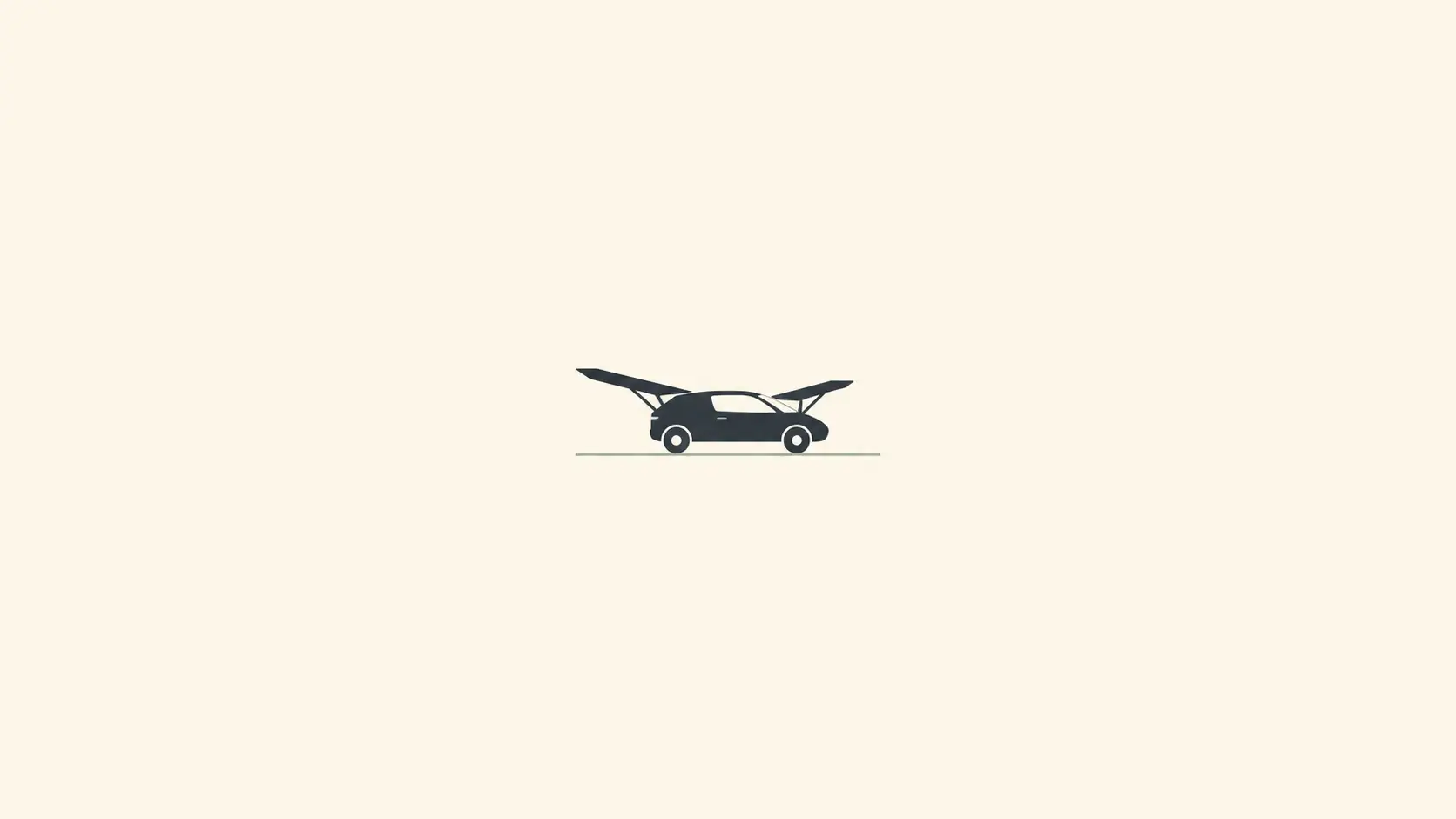
The next generation of flying cars may arrive as a vehicle carrying a small aircraft, or a car that unfolds into a gyroplane. Buyers could drive to a suitable flying site, prepare for takeoff and continue their journey through the air. Chinese patents and recent manufacturing milestones suggest that this market is approaching, although everyday flight above city traffic remains a much more distant prospect.
ParallaxSee forecasts that by the end of 2028, at least one newly commercialized, factory-built model for road travel and flight will have the approvals needed for customer operation in at least one country and will have delivered 100 complete vehicles or paired systems to paying customers after October 7, 2026. House probability: 65%, a rounded editorial estimate for this defined outcome. The forecast includes transforming vehicles and purpose-built cars with docked aircraft; it concerns a small initial market.
The first certified flying car is already part of history. In 1950, the Fulton Airphibian received approval from the United States Civil Aviation Administration. Its occupants could fly to an airport, detach the wings, tail and propeller, then drive onward. The design worked, but financial difficulties and the compromises of combining aircraft and car technology prevented commercial success. That experience still matters: demonstrating flight is only one part of creating a useful product. Smithsonian collection record
Today's terminology can obscure that distinction. An electric aircraft that takes off vertically is often called a flying car even when it cannot travel on roads. EHang's EH216-S illustrates the progress of passenger aircraft: in March 2025, the company announced operator approvals allowing ticketed services at designated sites in Guangzhou and Hefei. Such services bring personal flight closer, but do not give a passenger one vehicle for both driving and flying. EHang's SEC-filed announcement
China's ARIDGE, previously known as XPeng AeroHT, offers a different proposition. Its Land Aircraft Carrier pairs a six-wheel ground vehicle with an aircraft whose blades and arms fold for storage. The ground vehicle also recharges the aircraft. The system is designed around taking a compact flying machine along on a road journey, avoiding the need to lift the entire carrier vehicle into the air. ARIDGE product description
Its production timetable makes 2027 an important year to watch. In an April 2026 interview, XPeng president Brian Gu told Reuters that large-scale production was expected in 2027, with early deliveries then targeted for late 2026. Aviation approval was still being pursued at that time. These targets support a possible commercial rollout during 2027–2030, but neither orders nor a factory establish that customers have received approved, usable vehicles. Reuters interview with Brian Gu
The Chinese patent filings reveal some of the practical work behind the product. Guangdong Huitian's application CN119872390A, published on April 25, 2025, describes a telescopic mechanism that draws an aircraft toward a road vehicle. Inclined guide surfaces correct misalignment as the parts come together. This addresses a mundane but consequential problem: owners must be able to load and secure the aircraft without perfectly positioning two separate machines. Chinese transfer-mechanism application
A related approach appears in Huitian's international application WO2025087116A1, published on May 1, 2025. It describes automated docking and separation: the road vehicle approaches the aircraft, draws it into a storage cavity, deploys it and moves away to a safe area. This is a published application originating in China, rather than a granted worldwide patent. Together, these filings show attention to the transition between driving and flying, beyond the aircraft's ability to take off. Automatic docking and separation application
Another challenge is making flight manageable for the operator. Huitian's CN114545970B, granted on May 6, 2025, describes assistance that guides control inputs or helps an operator reach a target speed, heading and altitude. Simpler controls could make training more accessible. The patent, however, does not establish that customers can dispense with training or fly without the permissions their jurisdiction requires. Chinese flight-assistance patent
Other Chinese automakers have explored modular arrangements. Geely's CN107627945B, granted in June 2020, describes separate road and aircraft bodies, a docking platform and a server coordinating a shared transport system. Chery's CN118288713A, published in July 2024, proposes a passenger cabin with an aircraft above and a detachable road chassis below. Google's patent record currently marks the Chery application as withdrawn. These documents establish published design proposals, not completed transport networks or promised launch dates. Geely flying-car system patent, Chery split-vehicle application
The modular approach suggests a plausible early commercial path: specialize the components for their separate jobs and engineer a reliable connection between them. It also introduces a limitation. When the aircraft leaves its carrier behind, the user must plan where the road journey will resume. A vehicle that transforms as one machine could offer a more continuous journey, but must carry its road equipment through the flight.
Futuristic patents outside China explore that compromise. Toyota's US9216814B2, granted in December 2015, describes wings that stack above a vehicle for road travel and deploy for flight, with a wing surface changing shape between configurations. Alef's US11485489B2, granted in November 2022, describes changing wing orientation between vertical and forward flight, with a rotating seat accommodating the transition. They show inventive ways to fit flight capability into a vehicle; patent grants do not establish aircraft safety or commercial readiness. Toyota stackable-wing patent, Alef vertical-flight patent
Alef's manufacturing announcement illustrates why launch milestones require careful interpretation. In December 2025, the company said it had begun producing its Model A Ultralight. The release specified hand-built vehicles for a few early customers to test under controlled conditions, with training and maintenance support. That can provide useful development experience without yet establishing a general consumer market. Alef manufacturing announcement
Europe supplies another possible route. PAL-V's Liberty transforms between a road vehicle and a gyroplane. In September 2026, PAL-V announced European production organisation approval, following earlier certification milestones. The announcement described progress toward completing certification. Approval of a manufacturing organisation is significant, but must be distinguished from completing the product's path into customer operation. PAL-V Liberty, PAL-V production approval announcement
The strongest case against the 2028 forecast is that certification and reliable production could take longer than manufacturers expect. A successful prototype may need substantial changes before it can be built consistently and maintained by customers. The 65% estimate reflects judgment across those requirements: at least one model obtaining the necessary approvals, producing enough complete units and converting interest into paid deliveries. The historical failures and the difference between controlled testing and customer use leave considerable room for delay.
Even a successful launch would establish little about mass ownership. Flying sites, training, maintenance and operating restrictions would still shape how buyers use the vehicles. Recreational trips and journeys between suitable sites appear more plausible early uses than routine departures from crowded streets. The 2027–2030 rollout window is a forecast for limited commercial availability; the evidence does not support a reliable date for flying cars to become ordinary household transport.
The forecast will be assessed at 23:59:59 UTC on December 31, 2028. A qualifying model must first enter general customer availability after October 7, 2026, hold the required road and aviation approvals in at least one country, and have at least 100 complete units delivered to paying customers by the deadline. Purpose-built paired systems count as one unit each. Reservations, dealer inventory, unfinished kits, demonstrations and vehicles restricted to manufacturer-controlled development testing do not count. Official approval records and documented customer handovers will establish the outcome. The meaningful arrival of this generation will be measured by what owners can actually use.