
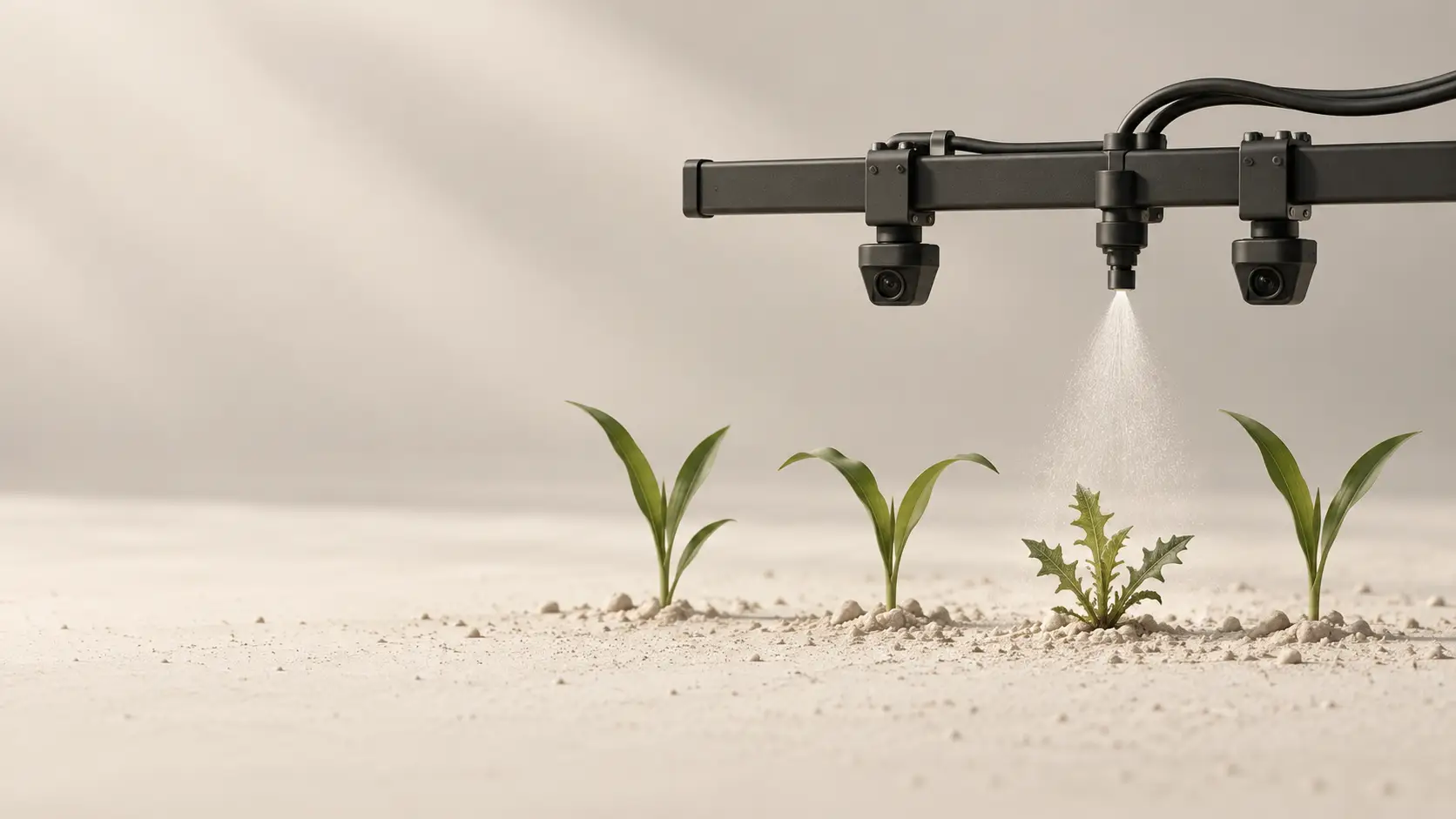
Imagine a soybean field in 2035.
The sprayer moves between the rows. Its cameras distinguish weeds from crop leaves, and individual nozzles open as targets pass beneath them. The farmer watches the machine's record of what it treated and what it missed.
The purchase will be judged at harvest. Did the field stay clean? Did the equipment hold up? Did the savings cover its cost? This is an imagined scene, built around equipment capabilities that already exist.
ParallaxSee forecasts that in the 2035 crop year, at least 25% of the combined corn and soybean planted acreage in the contiguous United States will receive at least one post-emergence herbicide application using real-time AI weed recognition and automatic spot spraying. That is our measurable definition of mainstream adoption in this article.
House confidence: 60%. The percentage is our editorial estimate of the chance that the acreage threshold is reached. The 25% threshold is an adoption target, not an estimate of today's use. This forecast concerns a specific farming practice; our broader judgement is that precision automation is agriculture's strongest near-term technology contender.
A machine that can identify a plant can make a different decision about what happens to it. That changes the scale at which a farmer can work. A field remains a field, but treatment can follow the distribution of weeds within it.
The basic sequence is straightforward. Cameras capture the ground as the sprayer moves. A trained model distinguishes likely weeds from crops, and the control system activates selected nozzles. The driver may still sit in the cab. Precise chemical application can spread without waiting for complete vehicle autonomy.
There is already evidence from working fields. A 2025 sugarcane study reported results across 25 hectares: robotic spot spraying reduced herbicide use by an average of 35% and achieved 97% of the weed-control effectiveness of broadcast spraying. The researchers also measured lower herbicide concentrations and loads in irrigation runoff. These results concern the tested sugarcane conditions; they establish technical promise, rather than a universal savings rate. Sugarcane field study
The economics begin with the spray bill. Where weeds occupy only part of a field, treating the places they grow can reduce unnecessary applications. The farmer must compare that saving with the price of equipment, servicing, software, fuel, training and any additional field passes. A reduction in chemical volume alone does not establish a profit.
The technology also has a familiar foundation. USDA reported that automated steering was used by 70% of large-scale crop-producing farms in 2023, and by 52% of midsize farms. Adoption rose from single-digit levels in the early 2000s. Those figures measure farms using steering, not acreage receiving AI spot spraying. They show that farmers can adopt useful precision tools on a large scale. USDA precision-agriculture adoption data
That history informs our forecast, but it cannot supply a directly comparable base rate. Steering solves a different problem and developed over a longer period. Our 60% estimate therefore uses an explicit judgement about the remaining technical, economic and deployment requirements, rather than presenting an analogy as a measured probability.
Our expectation is that larger farms and commercial applicators will lead adoption. A machine serving many acres has more opportunities to recover its fixed cost. Contractors could spread those costs across customers, allowing some growers to buy a spraying service without buying the equipment. That is a plausible adoption route, rather than a guarantee that the service will be available everywhere.
USDA's adoption data also show a pronounced size divide: smaller farms use precision technologies less often. A tool can become common across crop acreage while remaining out of reach for many individual growers. Reaching our threshold would consequently say little about whether access had become equal. USDA findings on farm size
The strongest objection is already visible in the research. An Arkansas soybean trial reported 43-59% reductions in herbicide use, but lowering detection sensitivity allowed weeds to escape. At the low setting, Palmer amaranth populations increased by 280% each year in the trial. Short-term chemical savings can therefore create a larger future weed problem. Arkansas three-year field research
Settings and the spray programme matter together. The Arkansas researchers favoured high sensitivity in most circumstances and recommended broadcasting residual herbicides while targeting post-emergence treatments. Our forecast allows that combination. It concerns targeted applications within a crop-protection programme, rather than the disappearance of blanket spraying. Arkansas guidance on sensitivity and residual herbicides
Reliability will decide whether early buyers return. Equipment has to cope with changing light, dusty cameras, crop canopies and weed populations. It must operate quickly enough to meet treatment windows, and someone must be able to repair it when it fails. A convincing demonstration can attract an order; several successful seasons can justify replacement purchases and expansion.
Spraying is the clearest near-term example of a larger shift. USDA-supported research includes robotic weeding, improved fruit detection, harvest assistance, and sensors for moisture and nutrient management. These applications have different levels of maturity. A successful weed detector does not establish that a robot can reliably pick delicate fruit. USDA's 2026 specialty-crop automation overview
We expect the first large gains to come from specific tasks with measurable results. A farmer can compare treated acres, chemical spending, weed escapes, crop injury and yield. That makes adoption a practical business decision grounded in records from the field.
Advanced crop breeding is the strongest competing candidate for a larger agricultural breakthrough. A useful trait can travel inside a seed, without requiring the grower to purchase a new machine. Over a longer horizon, genetic improvements could reach farms that remain poorly served by expensive equipment.
A 2026 Nature study identified a maize gene variant that improved yield stability under drought without reducing yield under normal conditions. It is a promising breeding target. The result does not establish a widely distributed, commercially proven variety, and it should not be described as a demonstration of AI-designed crops. Maize drought-resilience research
Engineered nitrogen-fixing microbes offer another possible route to lower input requirements. Yet performance can vary. University of Wisconsin trials at five locations in 2023 found that one commercial product did not significantly alter corn grain yield or its response to nitrogen fertilizer. Those findings apply to the tested product and environments, and do not settle the prospects for every microbial approach. Wisconsin nitrogen-fixer trials
Our preference for precision automation over the next decade rests on its combination of operating equipment, inspectable field results and immediate uses. Breeding could eventually have a greater effect on food security. The comparison is a judgement about timing and adoption, rather than a claim that a single technology can address every agricultural problem.
The environmental outcome will depend on how machines are used. Targeted spraying could reduce unnecessary chemical applications. Weak detection or poorly chosen treatment programmes could increase escapes and require additional intervention. Our adoption forecast does not promise a fixed reduction in national pesticide use, higher yields, or lower food prices.
We assign 60% probability to the defined 2035 acreage event. Our conditional estimates are a 90% chance that suitable equipment delivers reliable weed control across enough relevant conditions; given that, a 75% chance that total costs make adoption attractive across enough corn and soybean acreage; and, given both, a 90% chance that manufacturing, servicing and commercial use reach the threshold by 2035. Their product is 60.75%, rounded to 60%. These are subjective editorial estimates, not measured frequencies or independently validated model outputs.
Economics is the most uncertain assumption. Keeping the other estimates fixed, reducing the conditional economic estimate from 75% to 55% lowers the combined result to roughly 45%; raising it to 90% produces roughly 75%. No suitable resolved-forecast cohort currently supplies a defensible calibration adjustment for this specific event. The forecast can fail even if the machines perform well, because replacement cycles and uncertain savings can slow purchases.
The resolution test covers the 2035 crop year in the 48 contiguous U.S. states. The denominator is combined corn and soybean planted acreage, using final USDA NASS estimates available by the reporting cutoff. The numerator is acreage that receives at least one qualifying application during that crop year. A planted acre is counted once for a given crop, however many qualifying passes occur; official crop-acre accounting also governs any double cropping. USDA NASS Quick Stats
A qualifying application uses real-time camera-based AI recognition to identify weeds within a growing corn or soybean crop and automatically control herbicide delivery to selected locations. Human-driven and autonomous machines both qualify, as do owned and contracted equipment. Broadcast-only spraying, guidance alone, map-only variable-rate application, mechanical weeding and research-only demonstrations are excluded. Equipment sales and cumulative sprayed-acre totals cannot establish unique crop acreage.
We will prefer a nationally representative USDA adoption estimate matching this definition. USDA's Agricultural Resource Management Survey already collects field-level production and technology-use information, but we do not assume it will publish this exact measure. If official coverage is insufficient, the fallback is a transparent, nationally representative independent survey or an independently audited national dataset with a compatible denominator and documented deduplication. Manufacturer claims alone are insufficient. USDA survey documentation
The event period ends on 31 December 2035 at 23:59 UTC. Reporting is allowed through 31 December 2038, with revisions accepted until that cutoff. A qualifying national estimate of at least 25% resolves true; a qualifying estimate below 25% resolves false. A replacement measure must preserve the same scope and unit. If credible estimates conflict across the threshold, or compatible national evidence remains unavailable, the forecast will be marked ambiguous rather than treating missing evidence as failure. No final resolution will precede the close of the 2035 crop year.
Return to that imagined field. The important record is the season's result: the weeds controlled, the crops protected, the equipment repaired and the bill paid. Farmers deciding that those results justify another season would turn a clever machine into an ordinary part of farming.