
This original ParallaxSee forecast is written from an Indian perspective, with Khushwant Singh's plain speech, social observation and dry wit as its stylistic reference. It is not attributed to Singh.
We Indians have exported software engineers, yoga teachers, chief executives and relatives who telephone at inconvenient hours to ask why one is still unmarried. What we have not exported is a restaurant chain before which ordinary Americans willingly stand in line.
That will change in 2029.
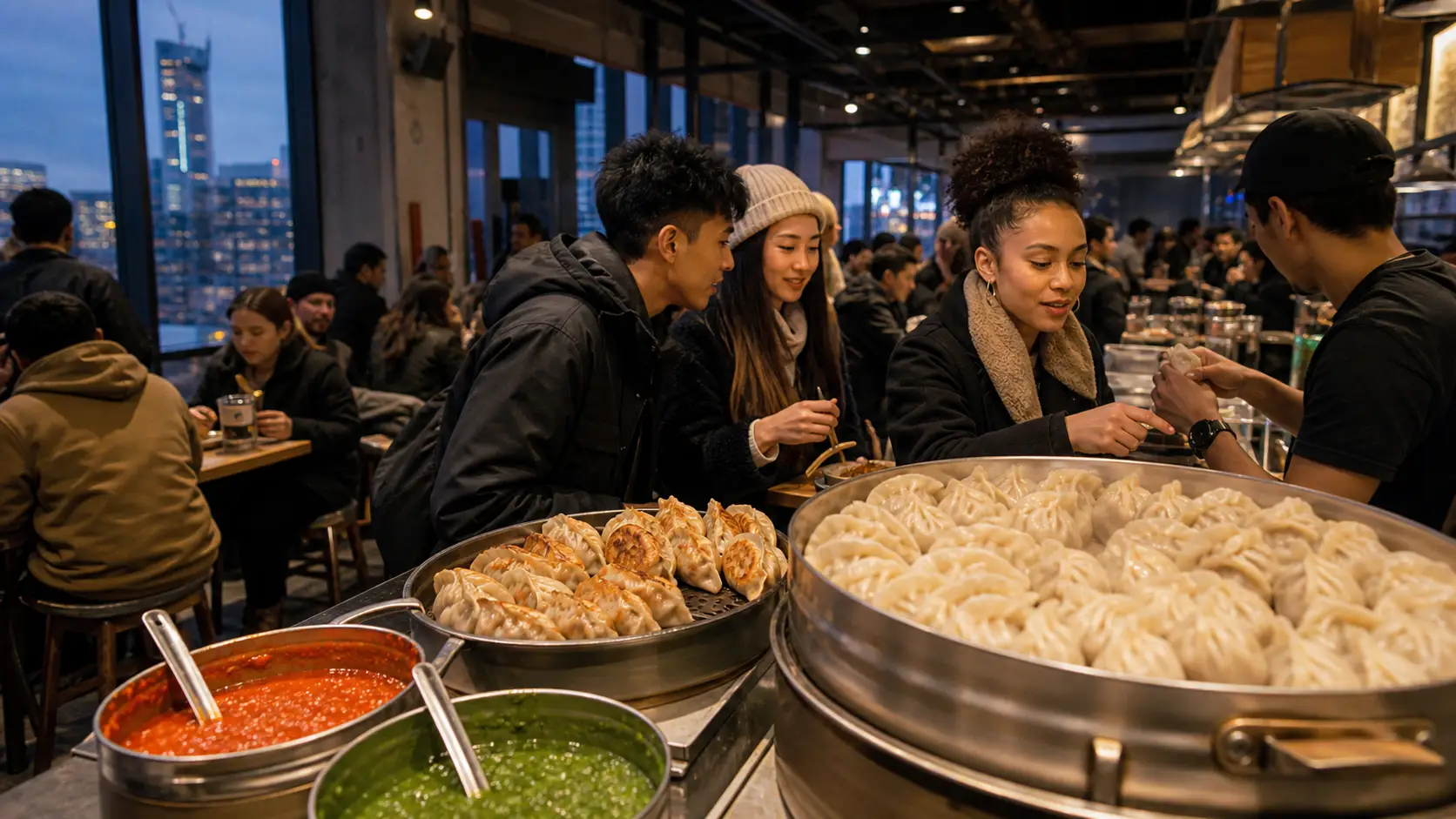
The company to do it will not sell elaborate thalis or lecture Americans on the proper treatment of biryani. It will sell them dumplings. Wow! Momo, born in a tiny Kolkata kiosk, will open an official American flagship and discover that the United States has been waiting for its product without knowing its name.
The likely opening will be in New York, New Jersey or another dense East Coast market. Founder Sagar Daryani has long dreamed of seeing his sign in Times Square. It sounds like entrepreneurial theatre. In this case, it is also sensible geography.
America knows the dumpling. It simply has not yet met the Indian fast-food machine built around it.
From Tollygunge to Times Square
Daryani and Binod Homagai started Wow! Momo in 2008 with ₹30,000 and a 36-square-foot kiosk inside a Spencer's store in Tollygunge. They were young commerce graduates from St Xavier's College, Kolkata. They had no celebrated chef, inherited restaurant empire or rich uncle prepared to lose money on their behalf.
They had a steamer and cheek.
That kiosk has become a network of more than 850 outlets in over 90 Indian cities. During the 2025–26 financial year, the company added 200 stores—roughly one every two days. It expects to add another 150 to 200 and is pursuing annual revenue of ₹1,200 crore.
These are no longer the figures of a promising neighbourhood business. They describe an organisation learning to procure ingredients, train workers and reproduce a recognisable product across a continent-sized country.
Daryani once reduced his ambition to a useful question: “Why can't we come up with our own McDonald's of momos?”
The answer is that it can.
A product that speaks American
A momo requires no cultural instruction manual. It is dough around a filling. Americans already eat Chinese dumplings, Japanese gyoza, Polish pierogi, Italian ravioli and Mexican empanadas. They have rarely encountered a carbohydrate they could not adopt.
The momo's history belongs principally to the Himalayan world. Its precise beginnings remain disputed, but it is widely traced through centuries of exchange between Tibet and Nepal. India did what India often does with food: welcomed it, spiced it, fried it, covered it in sauce and began an argument over who makes the best version.
Wow! Momo turned that street food into a system. It sells steamed, fried, pan-fried and tandoori momos; vegetarian and meat fillings; momo burgers and even chocolate momos. Some inventions are inspired. Others sound like decisions made after an excessively long marketing meeting. The important point is that the underlying product remains simple.
A momo can be cooked in a compact kitchen. It can be sold from a small kiosk or a full restaurant. It travels well in a delivery box, accommodates vegetarian diets and accepts local flavours without losing its identity.
This is exactly how a foreign food becomes American fast food.
America is already preparing the table
Indian cuisine recorded the fastest growth of any cuisine category in the United States during Datassential's latest measurement period, with restaurant units increasing 9.8 per cent. Indian food has moved beyond the suburban buffet and the occasional vindaloo ordered as a test of masculine courage.
The country also contains approximately 5.2 million Indian Americans. They provide an opening audience, but not the final market. Wow! Momo will succeed only when its queue includes office workers, students and families who cannot locate Kolkata on a map and feel no obligation to try.
That audience is already learning the product. In 2025, Deep Indian Kitchen introduced frozen momos in flavours including butter chicken and chicken tikka masala. The company says its products reach more than 21,000 American stores.
Frozen retail is the rehearsal. Restaurants will be the performance.
Why 2029
Wow! Momo's immediate work is still in India. Its domestic network is expanding towards smaller cities, while its supply chain and packaged-food operations grow beside the restaurants. That work will give the company purchasing power, managers and a repeatable kitchen model.
By 2028, the sensible move will be a compact American test: delivery kitchens, university food courts or licensed counters in New York and New Jersey. In 2029, the company will place the full flag in the ground with a prominent official restaurant.
An unrelated restaurant in Irving, Texas, already uses the words “Wow Momo.” It should not be confused with Kolkata's Wow! Momo Foods. As of 2026, the Indian company remains notable among large international chains that have not officially entered the United States. That distinction will disappear in 2029.
The first American menu will be shorter than the Indian one. Steamed chicken and vegetable momos will establish the product. Fried and tandoori versions will supply indulgence. Butter chicken momo will do the diplomatic work. A spicy sauce will inspire online challenges among people who should know better.
The American operation will probably begin with company-controlled stores or a strong local operating partner. It cannot afford the usual foreign-chain stupidity: selling a magnificent origin story while serving an indifferent lunch.
India's export will be the format
Haldiram's, Bikanervala and numerous regional restaurant groups have already carried Indian food abroad. They primarily serve people who arrive knowing what they want. Their menus resemble small telephone directories.
Wow! Momo possesses a different advantage. Successful fast-food brands usually own one uncomplicated noun: burger, pizza, taco, chicken or doughnut. Wow! Momo can own dumpling.
That narrow identity is its strength. An American customer does not need to understand India's regional cuisines before ordering lunch. He must merely decide whether his momos should be steamed or fried. Even an American can manage this.
The chain will encounter high rents, expensive labour and fierce competition. None will stop it. Its kiosk heritage was created for costly urban space, while its centralised preparation and short cooking process are suited to markets where kitchen labour is dear. Its menu can change without changing the equipment or confusing the customer.
By the end of 2029, one successful flagship will be followed by several smaller counters. The expansion corridor will run through New York, New Jersey, Chicago, the Bay Area and Texas. The Indian diaspora will provide the first reviews. Everyone else will provide the scale.
In 2008, two young men in Kolkata asked whether a roadside momo could become a brand. India answered with 850 restaurants.
In 2029, America will answer by standing in line.
Taste the evidence now
Readers need not accept a founder's pitch or a forecaster's appetite. Wow! Momo's current official Kolkata menu displays the whole machine: Darjeeling momos, pan-fried formats, tandoori variants, MoBurgs and the improbable chocolate momo.
English-language customer reviews are available on Tripadvisor and Zomato. They praise variety and convenience, then complain about oiliness, price and uneven service. This is useful. A real mass-market chain should produce loyalists, grumblers and arguments over value. A brand loved by everybody generally exists only in its own press release.