
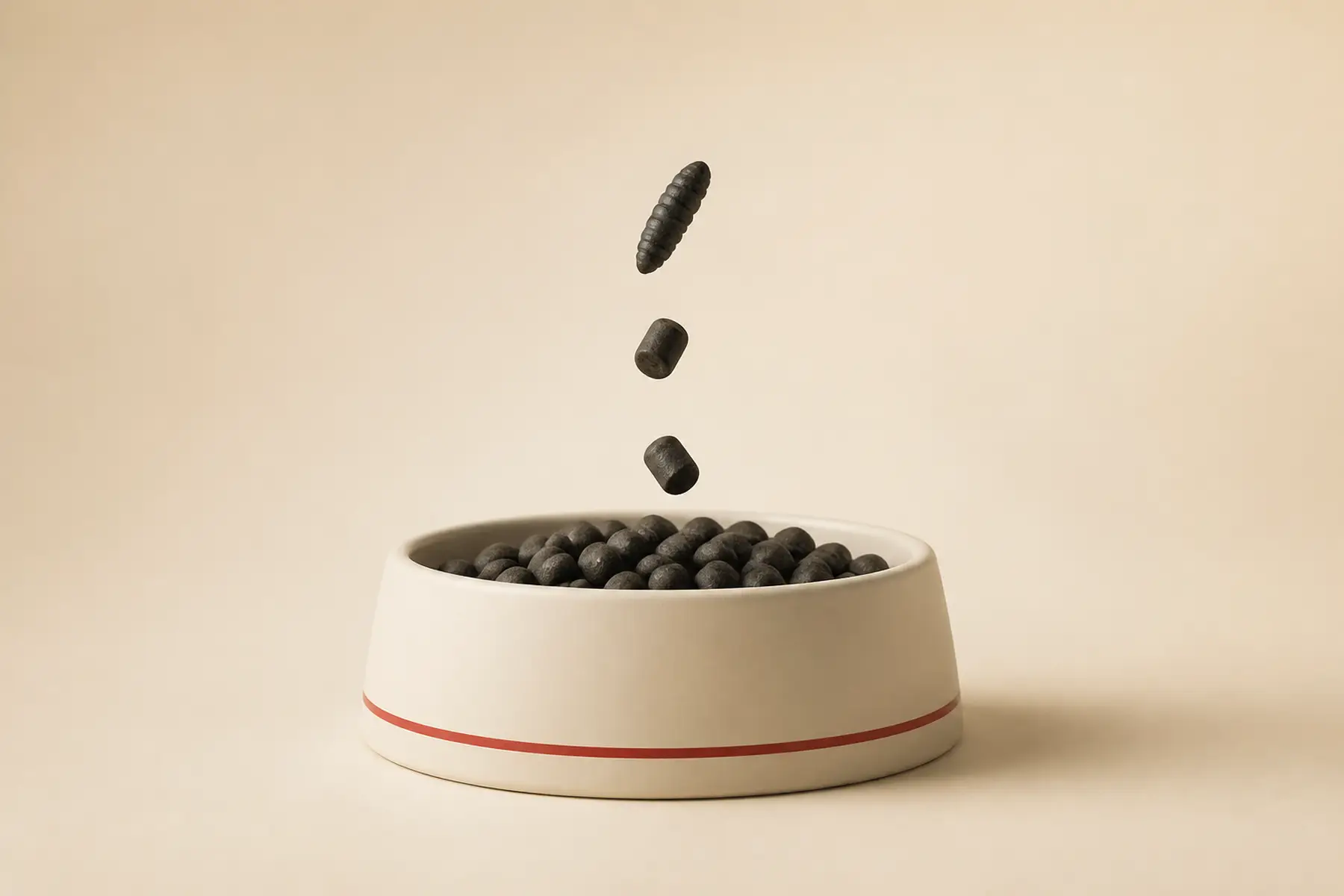
The most important animal in the pet-food industry of 2032 will fit in the palm of a hand. It will spend its short life inside a warm Thai shed, converting clean fruit trimmings, soybean pulp or brewery residue into protein and oil. It will then disappear into a familiar tray of cat food or a brown piece of dog kibble. The owner will open the pack, the pet will eat, and a new livestock system will have entered the home without fanfare.
Thailand is the country most likely to make that transition ordinary. In 2025 it exported $2.899 billion of pet food, captured 10.3% of world exports and ranked second only to Germany. More than four-fifths of its output is made for foreign brands. Its factories already understand the demanding work: formulation, retorting, traceability, export paperwork and the appetites of animals that cannot be persuaded by a sustainability report. Thailand's pet-food position in the global market
ParallaxSee forecasts that by the end of 2032, at least three distinct Thailand-based manufacturers will sell complete-and-balanced dog or cat food lines containing a named insect-derived protein in Thailand and in at least two of the country's five largest current export markets: the United States, Japan, Italy, Australia and Malaysia. At least one qualifying line will be formulated for cats, and each will remain commercially available for six continuous months. Treats, supplements and one-off trials will not count. House confidence: 72%.
This is how a strange ingredient becomes mainstream: first the science makes it safe, then a manufacturing country makes it boring. Thailand is ready to do both.
01 — Thailand already operates the world's quiet pet-food kitchen.
The future ingredient will enter an industry built at unusual scale. Thailand's Office of Industrial Economics counted 317 pet-food brands and businesses, with 36 new producers appearing in 2024. The United States bought 35.6% of Thailand's exports in 2025; Japan, Italy, Australia and Malaysia formed the next four destinations. In four of those five markets, Thailand was already the leading overseas supplier. Office of Industrial Economics report
The country's decisive advantage is hidden on the label. More than 80% of Thai pet-food exports are original-equipment manufacturing: recipes made in Thailand and sold under somebody else's brand. A Thai factory therefore needs no global consumer identity before it changes what millions of pets eat. It needs a validated formulation, a reliable ingredient stream and a foreign customer willing to place an order. One successful production line can appear as several supermarket brands across several countries.
This industrial base grew from seafood. Tuna processors learned to separate edible fractions, formulate soft textures, seal metal cans and pouches, and sterilise wet food without destroying its appeal. Those capabilities made Thailand formidable in cat food, where aroma, moisture and texture decide whether a nutritionally perfect meal is eaten or abandoned beside the bowl.
The home market is large enough to serve as the first shelf. Kasikorn Research estimated Thai pet-food sales at 46 billion baht in 2025, up 12% in a year, with about 398,000 tonnes sold. It counted 5.38 million owned dogs and cats and found cats growing faster than dogs. Kasikorn Research on Thailand's 2025 pet-food market The ingredient can be tested locally, improved in an export factory and then travel under established foreign labels.
02 — A black soldier fly is a compact protein refinery.
The black soldier fly, Hermetia illucens, is useful because its larva performs an industrial transformation at biological speed. It eats before it becomes a fly. During that larval stage it concentrates nutrients into a body rich in protein and fat. Producers harvest the larvae, separate some of the oil and turn the remaining material into a meal that can enter a formulated diet.
Thai researchers have tested the process on materials that already exist around the country's food factories. A Khon Kaen University study raised larvae on tofu residue, fruit waste, spent brewery grain and other local by-products. The resulting larval material contained roughly 45% to 57% crude protein, depending on the feedstock. When the researchers moved from laboratory containers to a 25,000-larva tray, average harvest reached 4.15 kilograms of prepupae and unit costs fell with scale. Khon Kaen University industrial-feasibility study
The farm is becoming controlled infrastructure rather than a pile of scraps. CP Foods and Chiang Mai University began building a smart black-soldier-fly system with sensors and traceable inputs after several years of joint research. CP Foods and Chiang Mai University smart-farm project The warm climate supplies the insect's preferred biology; automation supplies consistency. Temperature, humidity, egg production, larval density and harvest time can all be measured.
That combination matters more than novelty. A pet-food formulator needs the same protein percentage, fat profile, microbial quality and flavour from one batch to the next. Thailand is turning an insect into a specification. Once the ingredient arrives at the factory with a certificate of analysis, it can be handled like any other protein input.
03 — Feeding science has crossed the threshold required for a real product.
Dogs have already eaten diets containing black soldier fly meal in controlled trials. In one study, 56 adult dogs received foods containing 5% to 20% larval meal or oil for 28 days; the diets were accepted and produced no concerning physiological changes. Black soldier fly protein and oil in adult dog diets Another trial used black soldier fly as the sole animal-protein source in a diet and found nutrient digestibility comparable with a venison-based control. Digestibility of a black-soldier-fly diet in dogs
Cats—the harder commercial test—have also crossed it. Canned diets containing black soldier fly ingredients were palatable in a cat study and produced no adverse changes in faecal quality or serum chemistry, although some nutrients were digested slightly less efficiently. Black soldier fly protein in extruded and canned cat food A later study followed queens through gestation and lactation and their kittens through growth, adding evidence that dried whole larvae can support demanding life stages when the complete formula is balanced. Black soldier fly larvae in feline reproduction and growth diets
In April 2026, the US Food and Drug Administration said it had no questions about a notifier's conclusion that dried black soldier fly larvae are generally recognised as safe as a protein and fat source in dog and cat food for all life stages. The dossier included cat, kitten and dog feeding data at inclusion rates up to 20%. FDA response on dried black soldier fly larvae This is regulatory language, not a promotional endorsement. It is also the clearest route yet from experiment to a product sold in Thailand's largest export market.
The larva supplies ingredients; the formula supplies the meal. Cats still require taurine, arginine, arachidonic acid and other nutrients in defined amounts. FEDIAF nutritional guidelines for complete pet food Thailand's advantage is precisely that its factories already know how to combine a novel protein with amino acids, vitamins, minerals, fats and flavour until the result is complete, stable and irresistible to the animal.
04 — Wet food gives Thailand a technical shortcut.
Insect protein carries an environmental advantage only when the production system is designed well. A 2023 life-cycle comparison found that electricity, heat and the material fed to larvae can make insect meal more resource-intensive than conventional soybean or fishmeal. Life-cycle assessment of black soldier fly protein A separate assessment of larvae raised on food waste identified drying as a major energy load and found that using fresh rather than dried prepupae could sharply improve the result. Life-cycle assessment of food-waste-fed black soldier fly larvae
Thailand can attack both variables. Its larvae can eat segregated food-processing residues close to the farm. Its wet-food factories can incorporate fresh or lightly processed insect fractions into high-moisture products, reducing the need to dry every kilogram into a globally traded powder. The product is then retorted: sealed in its pouch or can and heated to commercial sterility, a process Thai processors have practised for decades.
This is an inference from the research and Thailand's industrial geography, rather than a published national plan. It is also the most powerful technical reason for the forecast. Western insect companies often imagine a dry commodity meal shipped to a distant kibble plant. Thailand can connect the larva farm, the ingredient room and the wet-food retort inside one regional manufacturing system.
Thai Union saw the connection early. In 2021 it invested in Orgafeed, a Thai black-soldier-fly company, and linked the work to its i-Tail pet-care business and Laika insect-protein treats. Thai Union investment in insect protein for pet care The strategic lesson extends beyond one company: Thailand's wet-food expertise can turn the industry's most awkward processing step into an advantage.
05 — The clean residue stream can feed a new livestock industry.
Thailand generated 10.01 million tonnes of food waste in 2024, according to the Pollution Control Department—more than a third of municipal solid waste. Thailand's 2024 food-waste situation report The valuable feedstock is the clean, traceable fraction collected before it enters a mixed bin: fruit pulp from a processor, spent grain from a brewery, tofu residue or another consistent plant-based side stream.
That supply chain is already visible. Thailand's Office of Natural Resources and Environmental Policy and Planning described a partnership in which a fruit processor sends production leftovers to UPBIO's black-soldier-fly farm in Samut Sakhon. The larvae become material for animal feed and pet food; the remaining frass becomes fertiliser. Thai circular-economy profile of CH and UPBIO
Traceability turns disposal into feed manufacturing. A processor can document the original crop, exclude chemical contamination, deliver a predictable material and measure what enters each larval batch. That control produces a stable insect ingredient and protects the export customer. It also gives the food company a buyer for a side stream that once carried a disposal cost.
The pet bowl matters environmentally because its present footprint is large. A global assessment estimated that dry pet food alone is associated with 56 million to 151 million tonnes of carbon-dioxide equivalent annually and uses 41 million to 58 million hectares of agricultural land. Environmental footprint of global pet food Thailand does not need every residue stream to qualify. It needs enough clean material to replace a growing share of high-footprint animal protein with a locally farmed ingredient.
06 — Regulation now describes a road to the shelf.
Thailand's Department of Livestock Development says insect powder and insect oil sold as single ingredients are outside the category of specifically controlled feed that requires product registration. Complete pet food remains regulated and must satisfy the rules for its final formulation and claims. Department of Livestock Development feed-registration questions and answers This distinction lets ingredient companies develop the input while established manufacturers carry the finished meal through the familiar registration process.
The export routes are also open. The European Union authorised processed insect protein from seven insect species, including the black soldier fly, under feed rules in 2017. Its substrate rules are strict: manure, catering waste and uncontrolled waste streams are excluded, and feed-grade inputs are required. EU Regulation 2017/893 The FDA's 2026 response provides a comparable scientific pathway for the United States.
Those constraints favour Thailand's formal food industry. Tuna canneries, fruit processors and export pet-food factories already operate lot codes, hazard controls, supplier audits and laboratory testing. A larva raised on a documented factory side stream fits that culture. A larva raised on whatever happened to arrive in a waste truck does not.
The regulatory solution therefore strengthens the industrial solution: certified residue, controlled farm, analysed ingredient, complete formulation and traceable export pack. Each step is familiar. The living machine in the middle is new.
07 — Owners will buy the result once quality becomes visible.
The remaining gate sits with the human holding the packet. A 2026 Thai study surveyed 405 Generation Y pet owners who were already aware of black-soldier-fly pet food. Its convenience sample cannot represent every Thai buyer, but its model explained 60.7% of the variation in purchase willingness. Perceived product quality and pro-environmental behaviour were the strongest direct influences. Thai study of willingness to buy black-soldier-fly pet food
That finding gives brands a practical script. Lead with complete nutrition, digestibility, taste, food safety and traceability. Let the smaller footprint strengthen the product after those needs are met. The insect becomes appealing when the owner sees a better meal rather than a moral test.
Thailand's early ventures show both the possibility and the bottleneck. The government-backed Jaikla profile describes a closed black-soldier-fly farm designed for around 100 tonnes a month, yet operating at only 10% to 20% of capacity while downstream sales develop. Its premium dog treats prove that the ingredient can reach the customer; unused capacity shows that farming can advance faster than demand. Founder Itthikorn Thepmanee puts the proposition plainly: “Insects are more than an alternative; they can be genuinely sustainable, high-quality protein.” Jaikla black-soldier-fly company profile, translated from Thai
Pet-food acceptance has one unusually honest referee. The dog eats the biscuit or it does not. The cat returns to the bowl or walks away. Thailand's formulators have spent decades solving that verdict for tuna, chicken, gravy and jelly. By 2032 they will make insect protein pass it too.
08 — OEM manufacturing will turn one formula into an international category.
A consumer revolution usually requires a famous brand. Thailand can build this one through a factory catalogue. A manufacturer validates an insect-based cat mousse or dog pâté, offers it to overseas customers and adjusts the flavour, pack and claim for each market. Several labels can emerge from the same technical platform. Retailers gain a differentiated product without building an insect supply chain of their own.
The export report already shows why this diffusion can move quickly. Thai factories comply with American, European, Japanese and Australian requirements, while the same plants produce for many brand owners. Thailand's pet-food position in the global market Once one insect formula survives feeding work, shelf-life testing, registration, retail review and repeat orders, the next customer buys a proven platform rather than an experiment.
Price will improve with utilisation. Jaikla's underused farm, new smart-farm projects and food-processor partnerships all contain capacity waiting for a larger outlet. Complete pet food supplies that outlet at a scale treats cannot. Factories can also blend insect protein with poultry, fish or plant ingredients, increasing inclusion as supply expands. Mainstream adoption begins as a dependable fraction of the recipe.
By 2032, the insect label will sit beside familiar claims such as sensitive digestion, novel protein and lower-impact sourcing. Some owners will choose it deliberately. Many will encounter it first inside a trusted brand made by a Thai factory they never knew existed. That anonymity is the forecast's engine.
09 — By 2032, Thailand will make the small animal ordinary.
The forecast requires three manufacturers, complete-and-balanced food, domestic availability, sales in two major export markets, at least one cat line and six months of continuity. That boundary is demanding enough to separate a category from a publicity batch. It is also modest beside the manufacturing system now forming.
The science can already formulate a usable protein. The FDA and European rules supply export pathways. Thai researchers can raise larvae on local processing residues at industrial density. Thai food companies are investing. The country's pet-food plants already serve the relevant markets, and its wet-food infrastructure offers a credible way to reduce the energy burden of drying.
The decisive move will occur inside product development rather than on a futuristic farm. A formulator will approve an ingredient specification. A palatability panel will empty its bowls. A foreign retailer will accept the pack. A second brand will order a variation. The insect farm will increase utilisation, and the price will settle into the recipe.
Pet food's next livestock animal will be counted by the thousand in a tray and by the fraction in a formula. Thailand will make that system reliable, exportable and ordinary. By the end of 2032, insect protein will have entered the mainstream bowl.