
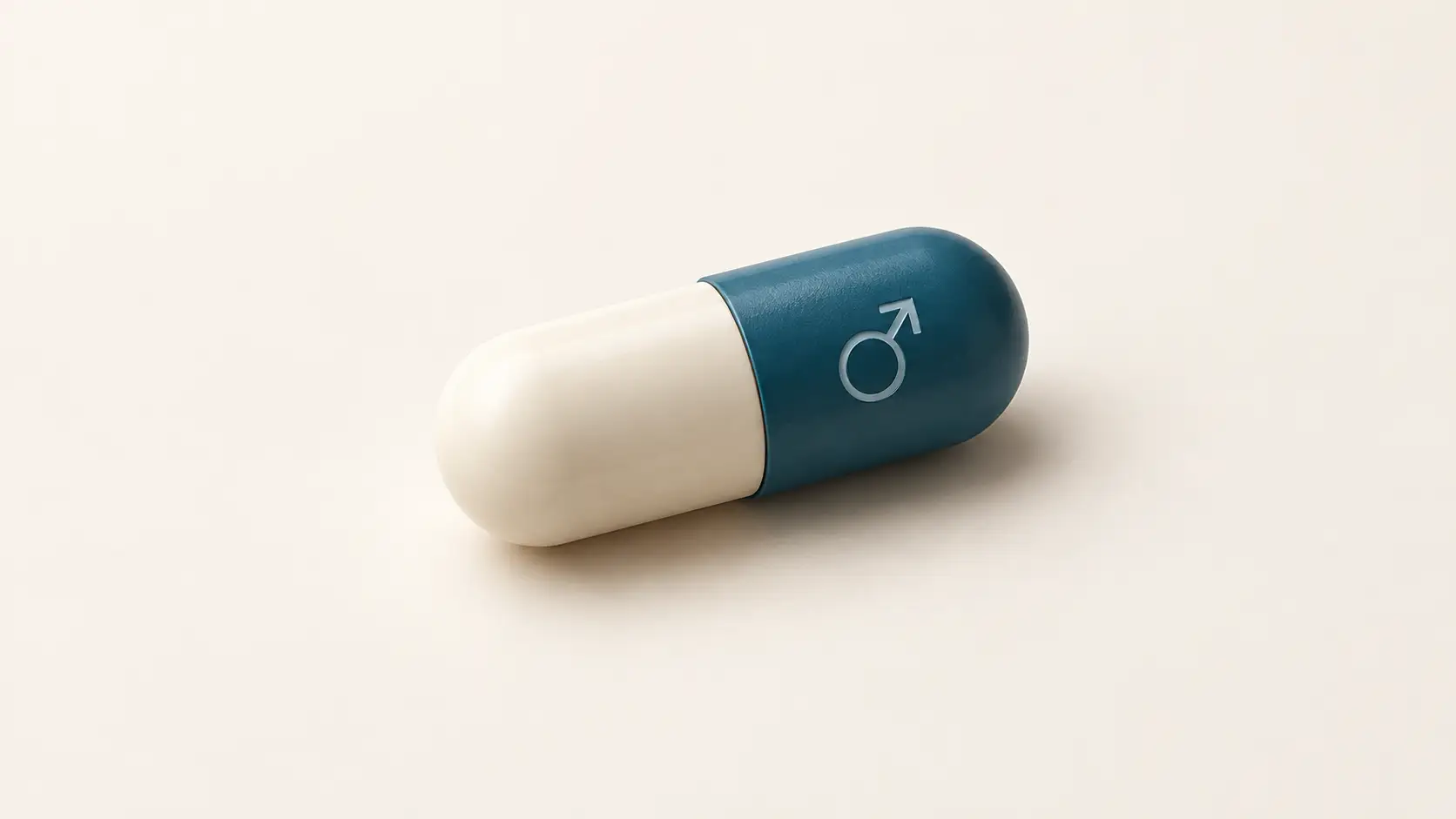
Imagine a couple discussing contraception and discovering that the next prescription can belong to him.
That ordinary conversation would mark an extraordinary scientific achievement. A man could take an oral medicine designed to temporarily interrupt sperm production, then stop when he wanted fertility to return. His partner would gain another option; he would gain a more direct way to take responsibility.
ParallaxSee's forecast is a first prescription launch by the end of 2035: a reversible, non-hormonal male contraceptive pill approved and ordinarily dispensed in the United States, United Kingdom, an EU member state, Australia or New Zealand. One qualifying market is enough. We assign this ambitious outcome a 25% probability.
The leading example is YCT-529, an experimental molecule already administered to adults in a published early human study. Its contraceptive effectiveness in people remains to be established. The research has nevertheless moved the question into a much more interesting place: which biological signal should a male pill control, and how can that control become dependable enough for everyday life? First human study
A conversation inside the testes
Sperm development depends on instructions inside cells. Retinoic acid, made from vitamin A, binds to receptors that help control gene activity as cells develop into sperm.
YCT-529 targets retinoic acid receptor alpha, usually shortened to RAR-alpha. It acts as an antagonist, blocking the receptor's response to that signal. Researchers aim to interrupt sperm development while leaving the sex-hormone system alone. Receptor and animal study
The attraction is precision. Drug designers can work on a particular interaction rather than treating fertility as one inseparable package of sperm production, testosterone and sexual desire.
This is molecular engineering, not a reason to change anyone's vitamin intake. The investigational drug targets a signaling pathway; it is not a dietary contraceptive.
Four hundred attempts to find the right fit
Gunda Georg, the University of Minnesota pharmacy researcher behind the program, described the social problem plainly: “Women are mostly responsible for birth control.”
The chemical solution took years. Her team explored roughly 400 molecule designs, using computer modeling alongside laboratory testing. The work received National Institutes of Health support, and the university licensed the technology to YourChoice Therapeutics in 2021. Georg's account of the discovery
That search explains why knowing an attractive biological target is only the beginning. A useful medicine must fit its target, survive its journey through the body and deliver a controllable effect. Each property gives chemists another problem to solve.
The eventual capsule is the visible end of that invisible labor: hundreds of small decisions about the shape and behavior of a molecule.
Stopping sperm production—and watching it return
The animal work supplies the forecast's scientific foundation. In the researchers' mouse experiments, fertility suppression reversed after treatment stopped, with recovery within approximately six weeks. In non-human primates, sperm counts fell and subsequently recovered within 10–15 weeks after dosing ended. Those primate measurements concern sperm counts, rather than demonstrated pregnancy prevention. Published animal results
The two directions matter equally. A reversible contraceptive must produce a dependable interruption and a dependable return. The recovery results make the project especially compelling: they point toward temporary control over a biological process that can resume.
They also suggest the kind of product this pathway could create. A sperm-production pill would involve a transition into protection and a transition back to fertility. Human trials must establish those intervals; animal recovery times cannot become instructions for people.
The capsule has entered human research
The first published human trial involved 16 vasectomized men receiving single doses. It examined tolerability and how the body handled YCT-529. It did not measure sperm suppression or pregnancy prevention.
The study reported no severe or serious treatment-emergent adverse events. One participant experienced a mild, temporary, symptom-free cardiac rhythm abnormality considered possibly related to the drug. Measured hormones, sexual desire and mood showed no reported changes under these short-term study conditions. Longer exposure still needs investigation. Human safety and pharmacokinetic results
The registered follow-up study extends dosing into 28-, 90- and 180-day parts, with an estimated enrollment of 88 men. As checked on 28 September 2026, its public record had no posted results. The record was last updated in February and still listed recruitment, despite an estimated July completion date; that estimate does not establish that the study finished. Repeat-dose trial record
Repeated exposure is where the next major answers must emerge: whether the drug can maintain a useful effect, how participants tolerate it and what happens after they stop.
A couple is the unit of proof
A laboratory can count sperm. A contraceptive must prevent pregnancy in the circumstances in which people actually use it.
Guidelines from the European Academy of Andrology and American Society of Andrology describe a development path involving biological assessments, recovery and studies in couples. Their proposed efficacy program includes a year of observation. Semen measurements help researchers develop a method; pregnancy outcomes establish whether couples can rely on it. These are professional development recommendations, not a product approval. Andrology development guidelines
The engineering therefore extends beyond the molecule. A future product needs understandable rules about beginning treatment, missed doses, monitoring and stopping. Those rules must come from clinical evidence and an authorized label.
The best version of a male pill would give users a routine they can understand and researchers an outcome they can verify.
Why 2035 belongs in the conversation
In September 2026, the World Health Organization suggested that new reversible male contraceptives might reach the market within five to ten years. That outlook covers several hormonal and non-hormonal approaches; it does not promise an oral product. It does place the coming decade within a credible development horizon. WHO's current assessment
WHO also published its first target product profiles for new male methods, setting out the characteristics developers should aim for, including safety, effectiveness, acceptability and affordability. The framework gives funders and researchers a clearer destination. WHO's development framework
Our 2035 date allows a sequence of demanding steps. The late 2020s could establish repeated-dose effects and recovery. Successful candidates could enter couple efficacy studies around the turn of the decade, followed by larger safety programs, manufacturing validation and regulatory review in the early-to-mid 2030s.
That is an editorial scenario, not an announced schedule. Its advantage is time for the evidence to accumulate. The first successful market launch could establish a prescribing pathway that later products improve.
The customers already have a reason to listen
A 2024 study surveyed men across six lower- and middle-income countries and the United States. It reported average stated interest of 61% in trying a new male contraceptive during its first year of availability, with substantial differences between countries. That measures hypothetical interest in new male methods, not future pill purchases or reliable daily use. Multi-country demand study
Even with that distinction, the commercial question has substance. Researchers are developing a product for a responsibility couples already manage, rather than inventing a need and hoping customers acquire it.
For women, the gain would be another choice about how contraception fits their lives. For men, it would be a new form of agency over their own fertility. Each person's choice remains their own: a partner's prescription creates no obligation to discontinue another method.
“Choice is a gender equality issue,” WHO's Pascale Allotey said when presenting the wider contraceptive agenda. That is the most useful measure of the promise. Allotey's statement
What could keep the prescription out of reach
The strongest objection concerns the safety standard. A medicine taken repeatedly by healthy people must justify its risks. Retinoid signaling has functions beyond reproduction; receptor-subtype selectivity does not mean effects are confined to the testes. Biological rationale and limitations
Successful development needs a workable balance between suppression, tolerability and recovery across different users. A dose that performs well for some participants may prove inadequate or unsuitable for others. Small early studies cannot answer every long-term question.
Funding could become another bottleneck. Larger trials, manufacturing and distribution require sustained investment. Demand surveys help explain the opportunity, but investors still need a convincing clinical result. An affordable retail price remains a goal, not an established figure.
The human paper also discloses sponsor-linked authors and commercial interests, including Georg's inventor and consultancy roles. These are results from an invested development group, not independent replication. Study disclosures
The central failure scenario is straightforward: research keeps progressing, but no oral non-hormonal product completes that entire journey before 2036.
The forecast we will check
Our numerical model gives a 55% chance of adequate human proof of concept and early safety, followed conditionally by 60% for a successful larger development program, 90% for authorization, 85% for meeting the calendar and 95% for ordinary dispensing. Together, those judgments produce approximately 24%, rounded to 25%.
The outside-view benchmark is sobering: a BIO/Informa/QLS analysis of 2011–2020 drug development estimated roughly 17% eventual approval from Phase II for non-oncology programs. It is an imperfect comparison with a mixed Phase 1b/2a contraceptive study, and it does not measure launch by 2035. Our component probabilities are editorial adjustments, not measured male-pill success rates. The score makes delay or failure more likely than success. Clinical-development reference class
The test is one formally authorized, reversible, non-hormonal oral male contraceptive with documented ordinary prescription dispensing in a listed jurisdiction by 31 December 2035. Trial access, off-label prescribing, hormonal gels and implants do not count. YCT-529 need not be the winner.
The achievement would be deceptively small: a capsule, a prescription and another name on the pharmacy label. Inside that capsule would sit a new way for couples to organize one of their most consequential shared decisions.
This is a research forecast, not contraceptive advice. Experimental findings are not a basis for changing an existing method. A pill designed to suppress sperm should not be treated as protection against sexually transmitted infections. Contraception and infection prevention