
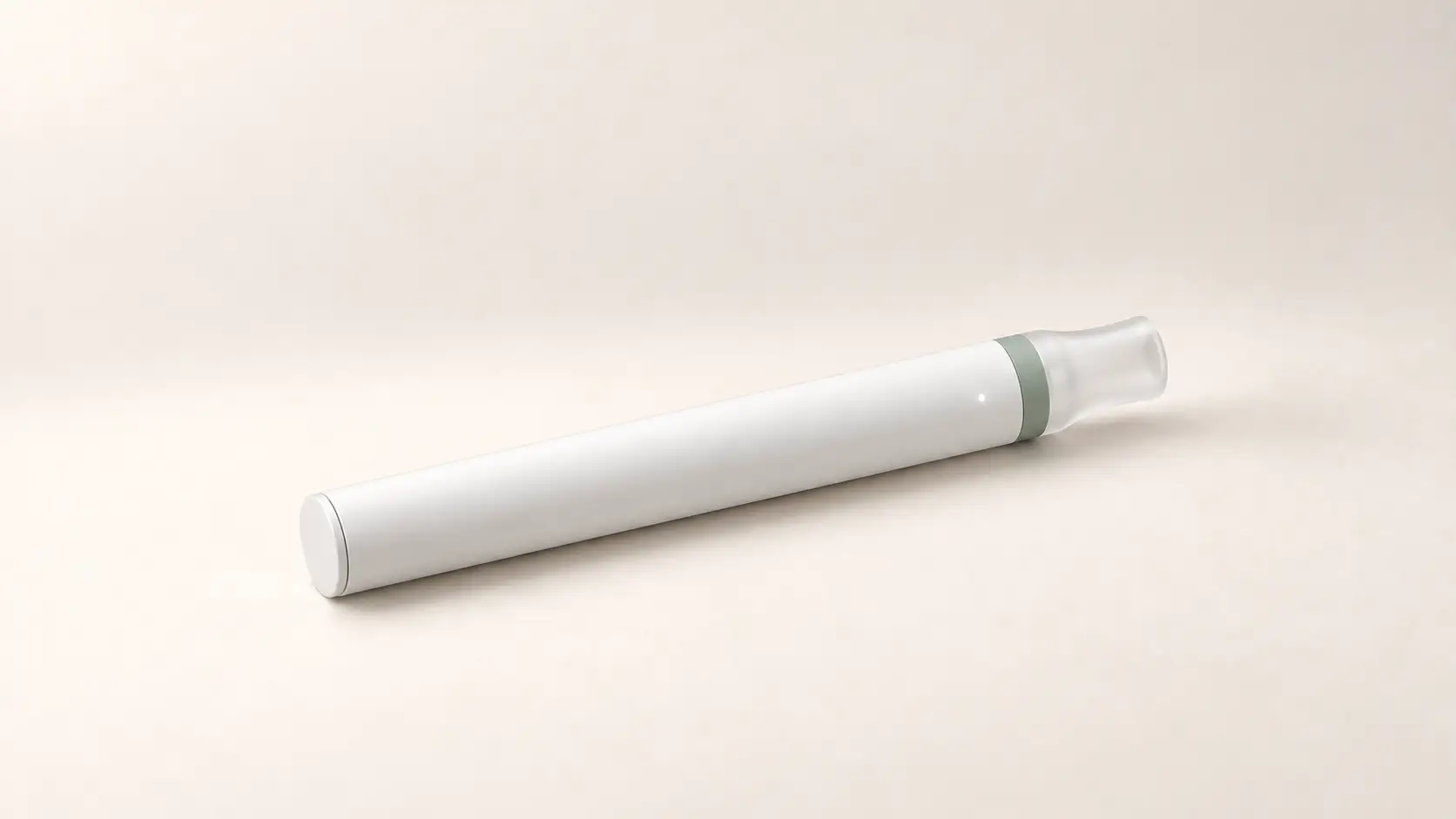
Imagine a paediatric clinic in 2040. A child has a diagnosed vitamin deficiency and a condition that makes conventional treatment difficult. The doctor discusses a small inhaler with the family: a sealed pharmaceutical cartridge, a measured treatment and follow-up tests to establish whether it is working.
There is no tobacco, nicotine or burning. This is a possible future for inhaled medicine—not a recommendation that children smoke. The American Academy of Pediatrics’ policy, reaffirmed in August 2025, identifies electronic cigarettes as unsafe for children and adolescents. AAP policy
ParallaxSee assigns a 35% chance that, by 2040, at least one pulmonary vitamin treatment will have both regulatory approval for a defined childhood deficiency and a formal clinical recommendation for its use.
The forecast concerns a prescription for selected patients. It does not predict a healthy cigarette or endorse today’s vitamin vapes.
The most surprising evidence comes from children who received an experimental vitamin aerosol more than a quarter of a century ago.
01 — The experiment already happened in Ethiopia.
In 1999, researchers reported a placebo-controlled pilot study of inhaled vitamin A in preschool children in Gondar, Ethiopia. The participants were aged two to five. Those receiving the vitamin preparation showed improved blood markers of vitamin A status after three months. The original study
This was a small medical experiment. It did not establish the long-term respiratory safety of repeated treatment, prove superiority to oral supplementation or demonstrate that otherwise healthy children should inhale vitamins.
Its importance is narrower and still remarkable: a nutrient delivered through the airways could produce a measurable change in nutritional status.
That finding sharpens the question. If absorption was possible in 1999, why has a vitamin inhaler not become an ordinary part of paediatric care?
The explanation must extend beyond making a mist. A useful treatment needs a reason to replace what doctors already have.
02 — Getting a vitamin into the blood is only the beginning.
The lungs offer a potential route into the circulation. Nutritional medicine has explored that route for decades.
A 1967 study in the British Journal of Haematology reported increased blood B12 after aerosol inhalation. Six patients with pernicious anaemia achieved clinical and haematological remission. Yet the author concluded that the method was not superior to injections and therefore had no therapeutic application. The B12 study
That conclusion remains a useful challenge to every modern vitamin-inhaler proposal. A laboratory can demonstrate delivery. A doctor needs a better outcome, a more manageable treatment or another meaningful advantage for a particular patient.
The invention has to improve treatment enough to justify introducing a new route of exposure.
03 — The promising device makes droplets mechanically.
One credible route uses a vibrating mesh: a thin, perforated membrane that moves rapidly and pushes liquid through tiny openings. The result is an aerosol of droplets. This process can create a mist without the hot coil used in ordinary liquid-heating vapes.
A 2025 engineering paper described a lead-free piezoelectric mesh atomiser that produced a median particle size of approximately three micrometres under its experimental conditions. Piezoelectric materials change shape when an electrical signal is applied; here, that movement drives the membrane. This was a device study, not a trial of vitamins in children. Atomiser research
For our imagined treatment, the surrounding design would matter just as much: a sealed formulation, controlled output, an age-appropriate mouthpiece or mask, and a clear indication that delivery had finished.
Those are proposed features, not a description of an approved product. Their purpose would be to turn an uncertain puff into a reproducible medical treatment.
Even then, the quantity leaving a cartridge would have to be distinguished from the quantity reaching the lungs and ultimately becoming available to the body.
04 — The first patients would have a specific problem to solve.
The strongest clinical case would concern children for whom established supplementation is ineffective, impractical or particularly burdensome. A condition affecting absorption or swallowing might create such a need, although it would not automatically make inhalation suitable.
A 2025 review calls this prospective field aeronutrient therapy. It argues for investigating controlled nutrient inhalation where conventional delivery is unsuitable, while acknowledging the limited evidence and substantial work ahead. It is a research proposal supported by earlier studies, not a demonstration that modern vitamin vapes treat children safely. Aeronutrient therapy review
The useful question would be specific: can this formulation correct this child’s deficiency with an acceptable balance of benefit and harm?
That question also changes the product. A prescribed treatment would have an indication, a defined course and monitoring. It would not invite healthy children to inhale whenever they wanted more energy or better concentration.
05 — Child-specific evidence will determine the timetable.
A successful adult treatment would provide a starting point, not an automatic paediatric prescription. Researchers would need to establish how the intended children use the device, how much treatment they receive and what happens to their airways during repeated exposure.
FDA’s paediatric research framework requires additional protections, including caregiver permission and, when appropriate, the child’s assent. It limits allowable research risks according to the prospect of direct clinical benefit. FDA paediatric ethics
The respiratory safety question is real. During the EVALI lung-injury investigation, researchers detected vitamin E acetate in lung-fluid samples from 48 of 51 affected patients and none of 99 healthy comparison participants. Most cases with relevant information involved THC exposure. This finding cannot be generalised to every vitamin preparation; it demonstrates why familiar nutritional ingredients still require route-specific testing. The original investigation
Today’s retail products have not cleared that evidential hurdle. FDA warns that wellness vapes are sold with unproven health claims and can present inhalation risks. They are not substitutes for a child’s prescribed treatment. FDA warning
06 — The hardest competitor may be an ordinary supplement.
An inhaler would enter a field with established treatments. NIH describes oral, injected and prescription nasal forms of B12; a nasal spray is a different route from delivery deep into the lungs. NIH B12 overview
For vitamin A, WHO already recommends supplementation programmes for young children in settings where deficiency is a public-health problem. These programmes raise the standard a replacement must meet. WHO recommendations
Our commercial inference is that the first viable vitamin inhaler would serve a narrow clinical need. A reusable device, pharmaceutical cartridges, instruction and monitoring all create work that a simpler treatment may avoid. A manufacturer would have to demonstrate value across that whole process.
For one patient, avoiding a difficult treatment procedure might justify the extra equipment. For another, an established oral preparation might remain the better choice.
The success story would begin with patients who gain something concrete, then expand where the evidence supports it.
07 — Why 2040, and why 35%?
The 2025 aeronutrient review anticipates a decade or more before the approach could be used at scale. That is an outlook for the field, not a promised paediatric approval date. We extend the horizon to 2040 to allow for formulation development, clinical comparisons and child-specific evidence. The research outlook
Our research did not identify a late-stage paediatric programme that could anchor a firm launch schedule. The long interval since the early vitamin studies is itself evidence against an easy transition into routine care.
The 35% estimate is a subjective scenario assessment, not a measured medical probability. Our working assumptions are a 70% chance of sustained sponsored development, followed conditionally by 75% for clinically useful delivery and acceptable safety, 75% for favourable child-specific evidence, and 90% for qualifying approval plus a formal recommendation by the deadline. Multiplying these editorial judgments gives approximately 35%.
This is a plausible minority scenario—not an assertion that paediatric vitamin inhalers are inevitable.
We will count the forecast as fulfilled only if, by 31 December 2040, a vitamin formulation for delivery to the lungs has an explicit indication for treating a diagnosed deficiency in an under-18 population, authorised in the United States, United Kingdom or European Union, and a specialist guideline or hospital treatment protocol recommends it outside research. Both must remain in force at the deadline. Retail wellness claims, nasal sprays, clinical experiments and isolated off-label prescriptions do not qualify.
Return to the imagined clinic. The achievement would be a child receiving an effective treatment that had previously been difficult to provide, with evidence that its benefits justify its risks.
That would give doctors a reason to prescribe a vitamin inhaler. It would give them no reason to recommend cigarettes.