
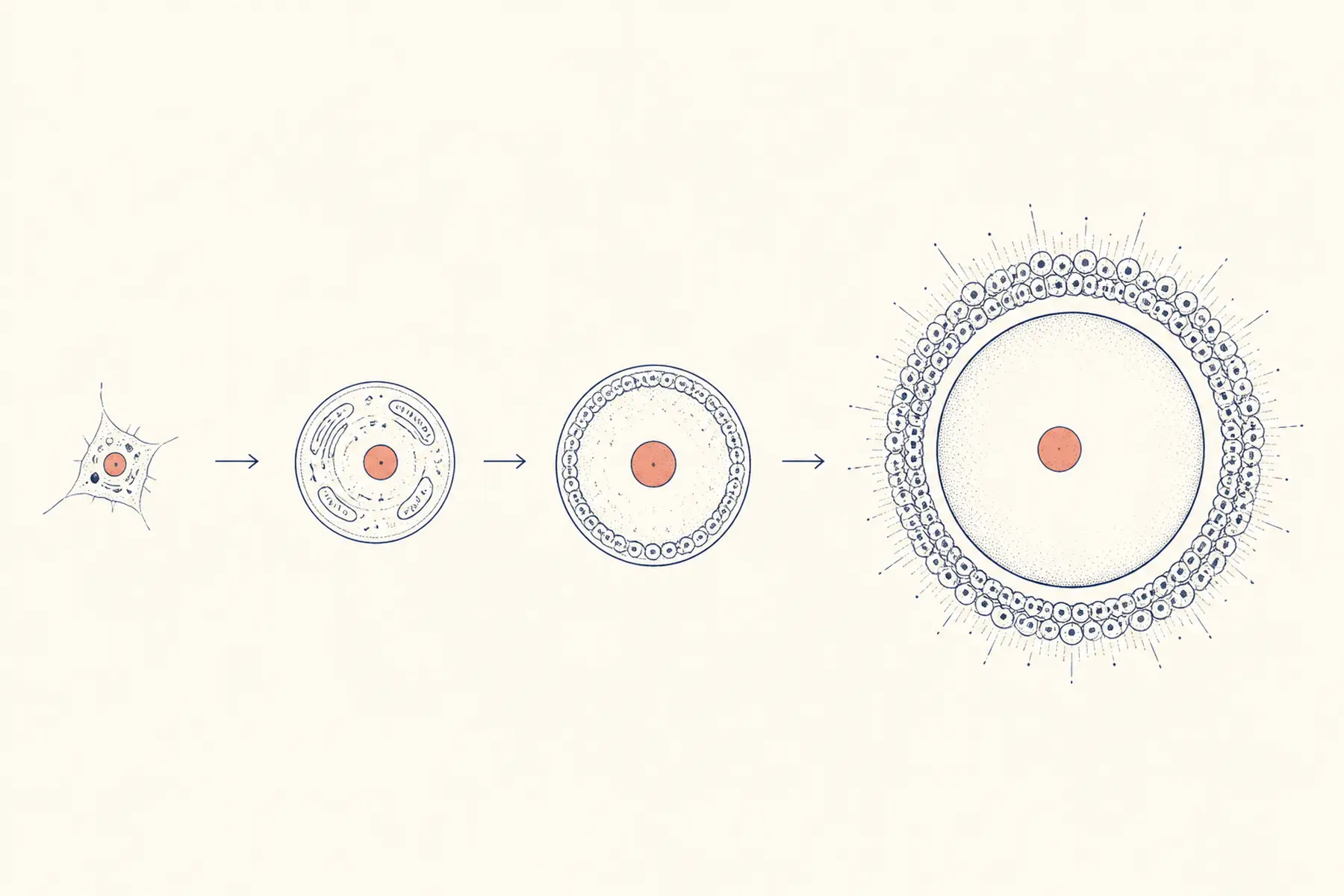
In 2023, a group of Japanese developmental biologists took cells from the tail of an adult male mouse and made eggs from them. The researchers first returned the cells to pluripotency. They isolated descendants that had lost the Y chromosome, duplicated the remaining X, guided the resulting XX cells into the female germ line and placed them inside a reconstructed ovarian environment. The eggs were fertilised. Embryos were transferred. Mice were born. The experiment in Nature
The achievement was far more radical than a new version of IVF. IVF retrieves an egg that an ovary has already spent months preparing. In-vitro gametogenesis, or IVG, attempts to manufacture the egg itself. Its raw material can be an induced pluripotent stem cell made from skin or blood. Its machinery is a sequence of chemical signals, supporting cells and carefully timed changes in gene activity. Its product must contain half a genome, the correct maternal epigenetic marks and the enormous cytoplasmic store that powers the first days of embryonic life.
Human cells have travelled much of this route without completing it. Scientists can turn adult fibroblasts into pluripotent cells, specify human primordial germ-cell-like cells, grow them into oogonia-like precursors and reproduce the sweeping erasure of DNA methylation that resets the germ line. In 2025, researchers induced human somatic chromosomes inside reconstructed oocytes to separate into a reduced set. No laboratory has yet reported a fully functional human egg made from a body cell. The missing steps have become individual experimental problems rather than an unknowable biological mystery.
ParallaxSee forecasts that by the end of 2040, the first publicly verified baby will be born after fertilisation with an in-vitro-derived human gamete whose nuclear genome originated in a cultured pluripotent or ordinary body cell. The first case will most likely use an egg derived from the cells of a woman who cannot produce viable oocytes. Donated egg cytoplasm may provide mitochondria and maternal factors. Reproduction involving two genetic fathers will follow later. ParallaxSee confidence: 67%.
The egg was once treated as a biological inheritance that medicine could retrieve, freeze or donate but never manufacture. Developmental biology is turning it into a process that can be reconstructed step by step.
01 — A skin cell can be returned to the beginning.
Every cell in a body carries essentially the same genome. A skin fibroblast and an egg differ because they read different parts of it, package their DNA differently and maintain separate networks of active proteins. The first requirement for IVG is therefore a controlled loss of identity.
In 2007, Kazutoshi Takahashi, Shinya Yamanaka and colleagues introduced four transcription factors—OCT4, SOX2, KLF4 and c-MYC—into adult human dermal fibroblasts. The cells adopted the morphology, gene expression, epigenetic state and developmental range of embryonic stem cells. The human induced-pluripotency experiment These induced pluripotent stem cells, or iPSCs, supplied reproductive biology with an extraordinary starting material: a renewable cell line carrying the genome of one specific person and capable of entering many developmental paths.
The four factors do not turn skin directly into egg. They release the cell from its mature programme. Researchers then reproduce a succession of embryonic instructions. The distinction matters because the germ line is established very early in development and follows a route that ordinary adult tissues have long abandoned. A reliable egg must travel through that route rather than merely acquire a few egg-like markers.
IVG begins with a small biopsy. Fibroblasts are expanded, reprogrammed and divided into clonal lines. Whole-genome sequencing and chromosome analysis can reject lines carrying mutations, rearrangements or abnormal chromosome numbers. A selected clone then becomes the common ancestor of every later experimental cell. This makes quality control possible at a scale unavailable inside an ovary: the starting genome can be read, archived and compared with the final gamete.
The reprogrammed cell is powerful and unfinished. It can still become neural tissue, muscle or tumour-forming cells if the later signals are wrong. The great achievement of the last fifteen years has been the construction of a one-way developmental itinerary that moves it from pluripotency into the germ line and separates the intended cells from everything else.
02 — The first destination is a cell that remembers no body.
In a human embryo, the future egg or sperm begins as a primordial germ cell. This tiny founding population is specified around the third week of development, migrates towards the forming gonad and undergoes one of the most extensive molecular resets in human biology. The cells silence somatic programmes, reactivate developmental potential and prepare their genomes for sex-specific instructions.
Katsuhiko Hayashi and Mitinori Saitou first reconstructed this waypoint robustly in mice. Their 2011 system moved embryonic stem cells or iPSCs through a short-lived epiblast-like state and then exposed them to signals that produced primordial germ-cell-like cells, or PGCLCs. When transplanted into testes, the selected PGCLCs completed spermatogenesis. The mouse germ-cell specification study The transient epiblast state was the crucial bridge. Cells became competent for germ-cell fate only during a narrow developmental window.
Humans use a related pathway with a different master switch. In 2015, Naoko Irie and colleagues showed that SOX17 is required to specify human primordial germ cells, while BLIMP1 stabilises the programme and suppresses competing somatic fates. The SOX17 study in Cell A parallel Japanese study led by Kotaro Sasaki established a robust route from human iPSCs through incipient mesoderm-like cells into purifiable hPGCLCs. Their transcriptomes resembled germ cells isolated from non-human primates. Robust induction of human germ-cell fate
This is the first major reason to expect a human IVG. Laboratories are no longer asking an undifferentiated cell to leap directly into an egg. They can reproduce an identifiable embryonic state, verify it with single-cell RNA sequencing and isolate it through surface markers such as EpCAM and integrin α6.
The hPGCLC is not yet a gamete. It has not entered meiosis, formed a follicle or acquired maternal cytoplasm. It has achieved something more fundamental: it has left the body-cell lineage and entered the only lineage capable of carrying a genome into the next generation.
03 — The ovary is being rebuilt as a culture system.
An egg does not mature alone. In the fetal ovary, germ cells communicate with granulosa precursors, organise into cysts, enter meiosis and become enclosed inside primordial follicles. Later, the follicle feeds the oocyte, exchanges molecular signals through gap junctions and regulates its growth. Reconstructing that neighbourhood has been as important as reconstructing the germ cell.
In 2012, Hayashi's group combined mouse PGCLCs with embryonic ovarian somatic cells to form reconstituted ovaries. After transplantation beneath an ovarian membrane, the cells erased imprints, reactivated the X chromosome, entered meiosis and grew into oocytes. Following maturation and fertilisation, those oocytes produced fertile offspring. The first offspring from PGCLC-derived oocytes
Four years later, the group moved the remaining ovarian phase into culture. Starting with mouse embryonic stem cells and iPSCs, researchers reproduced the entire female germ-line cycle in vitro. The resulting oocytes were fertilisation-competent and produced viable mice. The complete mouse germ-line cycle
The culture still depended on ovarian support cells taken from mouse embryos. In 2021, Takashi Yoshino and colleagues removed that dependency. They derived fetal ovarian somatic cell-like cells from pluripotent stem cells, combined them with stem-cell-derived PGCLCs and generated follicles containing functional oocytes. Fertilisation again produced live offspring. Ovarian follicles generated from pluripotent stem cells Both principal components of the follicle could now be manufactured.
This sequence explains how reproductive biology advances. Each paper closes one dependency on a developing animal: first the germ-cell programme, then oocyte growth, then the supporting ovary. The culture becomes increasingly defined, reproducible and measurable. Growth factors replace some signals; engineered somatic cells supply others; three-dimensional aggregates reproduce physical contact.
A human system will require a slower and more elaborate ovarian niche. A 2025 atlas of fetal rhesus-macaque ovaries mapped the emergence of distinct pre-granulosa populations and showed which later subtype contributes to primordial follicles. The primate ovarian-reserve atlas That map provides the recipe: the correct germ cell must meet the correct support cell at the correct developmental time.
04 — Human cells have begun the great epigenetic erasure.
A skin cell carries a molecular history. Chemical tags attached to DNA help preserve its identity and control which copy of a gene is active. A future egg must erase much of that history and then install a specifically maternal programme.
This is especially important for genomic imprinting. At a small but essential set of genes, the embryo uses either the maternal or paternal copy according to marks established in the gametes. Two chromosomes with the correct DNA sequence can still behave incorrectly if both carry paternal instructions or both carry maternal instructions. Growth, placental development and metabolism depend on that parent-of-origin distinction.
In 2018, Chika Yamashiro and colleagues placed human iPSC-derived PGCLCs into reconstituted ovaries made with mouse embryonic somatic cells. After roughly four months, some became oogonia-like cells. They underwent genome-wide DNA demethylation, erased imprint marks and moved towards the state immediately preceding meiotic recombination. Generation of human oogonia from iPSCs The experiment stopped before producing an oocyte, but it demonstrated that human reprogrammed cells could execute the germ line's deepest reset.
A 2024 Nature paper reconstructed that process more completely under defined signalling conditions. DNA methylation fell from about 85% in the starting human iPSCs to roughly 10% in induced germ cells. Nearly all tested imprint regions were erased, genes associated with meiosis were demethylated and the inactive X chromosome in female cells was reactivated. In-vitro epigenetic reprogramming of the human germ line
Male development has advanced in parallel. Researchers have taken human iPSC-derived PGCLCs into prospermatogonia-like states using reconstructed testicular tissue and traced the transition by single-cell sequencing. Human prospermatogonial specification The female and male routes are therefore becoming separate protocols built on a common reset.
Erasure is only the first half. A mature egg must establish maternal imprints at the correct loci while keeping the rest of the genome stable. This can be audited. Whole-genome bisulphite sequencing reads DNA methylation; long-read sequencing resolves difficult imprint regions; RNA sequencing checks whether parent-specific genes behave as expected. The epigenome has become an engineering specification rather than an invisible inheritance.
05 — Meiosis must halve the genome without breaking it.
Every ordinary human cell is diploid: it carries 46 chromosomes arranged in 23 pairs. Fertilisation works because egg and sperm each contribute one member of every pair. Their nuclei combine to restore 46. A laboratory egg that retains both copies would create a triploid embryo and fail.
Meiosis performs the reduction. Maternal and paternal homologues pair, exchange corresponding pieces of DNA and then separate through two specialised divisions. The process creates genetic diversity while asking the cell to move chromosomes that have been physically recombined. A missing chromosome causes monosomy; an extra one causes trisomy. Even natural human oocytes make such errors frequently, especially with maternal age.
A 2025 Nature Communications study attacked this bottleneck through mitomeiosis. Researchers placed the nucleus of a human somatic cell into an enucleated donor oocyte, where the cytoplasm reorganised the chromosomes on a spindle. Fertilisation alone left the reconstructed oocytes arrested. A selective inhibitor then activated the cells and induced them to discard a chromosome set into a polar-body-like structure. Sequencing showed that an average of 23 somatic chromosomes remained and followed their combination with sperm chromosomes in early embryos. Experimental ploidy reduction in reconstructed human oocytes
This route uses the natural machinery already stored inside a donated egg. It may reach the first clinical birth before a fully synthetic follicle does. The intended parent's somatic genome supplies the chromosomes; donated cytoplasm supplies the spindle, mitochondria, proteins and maternal RNA. The reconstructed egg must still create a clean haploid set and establish the correct maternal imprints, but it can borrow the most difficult cytoplasmic equipment.
The cytoplasm is not packaging. An oocyte is one of the largest cells in the human body because it accumulates the materials that govern fertilisation and early cleavage before the embryo activates its own genome. Mouse experiments show how a defect in a single oocyte regulator, MARF1, can disrupt RNA control, activate mobile genetic elements, increase DNA breaks and arrest meiosis. The MARF1 oocyte study
The first IVG baby will probably emerge from a hybrid system: a laboratory-derived nuclear gamete completed inside biological egg cytoplasm. Later generations of the technology will replace more of that borrowed machinery with stem-cell-derived follicles and defined culture.
06 — The male mouse egg proved that reproductive sex is a programmable state.
The 2023 male-mouse experiment began with XY iPSCs made from an adult tail. During culture, some cells spontaneously lost the Y chromosome and became XO. Researchers treated those cells with reversine, a compound that disrupts chromosome segregation, and selected rare descendants that had duplicated the X. The new XX cells were genetically derived from a male but chromosomally equipped for oogenesis.
They were guided into PGCLCs, placed with ovarian support cells, matured into oocytes and fertilised with sperm. The oocytes produced living offspring. The study established that an adult male genome could pass through an egg and support mammalian development. Functional oocytes from male mouse cells
Chromosomes were only one barrier. Mammals also require complementary maternal and paternal imprints. In 2018, a Chinese Academy of Sciences team tested that boundary directly with haploid embryonic stem cells. Removing three imprinting regions enabled fertile bimaternal mice. Producing live bipaternal mice required changes to seven regions, and those pups died shortly after birth. The bimaternal and bipaternal mouse experiment The contrast showed why making a real egg is preferable to treating any haploid cell as an egg: oogenesis supplies a coordinated maternal epigenetic programme.
For two men, one partner's cell would provide the nuclear genome of the laboratory egg and the other would provide sperm. A donated oocyte or engineered ovarian system would initially supply cytoplasm and mitochondria, so the child would carry nuclear DNA from both fathers and mitochondrial DNA from a donor. A gestational carrier would remain necessary. For two women, one cell would have to be directed towards a sperm-like paternal programme, a different biological challenge involving the establishment of paternal imprints.
The first use will be medically simpler. An XX cell from a woman with premature ovarian insufficiency, age-related oocyte depletion or fertility lost during cancer treatment already has the sex-chromosome configuration expected by the female pathway. Her partner or a donor supplies ordinary sperm. This route changes one component of IVF and provides a direct therapeutic rationale.
Same-sex reproduction makes IVG culturally visible. Infertility will make it clinically real.
07 — Safety will be built as a sequence of biological audits.
A gamete can look normal under a microscope and still carry a dangerous error. Clinical IVG will therefore be judged by a stack of measurements that did not exist when IVF began.
The starting iPSC clone can be checked by chromosome analysis, short- and long-read genome sequencing and comparison with the donor's original cells. During germ-cell differentiation, single-cell RNA sequencing can confirm that cells follow the intended lineage and expose residual somatic or pluripotent populations. Methylome maps can verify erasure and re-establishment of imprinting. Imaging can observe chromosome pairing, recombination, spindle formation and polar-body extrusion. The mature cell can be tested for mitochondrial number, metabolic function, RNA stores and activation response.
Non-human primates provide the next complete-system test. Rhesus iPSC-derived PGCLCs already survive transplantation into testes and progress into a later germ-cell state, although they have not completed spermatogenesis. Primate PGCLC differentiation after transplantation The primate ovarian atlas now supplies a high-resolution reference for the support cells and timing required on the female side. Together, these models create a route from molecular resemblance to functional gametes, embryos, births and long-term offspring follow-up.
The safety ladder should rise in a fixed order: repeatable human gametes for research; fertilisation and preimplantation development under licence; healthy offspring in non-human primates; multigenerational animal data; a narrowly selected human trial; pregnancy, birth and lifelong registry follow-up. The 2021 academic synthesis by Saitou and Hayashi already describes mouse IVG as a reconstructed process and human IVG as a sequence reaching early oocytes and prospermatogonia. The developmental roadmap
Current professional rules correctly reserve reproductive use. The International Society for Stem Cell Research places fertilisation for human reproduction with stem-cell-derived gametes in a category that should not proceed until safety, policy and regulatory questions are resolved. The ISSCR guidelines That threshold will turn into a clinical protocol once the preceding audits produce consistent results.
IVG is arriving in an era capable of reading every layer of the cell it creates. The first egg will face more molecular scrutiny than any naturally ovulated egg in history.
08 — By 2040, one laboratory gamete will complete the journey.
The remaining fourteen years contain a credible sequence of milestones. Human cultures must first complete meiosis and oocyte maturation reproducibly. Researchers must then show normal fertilisation, blastocyst development and molecular profiles under licensed research conditions. A non-human-primate programme must produce healthy offspring. Regulators must define a trial pathway for patients who lack usable gametes. The first pregnancy will then require the same long observation that accompanies any high-risk fertility innovation.
Policy is beginning to move before the final cell exists. The US National Academies convened a dedicated workshop in 2023 because human PGCLCs, oogonia-like cells and partial sperm pathways had already transformed IVG from speculation into a regulatory subject. The National Academies proceedings A 2024 Nature Medicine analysis by Eli Adashi, Katsuhiko Hayashi and I. Glenn Cohen examined assisted same-sex conception after the male-mouse result. The scientific and legal analysis
Britain is preparing the clearest bridge. The Human Fertilisation and Embryology Authority recommended in 2025 that future law allow IVG research embryos under licence while requiring affirmative regulations before treatment. The HFEA recommendation A 2026 government report went further, proposing a staged evaluation route and regulatory sandbox. It records active public and private research in the United Kingdom, Japan, the United States, the Netherlands and Belgium. The UK regulatory pathway report
The forecast resolves true if, by 31 December 2040, a regulator, peer-reviewed clinical report or treating institution publicly confirms a live human birth following fertilisation with an egg or sperm whose haploid nuclear genome was generated from a cultured pluripotent stem cell or an ordinary body cell. The gamete may use donated cytoplasm or mitochondria. Maturing a naturally existing oocyte removed from an ovary does not count. Cloning does not count, because fertilisation must combine two haploid nuclear genomes.
The first child will open a much larger biological era. Cancer survivors and people without functional gametes will gain a route to genetic parenthood. Egg supply will cease to be fixed by ovarian retrieval alone. Researchers will be able to observe human germ-cell development rather than infer it from rare fetal tissue. Same-sex genetic reproduction will become a technical extension of a medical platform.
IVF taught medicine to unite egg and sperm outside the body. IVG will teach biology to build one of them. By 2040, a cell once destined to make skin will have carried a human genome into the next generation.