
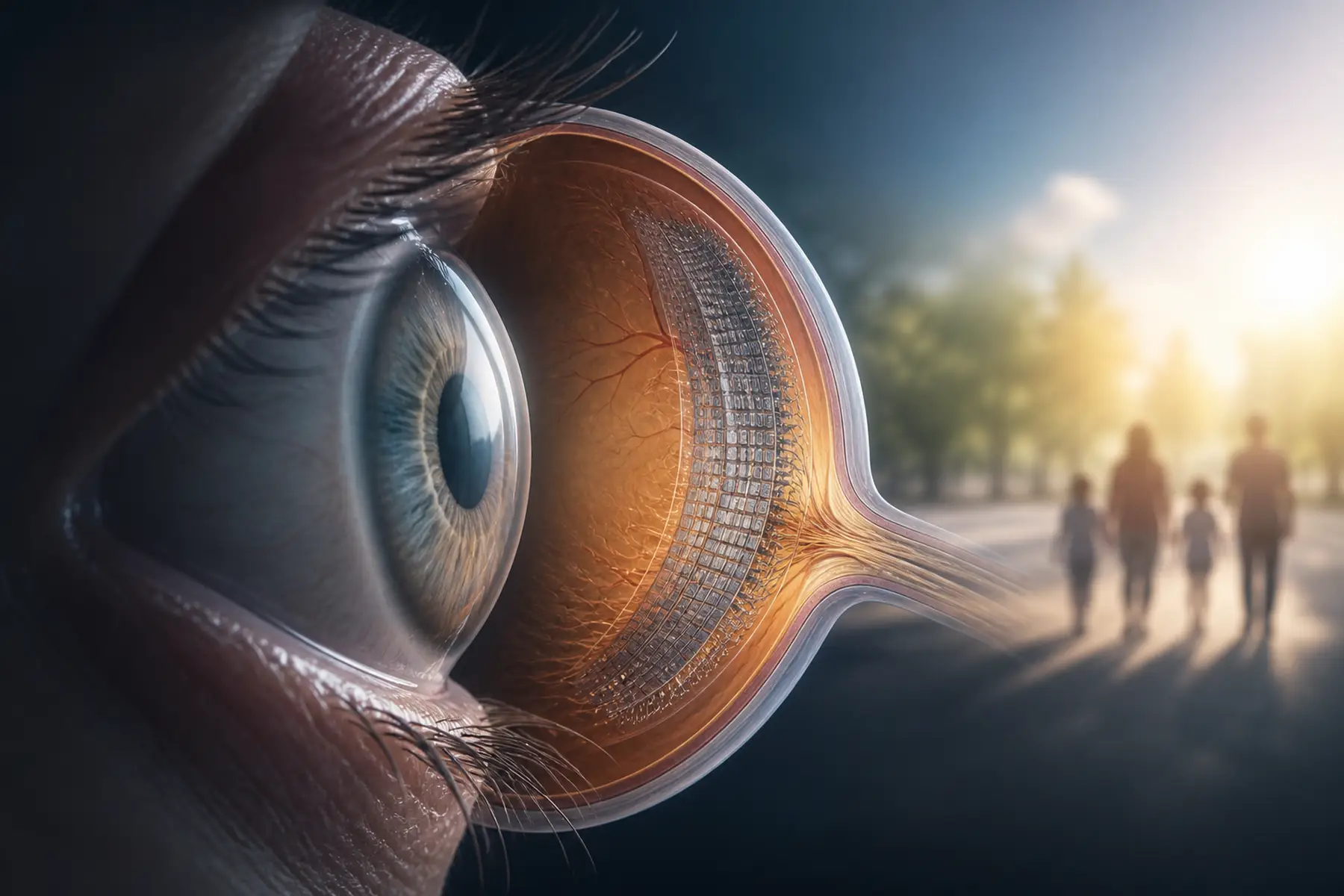
Blindness caused by retinal degeneration will become reversible.
The instrument that achieves it will not resemble a mechanical eye. It will be a film of light-sensitive electronics resting beneath the retina, paired with intelligent glasses and connected to neural tissue that still remembers how to see.
The scientific promise is direct: where disease has destroyed the eye’s natural photoreceptors but left the visual pathway alive, a synthetic layer will take their place. It will receive an image, turn light into electricity and pass the signal into the surviving retina. The brain will do the rest.
This is no longer a theory waiting for its decisive experiment. Patients with advanced macular degeneration are already reading through a photovoltaic retinal implant. European clearance has moved the technology from the research ward towards ordinary clinical use. The picture remains young, but the connection works.
From here, the synthetic retina becomes smaller, sharper, wider and more intelligent. It will progress from letters to faces, from central detail to the surrounding scene, and from a rare intervention to an established branch of restorative medicine.
The image has reached the brain
Earlier retinal prostheses proved that electrical stimulation could create points and streaks of light. They established the surgical route and confirmed that a damaged eye could still carry an artificial signal into the visual cortex.
PRIMA crossed the more important boundary. Its recipients perceived forms.
In its pivotal European study, a large majority of the assessed patients gained meaningful visual acuity. People who had lost the centre of their visual field could identify letters and words. With digital magnification and contrast enhancement, some read books, signs, prescriptions and crossword clues. Their natural peripheral vision continued to operate beside the new prosthetic image. The clinical results were published in the New England Journal of Medicine.
At Moorfields Eye Hospital in London, Sheila Irvine described the return of reading in language more important than an eye chart.
“It’s made a big difference. Reading takes you into another world. I’m definitely more optimistic now,” she said. UCL
Her experience defines the true threshold. A useful synthetic retina does not have to reproduce every detail of natural sight. It has to reconnect a person with the visible world: the printed word, the shape of a room, the movement of another person and, eventually, the expression on a familiar face.
European commercial clearance for PRIMA means retinal restoration now has a route into specialist hospitals. Science Corporation can build clinical centres, train surgeons and improve the device through patients using it in daily life.
The age of demonstration is ending. The age of refinement has begun.
The eye has an unfinished circuit
The retina is not simply a screen at the back of the eye. It is layered neural tissue which begins processing an image before the signal reaches the brain.
In degenerative diseases, the light-sensitive rods and cones often die while the neurons behind them survive. The input vanishes, but much of the circuit remains. Synthetic retinas exploit that biological opening.
A subretinal photovoltaic implant sits where the missing photoreceptors once worked. Camera glasses capture the scene and project a processed version into the eye using invisible near-infrared light. Microscopic photovoltaic elements convert that light into local electrical stimulation. The surviving bipolar cells receive the pattern and feed it through the retina, the optic nerve and the brain.
The implant needs no buried battery and no cable crossing the wall of the eye. Light carries both its power and its information. Because the projected beam is invisible to the remaining natural photoreceptors, artificial central sight can coexist with natural peripheral vision. The system’s architecture is described in the Journal of NeuroEngineering and Rehabilitation.
This is why the retina will advance faster than many other neural interfaces. Engineers do not have to translate an image directly into the language of the visual cortex. They can enter the pathway at an earlier layer and recruit neural circuits shaped by a lifetime of seeing.
The synthetic retina supplies the missing spark. Biology supplies the interpreter.
Sharper sight is already being fabricated
The central engineering challenge is not mysterious. The implant needs finer visual elements, closer contact with surviving neurons and a larger area of retinal coverage.
All of these are moving.
Laboratory implants with far smaller photovoltaic elements have restored visual responses at the natural resolution limit of animal eyes. Researchers have also removed an existing subretinal implant and placed a more advanced device into the same retinal pocket while preserving the tissue’s ability to respond. The work in Nature Communications points towards an implant that can be upgraded as the technology improves.
A separate human-retina model has shown how raised microscopic electrodes can concentrate stimulation around nearby bipolar cells, even when scar-like debris separates the electronics from its neural target. The study in the Journal of Neural Engineering describes a route to vision sharp enough for ordinary visual tasks without depending upon extreme magnification.
Wide-field devices are advancing alongside central implants. Flexible photovoltaic arrays can curve across the retinal surface and activate densely packed regions independently. POLYRETINA research shows how artificial vision can expand beyond a small central window and begin representing the surrounding scene.
The science no longer needs to discover whether retinal neurons can read a synthetic signal. It needs to refine the physical conversation between electronics and tissue. That is the familiar territory of semiconductor fabrication, materials science, imaging and surgical engineering.
Each generation will sit closer to the neurons, stimulate them more selectively and cover more of the visual field.
Software will decide what becomes visible
A natural retina receives whatever light enters the eye. A synthetic retina can choose.
That distinction will make prosthetic vision unusually powerful. The camera and processor can simplify a crowded scene before it reaches the implant. They can enlarge text, strengthen an edge, brighten a doorway, isolate a moving vehicle or emphasise the features of a face.
The implant provides the channel. Software decides how to spend it.
Researchers have already built machine-learning methods that identify facial landmarks and strengthen the features most likely to disappear in prosthetic vision. In simulation, this processing made expressions and emotions substantially easier to recognise. The published study shows how an implanted patient could receive better face perception through software rather than another operation.
Future retinal glasses will change visual modes as naturally as a camera changes focus. Reading mode will stabilise and clarify words. Face mode will preserve the eyes and mouth. Navigation mode will remove clutter and emphasise steps, doors, kerbs and approaching movement. Personal calibration will match stimulation to the surviving cells in each wearer’s retina.
The result will not be a crude imitation of a camera feed. It will be vision edited for human purpose.
The implant will become a medical platform
The route to widespread use is already recognisable to retinal surgeons.
The present implant is inserted using techniques derived from established vitreoretinal surgery. The eye is allowed to heal, the system is activated and the patient learns to interpret the returning image. Long-term follow-up has shown that prosthetic central vision can remain useful while surrounding natural sight is preserved. Clinical follow-up supports the idea that this is a durable interface rather than a temporary experiment.
The ability to replace an implant will turn the operation into a platform. A patient will not be permanently tied to the electronics available at the time of surgery. A more advanced synthetic retina can take the place of an older one, while glasses and processors improve without surgery at all.
Macular degeneration provides the opening market because it leaves peripheral vision intact while destroying the detailed centre. Retinitis pigmentosa and Stargardt disease will widen the mission. Organic photovoltaic films, flexible electronics and new electrode materials will create alternative designs for different patterns of retinal loss. A Nature Reviews Bioengineering survey describes a growing family of light-responsive materials capable of behaving like artificial photoreceptors.
The winning synthetic retina may eventually combine several of these approaches. What matters is that the clinical pathway, neural target and engineering logic have now converged.
The promise
The synthetic retina will restore useful vision to eyes medicine once considered permanently blind.
It will begin with the written word because letters are high-contrast forms and reading is easy to measure. It will advance to faces as resolution, contrast and intelligent image processing improve. It will expand into navigation as flexible arrays cover more of the retina. It will become easier to implant, personalise and replace.
The change will be profound because sight is woven through independence. Reading a message, recognising a visitor, locating a platform and finding a doorway are not laboratory tests. They are the visible structure of ordinary life.
The breakthrough has already occurred: an electronic layer beneath a damaged retina can return form vision to the brain.
Everything that follows is refinement.
Within a generation, the loss of photoreceptors will no longer mean the permanent loss of sight. Surgeons will place a new light-sensitive layer inside the eye, software will shape the image, and surviving neural tissue will carry it home.
The synthetic retina will not remain a metaphor for future medicine.
It will become sight.