
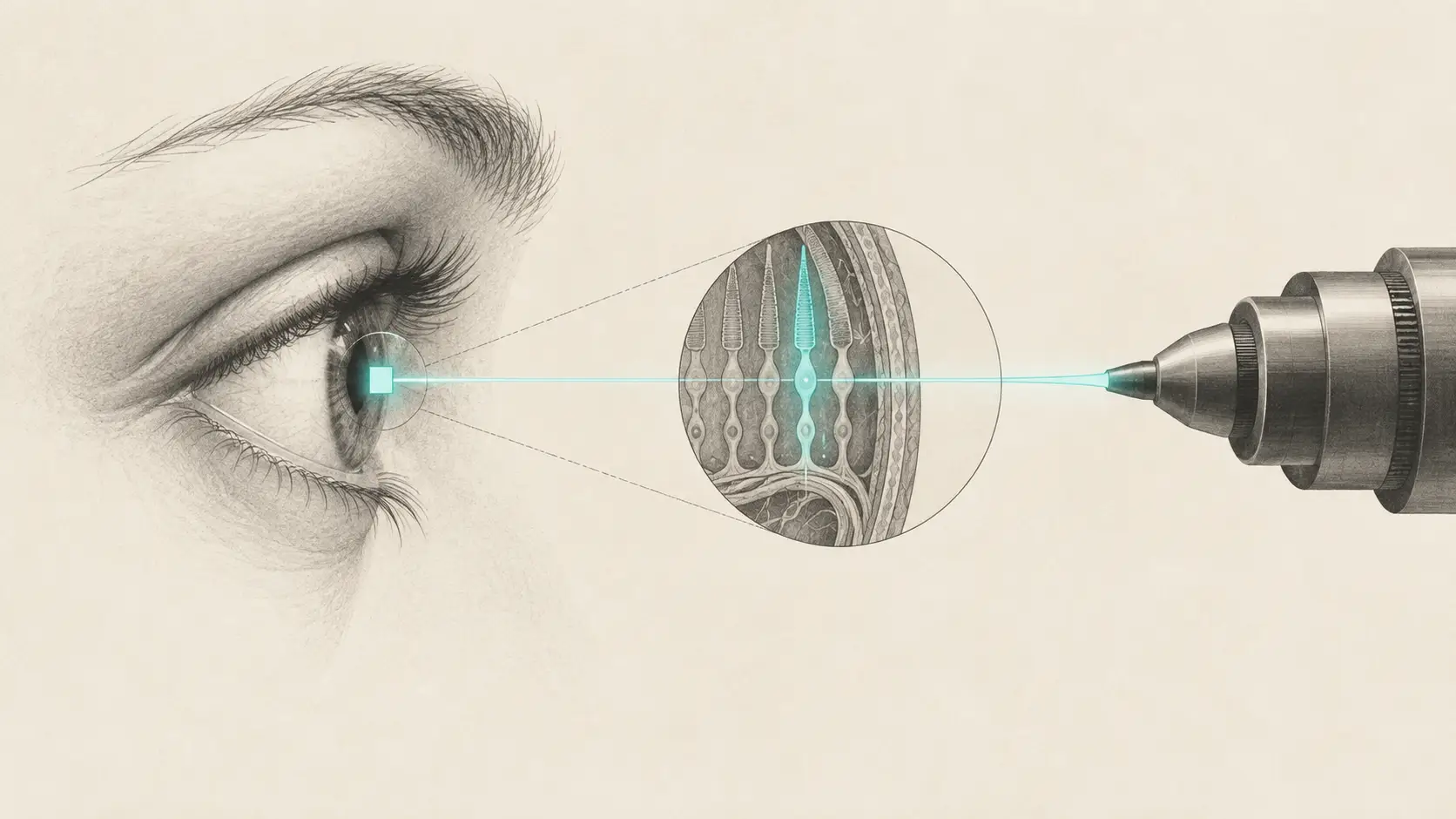
Imagine visiting a science museum in 2040. You sit before an instrument, fix your gaze on a small point and see a patch of color appear beside it. You ask what shade it is. The operator cannot hand you a photograph or bring up a faithful version on your phone. The instrument is the only way to see it.
That visit is a forecast. The color is real already.
In 2025, researchers at the University of California, Berkeley used precisely targeted light to make five study participants perceive a blue-green they named olo. Color-matching tests placed it beyond the range that ordinary light can produce for a human eye. The experiment established something remarkable: the familiar limits of color belong partly to the way light reaches our retinal cells, not simply to what the brain can perceive. Original study
ParallaxSee forecasts a 40% chance that, by 31 December 2040, an experience of a color beyond the natural human gamut will be offered to the public outside a research-participant study. The first venue is likelier to resemble a museum or specialist exhibition than an electronics shop.
01 — A new blue is different from a new sight
Chemists can invent a pigment, give it a name and sell it to painters. YInMn Blue, discovered at Oregon State University, is now available in artists’ materials and industrial coatings. It is a significant materials invention. It is also a blue that an ordinary eye can see in the ordinary way. Oregon State University, pigment manufacturer
Olo makes a different claim. It cannot be mixed in a paint factory or displayed faithfully by putting more saturated pixels on a screen. To understand why, consider the eye’s three kinds of color-sensing cone cells: S, M and L. They respond to overlapping ranges of light. Shine a wavelength that excites the middle, or M, cones and you will also excite other cones. No ordinary beam of light can give the eye the pattern of responses the Berkeley researchers wanted.
Their solution was to aim tiny pulses of laser light at individual cells. First they mapped which cones were which in a participant’s retina. Then their Oz system tracked the eye’s movements and directed pulses towards selected cones. By stimulating primarily M cones, it produced an experience participants described as an exceptionally saturated blue-green. When the researchers deliberately nudged the pulses off target, the effect gave way to the laser’s ordinary color. Berkeley’s explanation
A picture labelled “olo” can show where blue-green sits in our vocabulary. It cannot show olo. If your screen could reproduce it, the experiment would not have been necessary.
02 — The difficult journey from five participants to a queue of visitors
The achievement is already more than a fleeting flash. The team showed that its system could place shapes and moving imagery against the unusual color. But the prototype works over a visual area of just 0.9 degrees—a small patch off to one side of where a participant looks. It needs a map of that person’s cone cells, extremely accurate tracking and a specialized optical setup. One researcher compared the visible patch to a fingernail held at arm’s length. Original study, Berkeley interview
Those limitations suggest how the public will first encounter a new color. A shared instrument could serve visitors one at a time. It would need a reliable way to prepare each visitor’s retinal map, maintain alignment and establish appropriate eye-safety procedures. Making the experience available by appointment is a smaller leap than building it into lightweight glasses for people to wear all day.
Research gives the instrument another reason to improve. The Berkeley team is using precise cone stimulation to investigate how vision works and how retinal disease affects it. That scientific work could refine the same mapping and control on which a public demonstration would depend. This is a plausible route to an exhibition, not an announced plan for one. Berkeley’s research account
03 — Is it really a new color?
There is an honest argument over the word new. Olo did not add a fourth type of cone to the participants’ eyes. They called it blue-green, rather than reporting an unnameable fourth primary color. Some vision scientists regard it as an extraordinarily saturated version of an existing hue. The scientific debate
The narrower finding is strong enough to carry this forecast: the researchers’ color-matching tests placed the experience outside the natural human gamut. The claim concerns a perception that ordinary incoming light cannot reproduce, whether one chooses to call that a new color or an extension of blue-green. Original study
It is also distinct from giving someone an additional channel of information. Infrared-converting contact lenses, for example, aim to turn otherwise invisible signals into colors the eye already knows. Oz changes the pattern of activity that reaches the brain.
04 — Why 2040?
Fourteen years is enough time, in our judgment, to turn a delicate laboratory demonstration into a supervised public experience. The reason to expect a shared venue first is practical: one carefully maintained machine could give many people a short encounter with olo without solving the much larger problem of putting the technology in every home.
The strongest case against the forecast is the preparation required for each new eye. An instrument that performs beautifully for a small research group may remain too slow, exacting or expensive to operate for ordinary visitors. Research into vision loss may also prove more valuable than building an exhibition; progress in the laboratory would not necessarily lead to public access.
Our 40% estimate is a subjective forecast, not a development schedule from the Berkeley researchers. The milestone is specific: by the end of 2040, a museum, science center, gallery or commercial venue must make an instrument-generated color beyond the natural human gamut available to ordinary adult visitors, rather than only to invited research participants. At least 100 visitors outside a formal research study must complete the experience, and the color’s status must be supported by published color-matching or equivalent independent evidence. A new pigment, a more vivid conventional screen or a private laboratory study will not count.
For most of history, seeing a new color meant finding a new way to make paint. The next one may require us to find a new way to address the eye. If this forecast is right, the first public color that cannot be photographed will be a small patch beside a fixed point—and visitors will leave knowing that the picture they took cannot show what happened.