
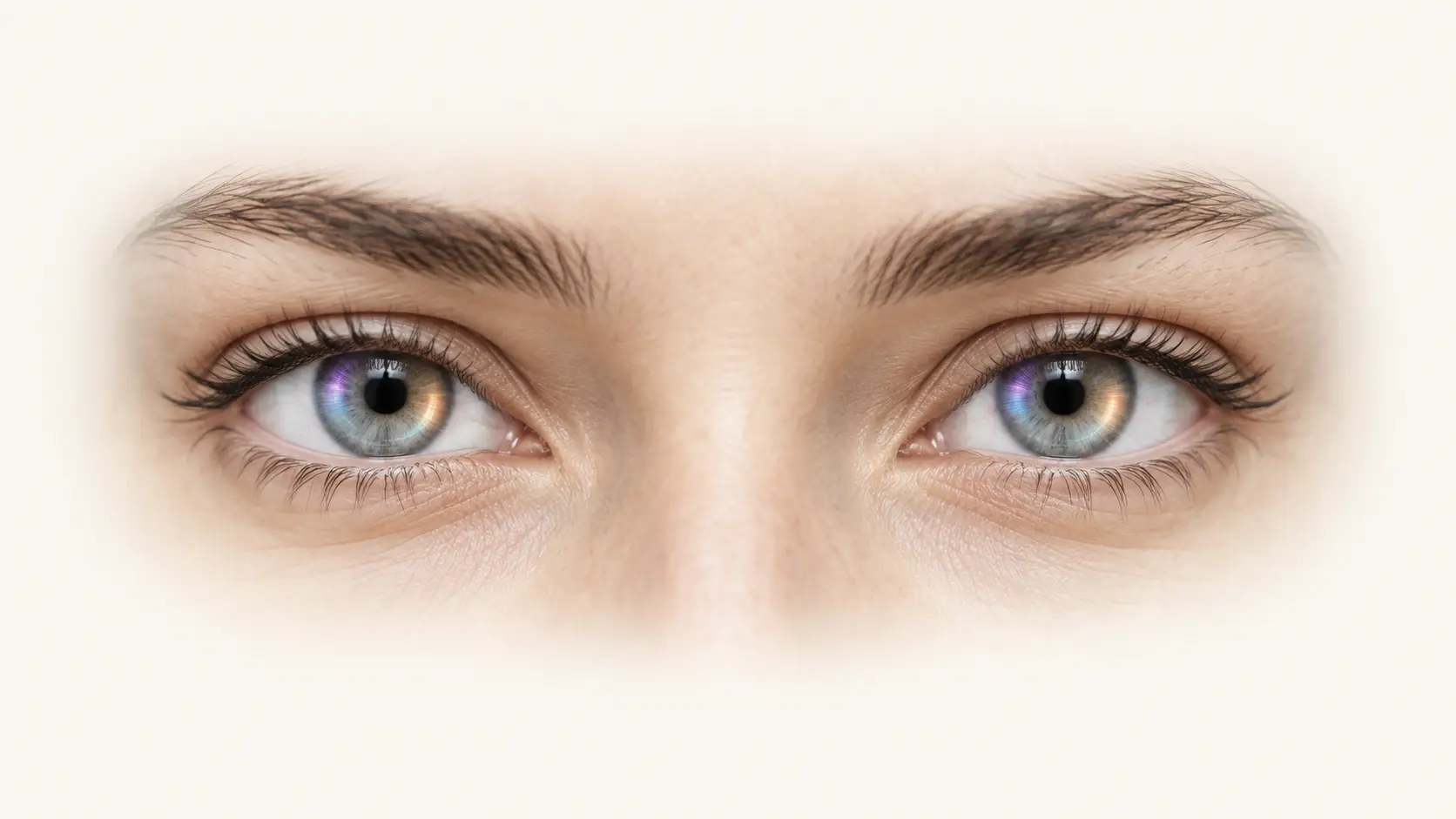
Imagine an inspection room in 2035. To one worker, a panel looks blank. To a colleague wearing specialist contact lenses, a marker glows against it. Both people are looking at the same surface. One can read information the other's eyes cannot detect.
The scene is a forecast. The underlying human ability has already been demonstrated: in 2025, researchers reported that volunteers wearing experimental lenses could perceive near-infrared signals. The human study
ParallaxSee assigns a 55% chance that, by 2035, at least one infrared-converting contact lens will be authorized and commercially supplied for specialist use in China, the United States or the European Union. Its first useful job could be as simple as making an otherwise invisible signal readable.
That is a small task with an extraordinary implication. A familiar, removable object could extend the range of information entering human vision.
01 — A new sense can begin with a translator.
The elegant part of this technology is where the transformation happens. Light changes before it reaches the retina.
The experimental lenses contain materials that absorb near-infrared light and emit visible light. Physicists call the process upconversion. Energy collected from lower-energy photons produces higher-energy visible emission. The lens becomes an optical translator, supplying the eye with a signal it already knows how to process.
In the 2025 Cell study, researchers also developed lenses that mapped different infrared wavelengths into distinguishable visible colours. Volunteers could tell apart information carried by different parts of the near-infrared spectrum. The conversion itself needed no battery. Original research
A useful analogy is a map with an extra information layer. Roads and buildings remain where they were; another channel becomes legible. Here, that additional channel comes from light outside our ordinary visual range.
02 — China moved the experiment from inside the eye to its surface.
An earlier milestone came in 2019, when a Chinese–American team reported near-infrared perception in mice after placing light-converting nanoparticles at the retina. That animal experiment established a route for delivering otherwise invisible information into mammalian vision. The 2019 paper
The later contact-lens approach gave the idea a removable, wearable form. Researchers at the University of Science and Technology of China, Fudan University and collaborating institutions brought together neuroscience, polymer engineering and luminescent materials.
Fudan's Chinese-language account explains the painstaking chemistry behind the apparently simple object. The particles needed to perform their light-converting work while remaining dispersed within a highly transparent lens.
“From design to synthesis, a single target product takes at least one or two months,” researcher Chen Zihan explained, translated from Chinese. He was describing the development of the desired particle structure, rather than the production time for each finished contact lens. Fudan's research account
That distinction captures the commercial opportunity. Researchers are doing the difficult work of discovering a repeatable material architecture. A manufacturer would then have to reproduce it consistently, comfortably and at an acceptable cost.
03 — Sharper vision will come from controlling where the light goes.
USTC's original Chinese announcement identifies the next engineering target. Converted light scatters, leaving the experimental contact lenses alone with limited spatial detail. Additional eyeglass optics allowed finer image recognition. The team also says the current conversion efficiency requires assisted infrared illumination. USTC's technical explanation
A separate Chinese-led study in Nature Communications points towards useful improvements. Researchers designed tiny light-converting spheres and layered optical structures that capture infrared energy more effectively and favour emission in a useful direction. They reported a lower illumination threshold and improved performance in experiments involving rabbits with retinal degeneration. The optical-engineering study
Think of the difference between a lamp scattering light around a room and an optical system steering more of it towards a particular destination. Efficient conversion and controlled direction help determine whether the wearer receives a faint blur or useful information.
The rabbit work and the human contact-lens experiment are separate studies. Bringing their advantages together remains an engineering proposition. Their importance is that the main obstacles have become specific: collect more useful light, direct it better and preserve ordinary vision.
04 — The first market could be a world of invisible labels.
The most plausible early product, in our assessment, serves a controlled environment with a clearly defined visual task.
An inspection station could use near-infrared markers to distinguish components. A laboratory could make equipment-status signals visible to suitably equipped staff. A specialist training environment could place an additional set of cues alongside the ordinary scene.
These are proposed applications, not announced deployments. Their attraction is that the user needs to recognise a signal or pattern, a smaller engineering challenge than obtaining a detailed view of an entire dark landscape.
The distinction between kinds of infrared matters. These lenses translate near-infrared illumination; detecting the longer-wavelength heat radiation used by thermal cameras is a different task. A contact lens that reveals an infrared marker would not thereby reveal a person behind a wall.
Even the narrower ability creates an intriguing design possibility: physical spaces with two overlapping sets of visual instructions. One is visible to everyone. The other becomes readable through an optical key.
That key would offer selective visibility, not guaranteed secrecy. Other suitable sensors could detect the same signals.
05 — The route to everyday use runs through eye safety.
The eventual product will be judged on what happens after repeated wear as well as what a volunteer can see during a demonstration.
The development programme would need to establish that the material remains stable, that its particles stay contained, and that the finished lens supports healthy wear. Optical performance would have to hold up alongside fit, oxygen transmission, cleaning or disposal requirements and safe illumination.
There is already a regulatory framework for products that sit on the eye. In the United States, even decorative contact lenses are medical devices requiring a prescription; FDA oversight extends beyond lenses that correct poor eyesight. FDA's explanation
That establishes the need for scrutiny. It does not establish which regulatory route an infrared product would take, or provide an approval date. Our research identified no verified product-specific FDA timetable.
A successful specialist launch could occur first in another jurisdiction. The article's 2035 forecast therefore concerns a qualifying product reaching one of the three named markets, with the relevant authorization and evidence for its intended function.
06 — Why 2035? Because the remaining race is for a useful product.
The strongest case for this forecast is the modest first commercial job. A lens that reliably reveals a deliberately illuminated marker could be useful long before one delivers cinematic night vision. Almost a decade allows time for sponsored development, repeated-wear studies, manufacturing work and regulatory review. That interval is our judgment, not a timetable supplied by the researchers.
The strongest counterargument is commercial. Goggles, glasses or a camera may perform the chosen task more conveniently and economically. A remarkable lens could remain a research achievement if too few customers benefit from putting the technology directly on their eyes. We found no reliable basis for forecasting its selling price.
Our 55% estimate is a subjective forecast, not a measured clinical success rate. We assign 70% to a sponsored programme delivering a manufacturable specialist lens, then 85% to adequate safety evidence and authorization conditional on that progress, and 90% to commercial supply conditional on both. The combined estimate is approximately 54%, rounded to 55%. No closely matched historical dataset supports treating those judgments as calibrated probabilities.
For the forecast to succeed by 31 December 2035, a qualifying lens must have valid authorization and documented commercial supply outside research. Controlled human testing must show at least 75% correct recognition of a predefined near-infrared signal or pattern, significantly above chance, while matched ordinary lenses do not enable above-chance recognition. External illumination can qualify; animal results, preorders and ordinary night-vision goggles cannot.
Return to the inspection room. The worker reads a mark that, a moment earlier, was inaccessible to the naked eye. The achievement may look unremarkable from across the room: a glance, a decision, a task completed.
From inside the lens, the world has acquired another layer.