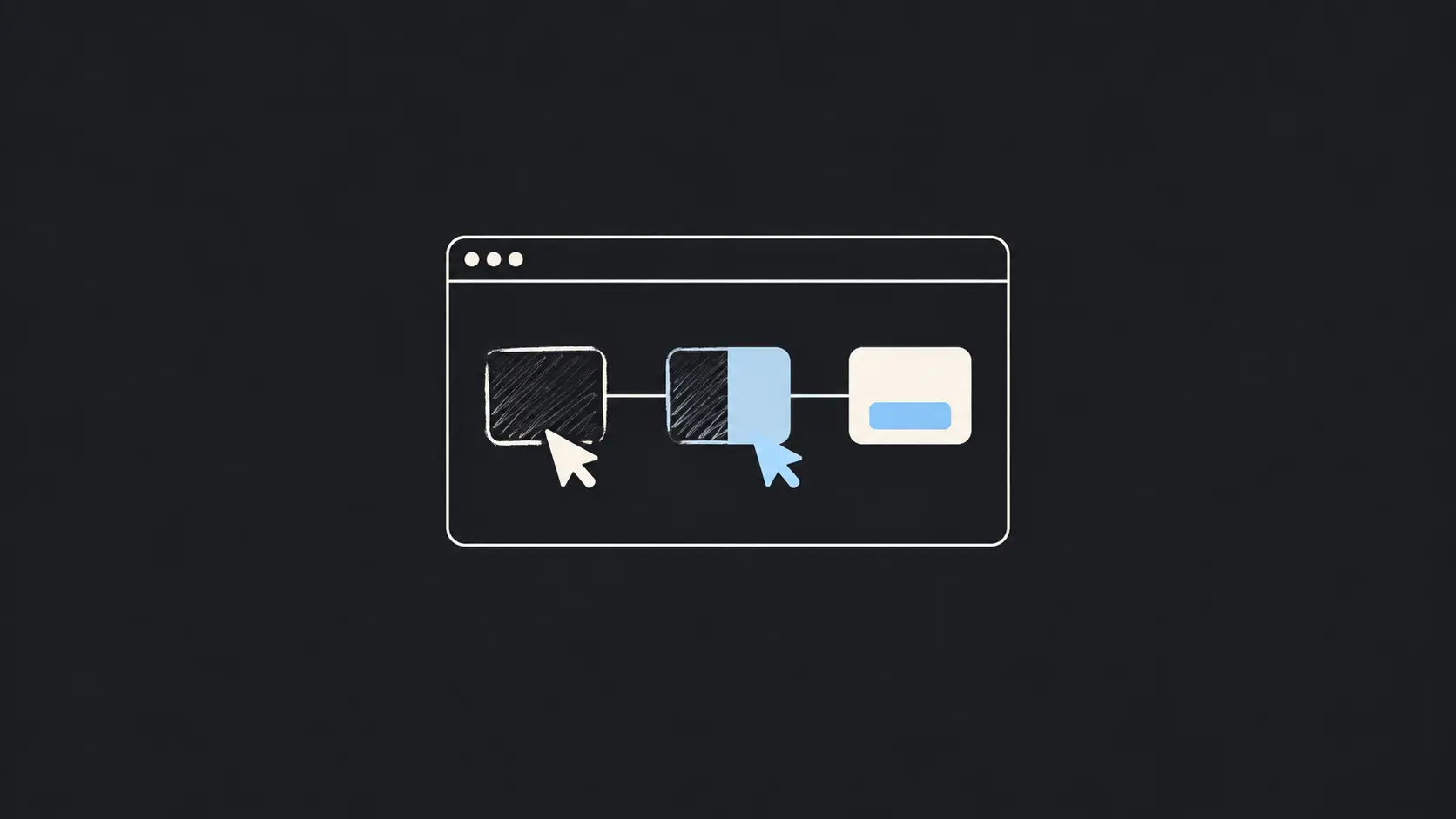
The designer circles a map and says, “Let this work without a signal.”
An AI collaborator highlights everything the travel app currently fetches from the internet. An engineer suggests saving the traveller’s planned route. A colleague wants the whole city available. Two versions begin taking shape beside the drawing, with different storage requirements and different rules for updating the information.
The team tries both. Someone asks what happens when a restaurant closes. The AI marks an assumption nobody had discussed: how long an offline recommendation should remain trustworthy.
This is the software studio we expect to emerge by 2030. The conversation, architecture and running program become connected parts of the same creative activity.
ParallaxSee forecasts a 65% chance that, by 2030, at least two independently maintained professional development platforms will offer a shared human–AI workspace combining editable designs, architecture linked to source code, comparable runnable alternatives and retained decision evidence.
Research systems already demonstrate important parts of this experience. The breakthrough ahead is bringing them together so that an idea can be discussed, changed and tested without repeatedly losing its context.
01 — The meeting will produce working software.
An integrated development environment, or IDE, gathers the tools used to write, run and debug a program. Its next expansion will bring the earlier, messier work of invention into the same environment.
Google’s Product Canvas offers an early glimpse. The January 2026 prototype combines a shared canvas, voice assistance, generated design sketches and working browser-based mini-apps. Its meeting mode lets Gemini participate alongside human collaborators, listening and contributing while they explore ideas. Google’s Product Canvas
The prototype is explicitly experimental. Its significance lies in the interaction: people can talk about a product while changing a representation of it together.
Our forecast extends that experience into a maintained project. A designer’s drawing would remain connected to the requirement it expresses. An engineer’s objection would attach to the component it concerns. An agent’s experimental implementation would retain the question it was built to answer.
For the travel-app team, “offline access” becomes something they can handle. They can disconnect a preview, explore a city and discover which parts of their idea survive the experience.
The meeting leaves behind both a clearer intention and the beginnings of its implementation.
02 — AI will help invent the question.
One of the most interesting research IDEs is Pail, presented at CHI 2025. It combines code, running output, conversation and a design panel. That panel distinguishes confirmed requirements from decisions the model introduced without explicit agreement, and offers alternatives that users can try and reverse.
In an exploratory study with 11 participants, the system helped people consider different ways of framing and solving their problems. It also exposed an important difficulty: participants could become overwhelmed by the volume of information and changes. The work concerned small interactive programs, rather than production-scale systems. The Pail research paper
The creative possibility is a collaborator that helps discover the product while helping build it.
In our imagined studio, the travel team requests better recommendations. The AI might suggest a different goal: help a visitor enjoy an afternoon without repeatedly consulting a phone. That could produce an entirely different interface—a short walking route with a few memorable stops.
The suggestion remains a hypothesis to explore with real people. Its value comes from opening a direction the team had not considered.
A useful AI partner will expand the range of possible ideas, then help the humans choose which deserve attention.
03 — Architecture will become something everyone can point to.
Software architecture describes the major parts of a system and how they interact. In the shared studio, those relationships become working objects.
A box representing offline storage would link to the code implementing it. A connection to the recommendation service would identify the interface carrying the data. Changing either would update the relevant view or clearly mark it as needing review.
There is a bounded demonstration of this principle in InstructPipe, another CHI 2025 research system. It translates instructions into a structured representation that an interpreter turns into an editable visual pipeline. People can inspect and reconnect the same machine-learning pipeline the AI generated. InstructPipe
The interpreter matters. It gives the picture a defined relationship to executable operations. Extending that relationship to application architecture is a harder undertaking, but a much richer destination than a diagram generated for a presentation.
Sketch-based interaction offers another route. Code Shaping lets programmers annotate code and output with free-form marks that an AI interprets as proposed edits. Its studies examined small programs; the system is an early investigation of how people can express programming intentions visually. Code Shaping
The future studio could combine these approaches. Draw a boundary, explain what it means and inspect the proposed consequences before accepting them. The model’s interpretation would be visible and correctable.
A sketch becomes the beginning of an engineering conversation.
04 — The program will become a shared experiment.
People and agents will collaborate more effectively when they can inspect the same running computation.
Marimo pair, released in April 2026, already places agents inside a live Python notebook. They can inspect variables, run temporary experiments and add persistent cells. Changes propagate through the notebook’s tracked dependencies, allowing people and agents to work with the same computational state. Its main setting is research and data work. Marimo’s implementation
That is a valuable technical foundation for the studio: shared access to what the program is doing, alongside the text that makes it happen.
For our travel app, the team could adjust the age of downloaded information, the amount of available storage and the quality of the network connection. An agent could build a small experimental panel exposing those controls. A human could move a slider and ask why a recommendation disappeared.
The environment would help them investigate the answer, preserving the relevant input, result and source revision.
This is a forecast about live models and runnable experiments, each with declared limits. A test environment cannot reproduce every condition encountered by real travellers. It can make a design assumption concrete enough to examine.
The studio’s tools may increasingly be created for the question at hand: a temporary visualisation, a failure replay or a comparison between two designs. The workspace becomes a workshop that can make its own instruments.
05 — Review will begin with the decisions hidden inside the code.
A program can implement the wrong promise perfectly.
The travel app might run without errors while treating a month-old restaurant listing as current. A conventional review can find the implementation. A richer review should also expose the assumption and who agreed to it.
Research is beginning to address this higher level of discussion. MAAD, a multi-agent architecture-design framework, assigns models analysis, modelling, design and evaluation roles. It produces architectural blueprints and trade-off reports. The work evaluates design artifacts, including feedback from industrial architects; it does not establish that the resulting architectures will perform reliably after deployment. MAAD’s research
Our forecast is a continuing review conversation in which proposals and objections remain attached to specific parts of the project. An agent might flag an inconsistency between offline access and the freshness requirement. A human could revise the requirement, request an experiment or reject the proposed implementation.
The accepted decision should then become something future work can check.
The MAGE framework, described in an August 2026 preprint, proposes making consequential engineering knowledge explicit through models, constraints and acceptance gates. It is a theory with case-based grounding, rather than a demonstrated universal solution. Model-Based Agentic Software Engineering
In the studio, “show when this information was last updated” could become a recorded requirement linked to its implementation and a repeatable test. A later agent changing the interface would inherit the obligation.
The project remembers what the team decided and how to notice when that decision has been broken.
06 — A collaborator needs to be visible—and interruptible.
Several intelligent participants working in the same space create a social problem as well as a technical one. People need to know where attention is directed, which changes are proposed and when someone else is already dealing with an issue.
Codellaborator, a CHI 2025 research prototype, gives an AI its own cursor, activity signals and discussions anchored to locations in the code. An 18-person study found that proactive assistance could disrupt work, while visible presence and contextual discussion helped reduce disruption and improve awareness. Codellaborator
The useful lesson concerns coordination. A developer should be able to see that an agent is investigating a particular interface and whether it is proposing, editing or waiting.
A good studio would also let the team quiet the models, reserve a component for human work or invite an agent into a discussion only when useful. Permission to examine an idea would remain distinct from permission to change the shared project.
That makes room for different kinds of contribution. A junior engineer can ask why a design works. A specialist can inspect the implementation. A designer can demonstrate the experience they want. Agents can connect those conversations to experiments without forcing everyone into the same mode of expression.
07 — The breakthrough is keeping the views in agreement.
The hardest part of this future is maintaining a trustworthy connection between intention, structure, code and observed behaviour.
Real applications contain changing configuration, external services and failures that depend on timing or unusual data. An elegant diagram can omit an important dependency. Several agents can produce convincing explanations from the same incomplete picture.
The studio will therefore need an explicit account of what it knows.
Source-analysis tools can identify relationships supported by the code. Execution records can show paths actually taken during a test. Human-approved requirements can state what must remain true. Model-generated suggestions can be marked as hypotheses. Each belongs in the project, with its origin and relevant revision attached.
When a change invalidates earlier evidence, the workspace should say so. A green result from an older implementation cannot silently certify a new one.
This is also where the familiar IDE retains its value. Its editor, debugger and analysis tools provide routes from a broad discussion into exact implementation details. The shared studio brings those capabilities into a larger creative process.
The result could widen participation without flattening expertise. More people can help shape the software; specialists retain the instruments needed to investigate it deeply.
08 — Why we put this studio in 2030.
The building blocks are unusually tangible: collaborative canvases, editable program graphs, agents inside running computations, design-exploration interfaces and recorded engineering obligations. Our forecast is that the next four years will turn these separate developments into a connected professional workspace.
We assign 65% confidence to the defined outcome. There is no established historical base rate for this exact combination. Our subjective scenario model assigns 85% to sufficiently dependable technical links, 90% to usable collaborative integration given that progress, and 85% to two independent platforms releasing the complete workflow given both. The conditional product is approximately 65%; the inputs are editorial judgments, not measured industry frequencies.
By 31 December 2030, we will look for at least two independently maintained, publicly available professional platforms that let human collaborators and AI revise shared designs; maintain architecture links to source or flag stale links; run competing implementations against common tests or scenarios; and retain decisions alongside their revisions and supporting evidence.
The capabilities must work together on the same persistent project. Connected tools may qualify; a collection of unrelated demonstrations will not. Verification will require released functionality and a reproducible walkthrough or direct inspection. This measures the arrival of the capability, rather than market share or the disappearance of conventional editors.
Return to the travel-app team. The map remains on the canvas. Beside it are the two offline designs, the experiments that separated them and the decision about keeping travellers informed when information grows old.
The software has advanced because people and machines had somewhere to explore it together.
That is the IDE’s next purpose: a place where an unfinished idea can be seen, questioned and made to run.