
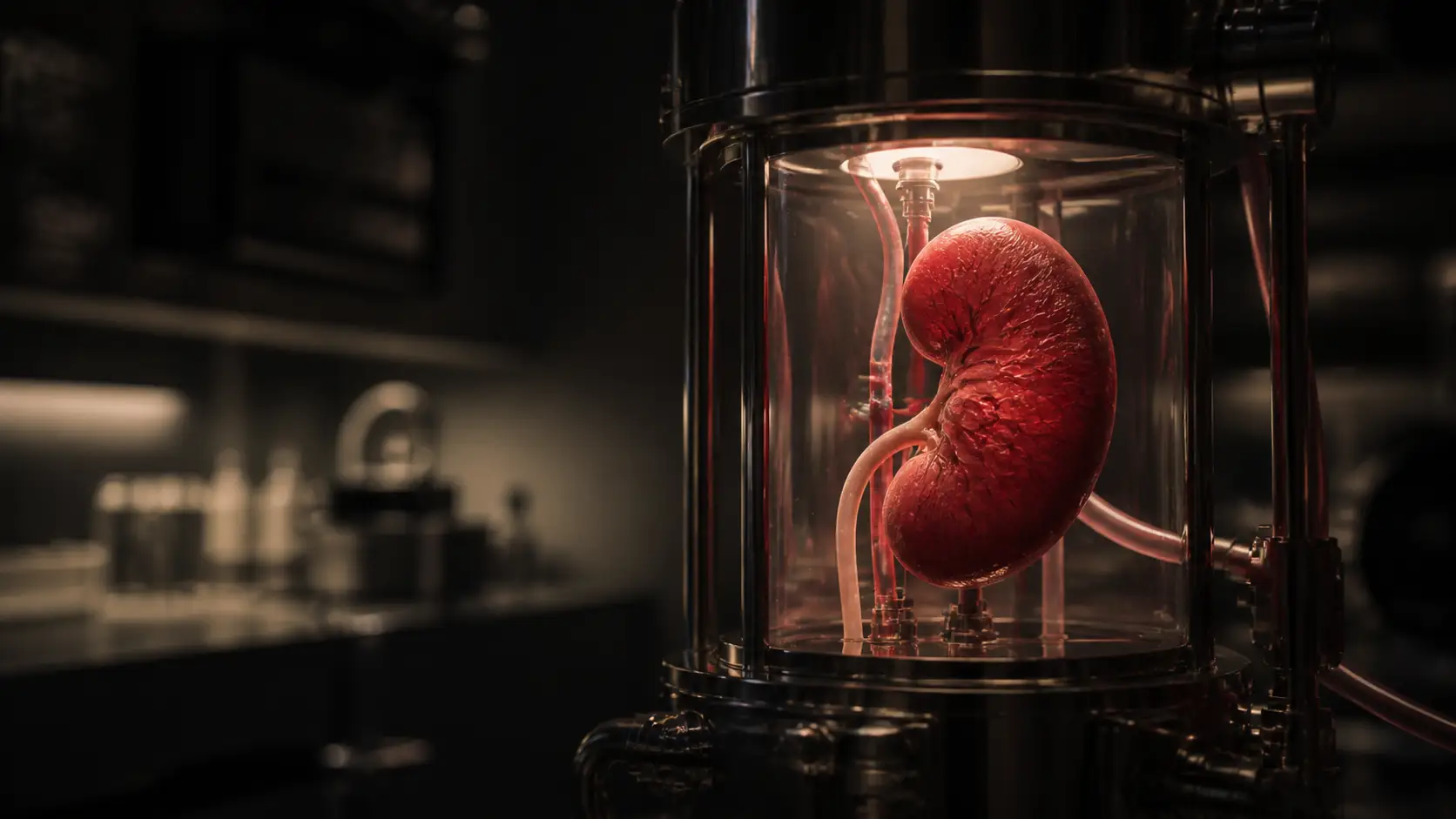
In physiology, the kidney is a maze of arrows: sodium moves here, water follows there, acid leaves, bicarbonate stays. In real life, kidney failure is measured in hours on dialysis and years waiting for a donor. A pig kidney can already clean human blood. That is no longer the science-fiction part. In 2024, a gene-edited pig kidney began working inside a living patient and freed him from dialysis. Another recipient later lived dialysis-free for a company-reported 271 days. The question has changed from can a pig kidney work in a person? to can we stop the immune system from wearing it down? By December 31, 2035, a living person will spend at least one full year with a gene-edited pig kidney, alive and off maintenance dialysis.
Why a pig kidney, not a lab-grown one. The phrase 'synthetic organ' makes it sound as if scientists are close to printing a replacement kidney from scratch. They are not. Researchers can grow kidney organoids—small clusters of human cells that reproduce pieces of kidney development—and they can strip cells from pig kidneys and refill parts of the remaining scaffold with human cells. Those recellularized kidneys have even shown short-term filtration in pigs. But an adult kidney contains roughly a million filtering units connected to blood vessels and a drainage system. Building all of that at transplant scale is a much harder problem than modifying an organ that already works. A pig kidney arrives with the plumbing, structure, and filtering machinery already in place.
Gene editing makes that working kidney less foreign. A normal pig kidney would be attacked almost immediately. Human blood contains antibodies that recognize sugar molecules on pig cells. Once those antibodies bind, they can trigger complement, clotting, inflammation, and rapid damage to the kidney's tiny blood vessels. Gene editing removes some of those molecular danger signs. Other edits add human genes that help control complement and coagulation or limit organ growth. The famous 69-edit pig did not receive 69 equally important upgrades: most of those edits disabled repeated copies of porcine endogenous retroviruses, while a smaller set changed immune compatibility. In a Nature study, a kidney made with this approach supported a macaque for 758 days. Gene editing does not make the kidney human. It makes the first immune attack less automatic.
We have already passed the 'can it work?' test. In March 2024, Richard Slayman received a gene-edited pig kidney at Massachusetts General Hospital. The organ began filtering, and dialysis stopped. Doctors treated an early episode of T-cell-mediated rejection. Slayman died 52 days after surgery from cardiac disease, and the published report did not identify rejection as the cause. That distinction matters: the patient died, but the kidney had been doing its job. Follow-up measurements showed that it removed waste, concentrated urine, balanced electrolytes, and participated in blood-pressure control, although some pig physiology—such as uric-acid handling and renin signaling—did not map neatly onto the human body. The physiology report turned a dramatic operation into something more useful: evidence that a pig kidney can join human circulation and perform real renal work.
The difficult part begins after the headlines. A transplant can make urine on day one and still fail months later. eGenesis reports that Tim Andrews lived without dialysis for 271 days before his pig kidney was removed. Because that number comes from the company that built the organ, it needs independent, peer-reviewed confirmation. Still, nine months is close enough to change the forecast. The gap between the reported record and one year is 94 days. That does not mean the final 94 days will be easy. It means the problem is no longer a distant invention. It is a durability problem.
Rejection is not one alarm. It is a building full of alarms. Removing the sugar molecules that cause hyperacute rejection only silences the loudest one. T cells can still recognize and attack pig tissue. B cells can make new antibodies. Complement can punch holes in cell membranes. Macrophages and other innate immune cells can keep inflammation alive even after circulating T cells have been depleted. Detailed immune profiling in a living recipient found exactly this kind of layered response. A 61-day decedent study found antibody-mediated rejection followed by combined antibody and cellular rejection; its multi-omics analysis showed human immune cells and pig tissue changing together over time. The obstacle is not simply 'rejection.' It is controlling several different forms of rejection without leaving the patient defenseless against infection.
Three improvements will carry a patient past one year. First, donor pigs will be edited more strategically. The goal is not the largest edit count, but the right combination of removed pig antigens and added human protective proteins. Second, immune treatment will become more precise. Drugs that block the costimulatory signals immune cells use to activate can protect the graft without relying only on broad immune suppression. Third, doctors will detect injury earlier. Creatinine rises after kidney damage has already occurred. Donor-derived cell-free DNA, antibody measurements, immune-cell profiling, and scheduled biopsies can reveal trouble sooner, when it is easier to reverse. The winning technology will not be the pig kidney alone. It will be the kidney plus a monitoring and rescue system.
The next challenge is durability after nine months. New antibodies, chronic blood-vessel injury, and accumulated drug toxicity become more important as a transplant ages. Early recipients also arrive with serious cardiovascular and infectious risks that can endanger them even while the kidney works. Crossing the one-year line requires four things at once: detecting slow immune injury before function falls, reducing the toxicity of long-term immune treatment, selecting patients who can survive recovery, and turning intensive rescue care into a protocol other transplant centers can repeat. These are the problems the next clinical cohorts are built to solve.
Infection is the risk that reaches beyond the patient. Donor pigs are raised in designated pathogen-free facilities, but living tissue can never be guaranteed sterile in the way a metal implant can. A hidden pig virus might behave differently in a heavily immunosuppressed person. That is why the FDA guidance requires traceable animals, stored samples, recipient records, and long-term surveillance. A confirmed donor-derived infection could stop trials altogether. Better screening and surveillance are therefore part of the transplant, even though they never enter the operating room.
What to watch next. The EXPAND trial plans to study up to 50 recipients, and United Therapeutics reported its first trial transplant in November 2025. The clearest progress marker will be a participant who reaches six months without dialysis and with stable filtration. Other strong signals are several kidneys from different donor animals behaving similarly, rejection caught before creatinine rises, and treatment that works without dangerous infections. Repeated graft failures at the same interval, progressive protein loss, clotting injury, or a regulatory pause will identify the next problems to solve. The social question matters too. The national transplant report describes a system already shaped by unequal access and long waits. A pig kidney that works but is available only to a few would be a scientific achievement and an incomplete medical solution.
What one year would mean. It would mean that a deliberately engineered animal organ can support a living person beyond surgery and early recovery, into ordinary long-term care. It would justify larger trials and move the debate toward durability, cost, manufacturing, animal welfare, and fair access. It would not prove that a pig kidney can last five years. It would not erase infection risk, replace human donation, or make xenotransplantation routine. But it would turn the basic question from 'can this be done?' into 'how can this be done safely and at scale?' That is a smaller claim than a cure for the organ shortage. It is also a milestone medicine now has a realistic chance to reach.