
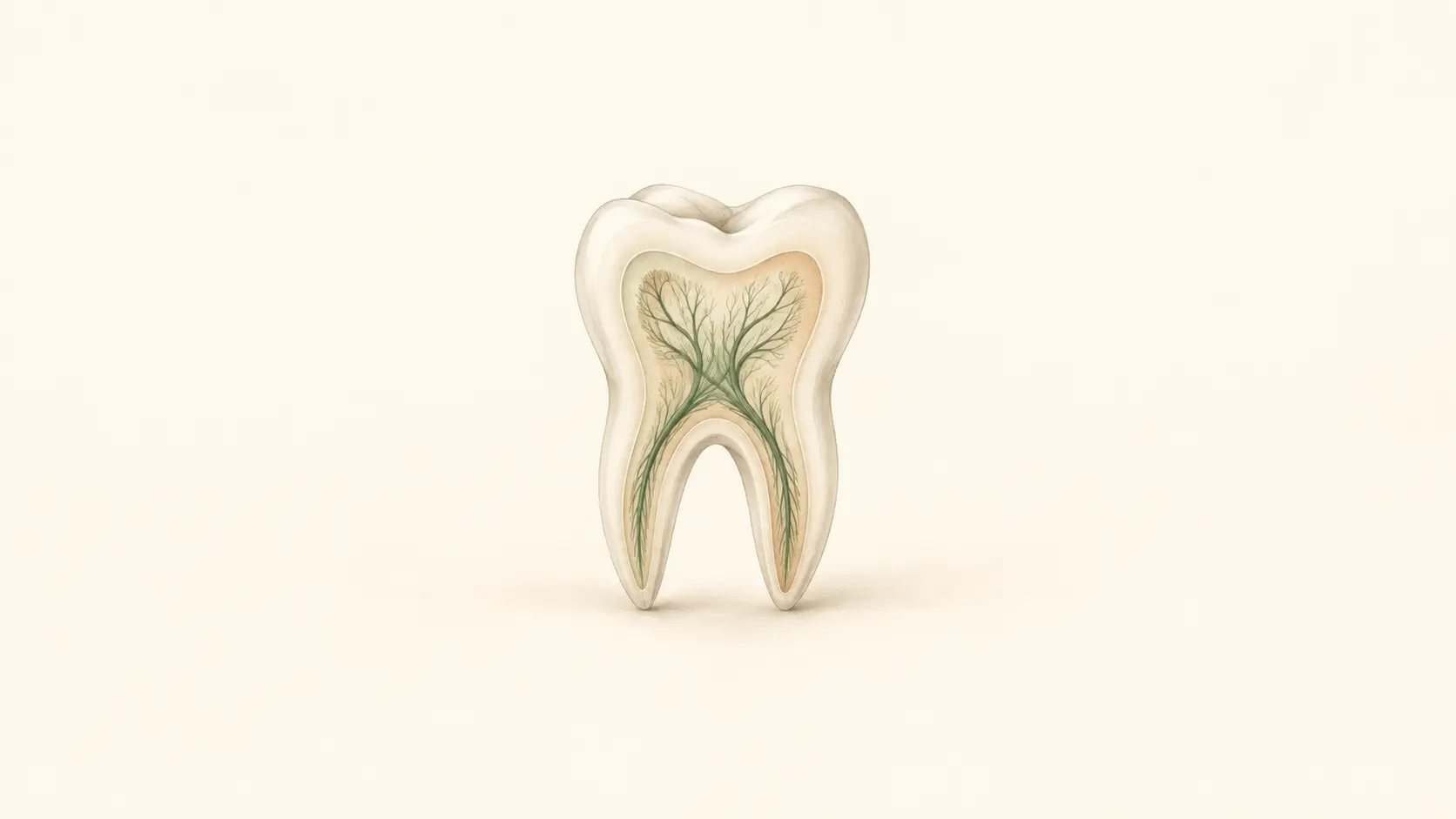
A damaged tooth could one day receive a treatment that restores living tissue: blood vessels inside its root, new dentin beneath its surface, or stronger support in the bone around it. The tooth would become a structure that medicine can help rebuild.
That possibility gives dental regeneration a practical starting point. Growing an entirely new tooth remains an extraordinary ambition. Preserving the living structures of an existing tooth offers several smaller, increasingly testable steps toward it.
ParallaxSee forecasts that by the end of 2035, at least one new randomized human trial enrolling 200 or more patients will demonstrate a statistically significant benefit on a prespecified primary clinical endpoint for regenerating tissue in or around existing permanent teeth, assessed at least six months after treatment. We assign this outcome a 65% probability, a rounded editorial judgment.
The forecast concerns a substantial research milestone. Approval and everyday availability would require further evidence and regulatory decisions. Its promise is nevertheless consequential: the first widely useful advances in tooth regeneration could help us keep the teeth we already have.
Restoring tissue inside an existing tooth
One of the most informative human experiments appeared in 2018. A Chinese-led team enrolled 40 patients whose immature permanent teeth had suffered traumatic injury and pulp death. Thirty were assigned to implantation of stem cells obtained from their own baby teeth; ten received an established treatment for injured immature teeth.
After exclusions, researchers evaluated 26 treated teeth and ten controls. At twelve months, they reported regenerated pulp with blood supply and sensory responses, alongside greater root development in the implantation group. Twenty treated patients were followed for safety for two years, with no adverse events observed in that small group. These were injured teeth that had not finished developing, which limits how confidently the result can be extended to mature adult teeth. The randomized pulp-regeneration study
The achievement suggests a useful way to think about regeneration. An existing tooth supplies much of the structure. Medicine may be able to restore a living interior without recreating the whole organ.
A related Chinese team subsequently reported a pilot study involving 15 patients with teeth knocked out by trauma. Their approach combined stem-cell aggregates with a decellularized tooth matrix: existing tooth material from which cells had been removed. At twelve months, the investigators reported functional recovery and continued root development. The retained matrix makes this a strategy for revitalizing tooth structure, rather than creating a completely new adult tooth from scratch. The tooth-avulsion pilot
China is testing an injectable repair
Periodontal disease offers another route. Here the regenerative target is the apparatus that holds a tooth in place, including surrounding bone and connective tissues.
A 2025 Chinese paper reported two randomized studies involving 132 patients in total: a 96-person trial and a 36-person dose study. Researchers injected donor-derived dental pulp stem cells into sites affected by periodontal disease, alongside conventional infection control. Follow-up lasted six months.
The results were mixed. The larger trial did not establish a significant advantage on its overall primary attachment measure. It did find an improvement in a bone-defect measure. A later subgroup analysis of severe disease found mean attachment gains of 1.67 millimetres with cells and 1.03 millimetres with saline. That subgroup was selected after the fact, so the stronger finding needs prospective confirmation. No serious adverse events were reported, but this sample and follow-up cannot establish rare or long-term safety. The two Chinese clinical trials
Those qualifications define the next useful experiment: select the relevant patients in advance, specify the main outcome before treatment, and test whether the benefit survives a larger comparison.
A program of that scale is already on the development map. Peking University's dental hospital recorded the launch of a multicentre, placebo-controlled Phase II program in December 2023. The hospital's Chinese-language announcement
Its registry record specifies a planned 204 participants and a six-month primary assessment of periodontal bone defects. The record was last updated in May 2024, now carries an unknown status and has no posted results. It establishes the intended trial, rather than its completion. The registered Phase II study
This is a reason for qualified optimism. Dental cell therapy has reached the point where a proposed larger trial can address a defined clinical problem. The result still has to earn that optimism.
Human development is becoming a usable map
The biological challenge is more precise than persuading cells to grow. They must produce the right tissue in the right arrangement.
In March 2025, Capital Medical University described research mapping the cells and molecular signals involved in early human tooth development. The work identified a guiding role for dental epithelium, the layer of cells that helps direct developing dental tissues. It offered potential targets for regeneration rather than a treatment result in patients. The university's Chinese-language research report
A related 2026 study extended this developmental map and investigated a sequence of WNT and NOTCH signals. Researchers identified a human pulp-cell population that could respond to those signals and generate tubular dentin in a mouse model of tooth damage. The experiment used human cells, but the recipients were animals. The human-development and dentin-regeneration study
The distinction matters because tissue quality is part of the problem. A repair strategy needs organized dental material with useful properties, and eventually evidence that those properties persist in a patient's mouth. Developmental biology is beginning to supply more specific instructions for attempting that repair.
Japan is trying to restart tooth development
Japan's best-known approach addresses a different question: can a drug release a biological brake on the formation of a tooth?
USAG-1 is a protein that inhibits developmental signals. In a 2021 study, researchers showed that blocking its activity could rescue missing-tooth development in genetically affected mice and induce additional teeth in animal experiments. Ferrets also developed an additional incisor under conditions that included repeated dosing and immunosuppression. Some mouse conditions produced fused teeth, illustrating the importance of controlling the response. The original anti-USAG-1 study
The finding provided a scientific basis for testing a developmental intervention. It did not establish that every adult has a usable replacement tooth waiting to be activated.
In August 2026, developer Toregem announced a regulatory trial-notification milestone for TRG035, its experimental anti-USAG-1 antibody. The proposed Phase IIa study targets 24 children with severe congenital absence of teeth. Its design is open-label and non-comparative, with enrollment planned after institutional review. That is an exploratory clinical step for a defined developmental condition; the announcement contains no human tooth-growth outcome. The sponsor's Phase IIa trial announcement
Children whose teeth failed to develop and adults who lost teeth after years of disease present different biological situations. Evidence in the first group would be important in its own right. Extending it to the second would require additional testing.
A complete replacement tooth remains a bigger task
The different approaches can advance together, but their achievements answer different questions. Revitalizing pulp, rebuilding periodontal support and initiating a new tooth are distinct clinical goals.
A complete replacement would have to integrate several successes. It would need an appropriate crown and root, a living interior, secure attachment and a position that works with the surrounding teeth. Producing dental tissue is one requirement within that larger task.
This is why the earlier arrival of tissue repair is a plausible forecast. Existing tooth structure supplies boundaries and a location for treatment. A periodontal injection can target a defined defect. A pulp intervention can aim to restore a damaged interior. Researchers can test each step without solving every requirement of whole-tooth replacement at once.
If those approaches succeed, they could also generate knowledge useful for more ambitious regeneration. They would help establish which cells and signals work in people, how to control their effects and what clinicians should measure over time.
What would count as progress by 2035
Our forecast requires a new peer-reviewed full report from a randomized trial with at least 200 patients, assessed after at least six months. The intervention must aim to regenerate pulp, dentin or supporting periodontal tissue in existing permanent teeth. Its prespecified primary endpoint must show superiority to placebo, sham or conventional care under the trial's planned analysis.
Eligible outcomes include pulp vitality, periodontal attachment, clinically assessed tooth support, imaging-measured periodontal bone repair or tooth retention. More cells in a laboratory dish, a positive exploratory subgroup or a successful animal experiment would not satisfy the forecast. Neither would permission to begin a trial.
The 65% estimate reflects the combination of human feasibility evidence, a larger planned clinical program and improving biological methods. It is an editorial estimate of the chance of that research milestone, rather than a measured drug-development success rate.
The strongest case against it is that the current signals weaken in larger studies. Benefits may be small or temporary. Cell preparation, infection control and patient selection may prove difficult to standardize. Financing and recruitment may delay a decisive trial. The mixed overall result in the 2025 periodontal paper makes those possibilities concrete.
Even so, the field has several routes to a useful result. Success does not depend on one antibody producing an entire new tooth. A treatment that reliably restores a damaged living tissue would establish a meaningful capability of its own.
For patients, the eventual change could be a different conversation about a threatened tooth: which structures remain, which can recover, and which medicine can help rebuild. The first regenerated teeth many people encounter may be familiar ones, given a better chance to remain their own.