
Research update — 13 September 2026: Added the first LNG carrier fitted with wind-assisted propulsion, scheduled for delivery under a long-term charter at the end of September. The forecast remains at 64%.
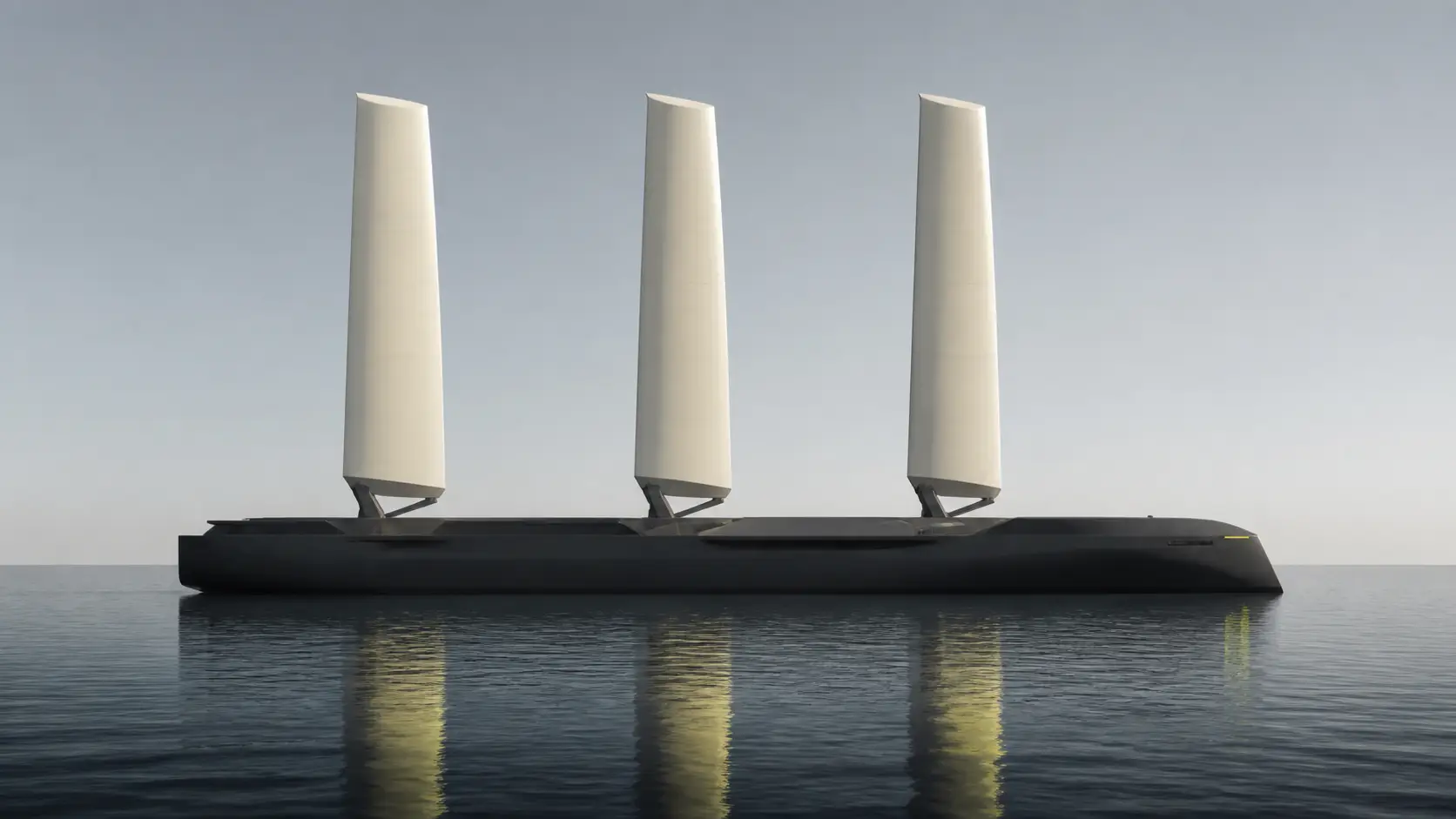
From a distance, the new cargo ship looks impossible: a black hull carrying three white blades, each as tall as a building. There is no web of rope, no crew running across the deck and almost no canvas. The sails turn by themselves. The bridge computer watches the wind. Far below, the engine quietly burns less fuel.
Not only has piracy returned from the nineteenth-century imagination to the waters off Somalia, but sailships are back in fashion again. In July 2026, the International Maritime Organization reported 44 seafarers held aboard three vessels hijacked off Somalia and in the Gulf of Aden. On other oceans, shipowners are once again learning how to make money from moving air.
ParallaxSee forecasts that at least 1,000 ocean-going cargo ships will operate with modern wind propulsion by the end of 2032. House confidence: 64%.
This will not be a romantic restoration of the clipper. Most of the thousand ships will retain an engine. Their sails will be rigid wings, spinning cylinders, suction foils or automated kites. The decisive invention is not fabric. It is control: sensors, software and machinery able to convert a restless wind into dependable thrust while the ship keeps its commercial schedule.
01 - A modern sail is an aeroplane standing on end.
The simplest way to understand a sail is to forget the picture of wind pushing a sheet from behind. That is only one way a sail can work, and it is not the important one here.
A modern rigid sail is shaped like an aircraft wing. Air divides at its rounded front edge, accelerates around the curved surfaces and leaves at the back. The sail turns that moving air, creating a difference in pressure between its two sides. The resulting force is called lift. On an aeroplane, lift points mostly upward. Turn the wing vertically and part of that force can point forward.
Some of the force also tries to shove the vessel sideways. The underwater hull, rudder and keel resist that motion. What remains is useful forward thrust. The propeller no longer has to do all the work.
The wind that matters is the apparent wind: the airflow experienced on the moving deck. It combines the natural wind with the air the ship creates by moving through it, just as a cyclist feels a breeze on a still day. The sail-control system continuously calculates that combined speed and direction, then rotates the wing to the angle that produces the most forward force without putting too much sideways load on the ship.
This is old physics with new obedience. A 2025 peer-reviewed review of wind-assisted systems found that the decisive research questions are now automation, route choice and the interaction between sails, hull, propeller and engine. The wind itself needs no refinery, tank or bunker barge. The difficult work is teaching an entire ship to use it efficiently.
02 - The new sail has four mechanical forms.
The most recognizable design is the rigid wing. It resembles a thick aircraft wing mounted vertically on a rotating base. Electric actuators change its angle as the wind shifts. Some designs telescope downward or fold flat before entering port. On the open sea, the controller finds the useful angle and keeps correcting it in movements too small to notice from shore.
The strangest design is the rotor sail: a tall cylinder spun by a small electric motor. The wind does not turn the cylinder. The motor does. As air passes the rotating surface, it speeds up on one side and slows on the other, producing a pressure difference and a powerful sideways force. This is the Magnus effect, the same physics that bends a spinning football through the air. The cylinder is oriented so that part of this force pulls the vessel forward. A University of Genoa propulsion study modelled the electricity consumed by the rotor alongside the thrust it creates, the diesel engine's fuel curve and the propeller's response. That complete accounting matters: the rotor earns its place only when the harvested wind power exceeds its own electrical appetite.
A suction sail looks like a narrow, rounded tower. A fan draws a thin layer of air through slots in its surface. That suction keeps the airflow attached to the sail instead of letting it peel away into turbulence. Attached air can be turned more strongly, so a comparatively small structure produces high lift. Researchers at the University of Glasgow have used computational fluid dynamics and optimization algorithms to study exactly how the blowing and suction openings should be shaped and controlled across changing wind conditions. Their peer-reviewed work treats the sail as an actively managed aerodynamic surface, not a passive tower.
Finally, a towing kite flies ahead of the bow, where the wind is usually stronger and less disturbed by the hull. It pulls through a cable rather than pushing from the deck. A University of Manchester team linked numerical models of a kite and a Flettner rotor to wind data on five shipping routes. Depending on the route, one modelled rotor contributed average propulsive power of 193 to 373 kilowatts, while the kite contributed 127 to 461 kilowatts. The Applied Energy paper demonstrated the essential point: the correct technology depends on where the vessel actually sails.
These machines look unrelated. Aerodynamically, they perform the same transaction: take momentum from moving air and turn part of it into forward force.
03 - The engine stays, which is precisely why the sail can return quickly.
The old commercial sailing ship had to wait for wind. The modern wind-assisted ship does not. It uses a hybrid arrangement: wind when available, engine whenever necessary.
Suppose a vessel needs a certain amount of thrust to hold its scheduled speed. In calm weather, the propeller supplies nearly all of it. When three wings begin contributing, the propulsion controller reduces engine power or changes the pitch of the propeller blades. The ship continues at the same speed while burning less fuel. If the wind falls, the engine takes the load back.
This makes wind propulsion unusually practical. A shipowner does not have to choose today between diesel, methanol, ammonia or a fuel that has not yet reached the port. A sail can reduce the consumption of any engine installed beneath it. If that engine is replaced later, the sail remains useful.
But the saving is not found by simply subtracting sail thrust from propeller thrust. A marine engine has a fuel map: some combinations of speed and load convert fuel into shaft power more efficiently than others. A propeller also has preferred operating points. When the sail removes part of the load, both machines move to new points on those maps. The result can be better or worse than a simple percentage subtraction.
Veronica Vigna and Massimo Figari modelled a ferry as one joined system containing rotors, diesel engines and controllable-pitch propellers. Under moderate Mediterranean winds, their case study produced fuel reductions of roughly 4% to 6% at design conditions and as much as 15% at lower operating speeds. The valuable finding was not a universal percentage. It was that changing propeller pitch allowed the ship to capture more of the rotor's benefit. The open model and case study show why the future sailship needs an integrated propulsion controller rather than an impressive wing bolted to an indifferent engine.
A separate 2024 case study reached the same systems conclusion from the other direction. When wind supplied 20% of the initial propulsive demand, the model calculated a 24.8% fuel reduction because the remaining engine and propeller happened to move into more efficient operating conditions. The researchers' propeller analysis is a useful warning against headline arithmetic: wind thrust, engine power and fuel consumption are related, but they are not identical numbers.
04 - Software turns weather into a fuel supply.
A conventional route planner asks how a ship can reach its destination safely and on time. A wind-optimized planner asks a more interesting question: where will the free power be tomorrow?
The shortest line across an ocean is not always the cheapest. A vessel may travel slightly farther to catch a broad band of useful wind, then arrive using less engine power. The calculation includes the weather forecast, wave height, current, cargo load, hull resistance, arrival window and the performance curve of each sail at different wind angles. It is repeated whenever the forecast changes.
This is not an academic model built on perfectly smooth water. In the German ROBUST research project, a 17,500-deadweight-tonne multipurpose cargo ship collected 64 measurements every ten minutes for more than a year. Those measurements included shaft power, fuel consumption, wind and waves. Researchers used the record to calibrate a ship-performance model, then tested route optimization against historical weather. The resulting study found that relatively small route changes could produce useful energy savings while remaining inside a defined travel-time window.
More recent research has asked how routing changes the value of the sail itself. James Mason and colleagues at the Tyndall Centre modelled wind propulsion across globally distributed bulk-carrier routes. On the most suitable routes, voyage optimization lifted carbon savings above 30% by deliberately seeking favourable wind speed and angle. Combining wind, routing and slower sailing pushed the modelled reduction as high as 60%. The peer-reviewed Ocean Engineering paper publishes its route-simulation data and, crucially, shows that the same equipment performs very differently on different oceans.
Sensors on the real vessel close the loop. They measure apparent wind, sail force, engine load and fuel flow. The controller compares prediction with reality and adjusts the angle of attack, rotor speed, propeller setting or route. Over repeated voyages, the ship becomes its own continuing experiment.
This is what separates the current revival from earlier attempts. A twentieth-century captain could read clouds and trim canvas brilliantly. The modern system can evaluate millions of route, speed and sail settings against an ocean-scale forecast, then revise the answer when the weather changes.
05 - The research refuses to produce one magic percentage. That is its strength.
A trustworthy wind forecast cannot say that every sail saves 20% of every ship's fuel. The result depends on sail area, hull size, speed, wind angle, sea state, route, engine map, propeller and even the spacing between sails. Academic studies return a range because the ocean presents a range.
Cem Guzelbulut and colleagues built a dynamic model of a very large crude carrier containing the hull, rudder, propeller, sail controller, wind and waves. Across their probability-weighted scenarios, one rigid sail reduced energy use by 3.07%; one rotor achieved 1.97%. When the model increased the equipment to ten sails, the reductions reached 22.8% for rigid wings and 16.03% for rotors. The 2024 study also found that reducing ship speed from seven to five metres per second saved roughly as much energy as adding another sail.
That does not make wind a minor technology. It shows how the technology scales. A single device on an enormous hull contributes a few percentage points. Several large devices, a slower operating speed and a route chosen for wind can move the result into an entirely different class.
Ruihua Lu and Jonas Ringsberg compared Flettner rotors, a wingsail and the DynaRig using a four-degree-of-freedom ship-performance model. Their Aframax tanker case used voyage information for a route between Gabon and Canada. The study found that rotor dimensions, ship speed, voyage and season all materially changed the saving. The best technology was not simply the device with the largest brochure number; it was the one matched to a particular hull and wind field.
The European Maritime Safety Agency commissioned a broad technical assessment of these findings in 2023. It reviewed rigid wings, suction wings, rotors, kites and soft sails, including structural integration, safety, operability and route-dependent performance. The EMSA report concluded that the potential is real while insisting on vessel-specific evaluation.
That is the intellectually exciting part of the return. Shipping has moved beyond asking whether wind can propel a steel vessel. Researchers are now optimizing how many sails it should carry, where they should stand, how each should turn and how the engine should respond every minute of the voyage.
06 - Three identical sails do not behave like three isolated sails.
The clean silhouette hides a difficult problem. Every sail changes the air that reaches the sails behind it. The hull and bridge distort the wind before it reaches the deck. A thirty-metre sail also applies force high above the water, creating a lever that tries to heel and turn the ship. Naval architects must calculate the complete aerodynamic and hydrodynamic system.
Akane Yasuda, Tomoki Taniguchi and Toru Katayama used computational fluid dynamics to examine two rigid sails on a ship. Their work showed that simply setting each sail to the angle that would be best in isolation does not necessarily maximize total thrust. Under some following-wind conditions, an L-shaped arrangement worked better: one sail produced more drag while the other exploited lift in the altered airflow. The 2024 study turns a simple design lesson into a powerful one—each wing needs individual control because each wing changes the wind seen by the next.
Rotor research has uncovered an equally important installation effect. A 2025 computational study found that a rotor mounted on a test hull could lose nearly 48% of its lift coefficient compared with the same rotor calculated in clean, undisturbed air. Changing the bottom geometry and adding a rotating end plate recovered much of the loss. The open-access naval-architecture paper explains why full-scale performance cannot be obtained by multiplying the result of one freestanding cylinder. The deck, foundation, wind profile and heel angle all matter.
The practical solutions follow from this research. Rotor sails tilt. Rigid wings fold, rotate or telescope. Foundations spread the load through reinforced deck structure. Control systems reduce aerodynamic force in gusts. Designers protect bridge visibility, radar and cargo access while ballast and hull form resist the sideways and heeling loads.
These are awkward problems, but they are ordinary engineering problems: airflow, structure, stability, machinery and control. None requires unknown physics. Each new paper makes the future ship less like a concept image and more like a specification.
07 - Regulation is making the wind appear on the balance sheet.
Ships carry roughly four-fifths of world trade by volume. At the beginning of 2025, the merchant fleet contained about 112,500 vessels of at least 100 gross tonnes, while more than 90% of active carrying capacity still used conventional fuels. UN Trade and Development describes a fleet under simultaneous pressure from fuel uncertainty, emissions rules and longer disruption-driven routes.
The International Maritime Organization's climate strategy calls for shipping's total annual greenhouse-gas emissions to fall by at least 20%, while striving for 30%, by 2030 compared with 2008. By 2040, the indicative reduction is at least 70%, while striving for 80%. The targets make fuel efficiency a present procurement problem rather than a distant moral preference.
Europe has gone further by writing wind directly into compliance arithmetic. Under FuelEU Maritime, a vessel equipped with wind-assisted propulsion can apply a reward factor when its greenhouse-gas intensity is calculated. The rule gives a larger benefit as the sail supplies a larger share of propulsion power. The regulation therefore converts invisible air into a measurable regulatory asset.
This is the commercial engine of the revival. Fuel saved is money retained. Carbon avoided reduces compliance exposure. Wind equipment works with the ship's existing engine and with whatever cleaner engine comes next. It is one of the few decarbonization technologies that asks the ocean for infrastructure and finds it already installed.
08 - One thousand ships is an industrial target built on solved science.
The literature now covers the complete chain: wind-tunnel tests and computational fluid dynamics for the sail; dynamic models for hull, rudder and waves; engine-propeller matching; long-run weather statistics; route optimization; structural and safety assessment. Researchers disagree about the saving on any particular voyage because the answer is conditional. They do not disagree about whether useful thrust can be produced.
The remaining leap is industrial. Factories must produce standardized wings and rotors. Shipyards must install foundations without treating every vessel as a research project. Classification records must become routine, and service teams must be able to repair the machinery in major ports.
Observed delivery data show the base from which that scaling begins. DNV counted 22 wind-assisted ships delivered in 2024 and 24 in 2025, carrying 49 and 63 individual sails respectively. The classification group's fleet update is useful here as a count of completed hardware, not as a promise of future performance. The International Windship Association's installation record lists more than 50 large ocean-going vessels already operating with wind systems.
A European Commission market study estimated technical-economic potential for 3,700 to 10,700 installations on bulk carriers, tankers and container ships by 2030 under different fuel-price and financing assumptions. The CE Delft analysis was a scenario study, not a timetable, and commercialization began more slowly than its upper cases assumed. Its detailed ship-and-route modelling nevertheless shows that one thousand vessels sit well inside the technically suitable fleet.
That scaling is now crossing into a more demanding ship class. On 10 September 2026, Mitsui O.S.K. Lines named the Fujin Sailor, the first LNG carrier fitted with wind-assisted propulsion and the first vessel to carry two of MOL's rigid Wind Challenger sails. MOL's announcement says the 174,000-cubic-metre carrier is scheduled for delivery at the end of September under a long-term charter to Chevron. The construction and naming are a deployment milestone; until delivery and operation, however, the vessel does not count toward this forecast's active-vessel threshold.
Bulk carriers and tankers will lead because they combine long open-ocean routes with relatively uncluttered decks. Roll-on/roll-off ships and gas carriers will follow. Container ships will adopt more slowly where sails interfere with stacking and crane operations, then accelerate as folding systems and sail-ready designs mature.
The forecast resolves true if, on 31 December 2032, at least 1,000 active ocean-going commercial cargo vessels of 400 gross tonnes or more carry an operational, class-approved system that derives propulsive force directly from wind. Qualifying systems include rigid or soft sails, rotor sails, suction wings and towing kites. A vessel advertised as wind-ready but lacking working equipment will not count. Recreational yachts, naval craft, fishing boats and permanently moored vessels will not count. The total will be established from classification records, fleet databases and the International Windship Association's installation register.
A thousand ships would still represent only a sliver of the global fleet. But it would prove that sail had completed the difficult crossing from research subject to industrial category. The nineteenth century supplied the silhouette. The twenty-first adds composite materials, live weather data and automatic control.
The most futuristic fuel in shipping will arrive free, invisible and from the side.