
The next great surprise in aviation may be waiting at the end of the boarding bridge.
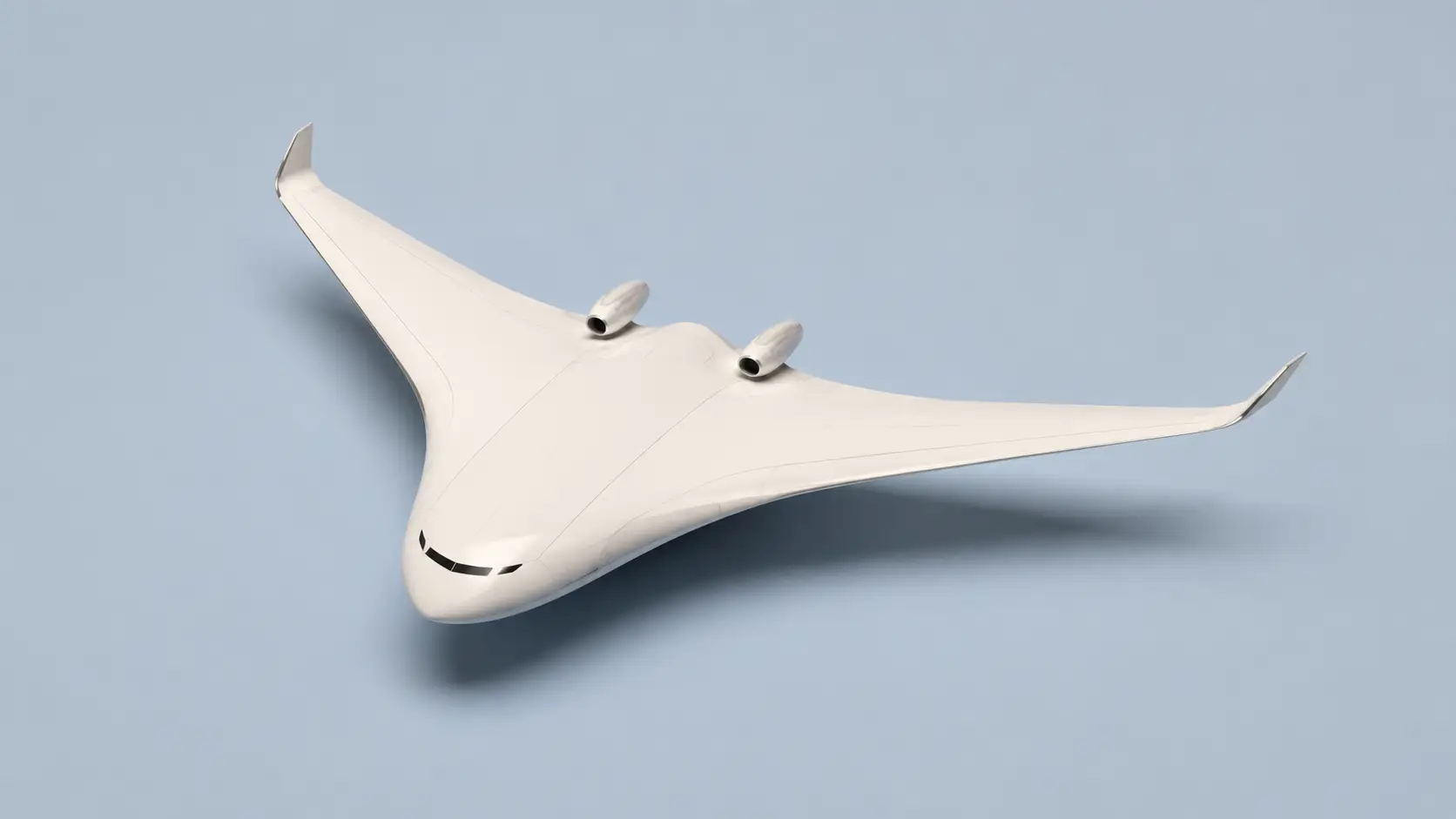
Beyond the door, the cabin spreads sideways. Passengers turn towards different seating bays. The familiar long tube has widened into the thick centre of a swept wing. Outside, the aircraft resembles a vast, flattened arrow.
That is the future ParallaxSee expects to enter ordinary airline service by 2040: a large passenger aircraft whose cabin sits inside a blended wing body. Forecast confidence: 65%.
The engineering story brings together three developments: specialised generative AI that proposes aircraft shapes, carbon-fibre structures that can carry an unusually wide pressurised cabin, and flight programmes moving the concept towards commercial scale. Chinese researchers are publishing algorithms and securing patents for the first; American and Chinese teams are pursuing the aircraft architecture.
Their convergence is our forecast. The evidence already establishes something exciting: engineers are acquiring a much more powerful way to explore what an aeroplane can become.
01 — The cabin becomes part of the wing.
A conventional airliner divides its work visibly. A long fuselage houses the passengers; wings provide most of the lift. A blended wing body brings those functions together. Its broad centre section accommodates the cabin while contributing substantially to the aircraft’s lifting surface.
The attraction is aerodynamic integration. A carefully shaped centre body and its outer wings can carry the required weight with less drag. In plain English, more of the aircraft’s shape works towards keeping it airborne.
NASA’s research treats the unusual cabin structure as an essential part of that calculation. Its work on blended-wing-body mass estimation uses detailed structural simulations to establish whether the weight of the wide pressure vessel preserves the aerodynamic advantage. Shape and structure have to succeed together. NASA’s research on blended-wing-body cabin mass
Chinese engineers call the architecture 翼身融合—wing–body integration. Northwestern Polytechnical University reported successful flights of a scale demonstrator in 2023, including take-off, landing and an autonomously followed route. That was a small experimental aircraft advancing a large-airliner concept, with the passenger version still ahead. Northwestern Polytechnical University’s flight-test milestone
The larger ambition is wonderfully tangible. Aviation could acquire a new silhouette, and passengers could acquire a new kind of room.
02 — Generative AI starts with the performance you want.
An aircraft designer ordinarily asks a question of a proposed shape: how will this fly?
Generative design also runs the question backwards: what shapes could deliver the flight performance we need?
The Chinese term is 反设计, or inverse design. Engineers supply aerodynamic requirements and operating conditions. A model proposes geometries that could satisfy them. Instead of beginning every search with one promising outline, the team can begin with a family of candidates.
China’s patent CN117216886B, granted on 5 April 2024 to the Computational Aerodynamics Institute of the China Aerodynamics Research and Development Center, describes precisely such a method. It uses a conditional diffusion model, trained on a database connecting aircraft geometries with aerodynamic performance, to generate shape representations under different flight conditions. Chinese diffusion-based aircraft-design patent
Diffusion is the family of methods widely associated with generating pictures from noise. Here, the output represents engineering geometry. Training teaches a system how to reconstruct meaningful shapes from corrupted examples; conditioning steers the reconstruction towards specified requirements.
These are specialist engineering models. Their useful knowledge comes from the relationship between geometry and physics.
A Xiamen University team illustrates the approach in a Chinese aeronautics-journal paper combining a deep neural network with a gated diffusion model. The network predicts aerodynamic behaviour and helps guide the generation of candidate shapes. Its validation concerned a restricted dataset of axisymmetric aircraft under supersonic conditions—a focused experiment demonstrating the method. Xiamen University’s gated-diffusion research
For the future airliner, the important capability is controlled exploration. Engineers gain more ways to ask the air a question.
03 — China is turning shape generation into an engineering workflow.
The most revealing Chinese development may be the institutional connection.
At the 2024 World Artificial Intelligence Conference, Shanghai AI Laboratory and COMAC’s Shanghai Aircraft Design and Research Institute jointly introduced 书生·翼飞, a generative system for airfoil design. An airfoil is the cross-sectional profile of a wing—the curve whose interaction with the air helps determine its performance. Shanghai AI Laboratory’s announcement
That partnership places generative design beside the people responsible for designing civil aircraft. The public announcement establishes a development programme; adoption in a certified passenger aircraft remains to be demonstrated.
Another Chinese filing shows how the workflow could become more ambitious. Published on 6 March 2026, CN121615258A describes a repeating sequence: generate candidate aircraft layouts, evaluate them, select a stronger candidate, update the desired performance and generate again.
The application comes from the same computational-aerodynamics institute behind the earlier patent. It is a published application, still listed as pending. Together, the documents show sustained work on a design process in which generation and evaluation repeatedly inform one another. Chinese application for iterative generative optimisation
Our inference is that this will change which unconventional ideas receive serious engineering attention. When evaluating alternatives becomes more accessible, a team can investigate more versions of a difficult concept before committing to expensive hardware.
A broad cabin, a different engine position or an unfamiliar wing profile becomes a design space to explore. The machine helps make the alternatives concrete.
04 — Fifteen seconds buys a candidate, and candidates matter.
A study in China’s Acta Aerodynamica Sinica gives this change a measurable form.
Researchers from the China Aerodynamics Research and Development Center and Northwestern Polytechnical University used a diffusion model to generate three-dimensional aircraft configurations represented by point clouds: collections of coordinates describing a shape.
Their accelerated method produced candidate configurations in under fifteen seconds in the reported experiment. The paper includes flying-wing outlines satisfying its design criteria. It also reports trade-offs between speed, diversity and aerodynamic accuracy. This is candidate-generation time within the study’s defined design space; simulation, structural development, manufacture and certification remain separate work. Chinese research on rapid three-dimensional aircraft generation
That distinction reveals the useful breakthrough. Aircraft engineering depends on repeated choices about which ideas deserve more computation, a model in a wind tunnel or a physical prototype. Better candidates can improve that sequence long before a model understands every aspect of an airliner.
ParallaxSee expects the next decade to bring systems that coordinate several specialist tools. A geometry generator proposes. An airflow solver checks. A structural model calculates loads and weight. A manufacturing assessment identifies awkward joints and inaccessible repairs. Engineers select the compromises worth carrying forward.
The exciting possibility is a faster conversation between disciplines. A shape that looks excellent to the aerodynamicist can immediately face the objections of the cabin designer and the structures team. More promising compromises survive to become hardware.
05 — Carbon fibre makes room for the passengers.
The giant wing has a deceptively domestic problem: keeping the room inflated.
At cruising altitude, cabin air pushes outwards against the aircraft’s skin. A circular fuselage handles this efficiently, carrying pressure largely through tension around its circumference. Flatten the cabin into a broad wing and the loading becomes more complicated. Wide panels must resist bending as well as the forces associated with flight.
NASA identified the cost and weight of this non-circular pressure shell as a central challenge in its structural research. Its pressure-cube programme examined a stitched composite construction known as PRSEUS, developed by Boeing, as part of a sequence of tests for hybrid-wing-body aircraft. NASA’s pressure-cube research
The materials opportunity is therefore about arranging strength. Carbon fibres can be organised into skins, stiffeners and internal members that carry loads through the cabin.
JetZero’s patent US12630282B2, granted in May 2026, describes one such arrangement. Stitched, resin-infused carbon cloth forms the outer skin and structural members. Longitudinal members connect the upper and lower skins, resist pressurisation loads and divide the passenger cabin into multiple bays. JetZero’s stitched-carbon aircraft patent
Imagine the upper and lower surfaces of the aircraft connected through an internal skeleton. That skeleton helps hold the pressurised shape together while organising the space occupied by passengers.
This is where generative design could become especially valuable. The outside surface influences airflow; the internal structure determines weight; the cabin layout determines usable space. The commercial aircraft emerges from solving all three together.
06 — The passenger gets a different kind of cabin.
A wide centre body gives cabin designers a new set of choices.
Seating can be distributed among adjoining bays. Several aisles can serve those spaces. Boarding flows, toilets, galleys and accessible routes can be reconsidered as a connected layout.
United’s April 2025 investment announcement described JetZero’s proposed cabin in those terms: multiple aisles and passenger bays, a wider main boarding door and opportunities for larger seats and accessible lavatories. These remain design intentions. Airlines will decide how much of the available space becomes comfort and how much becomes additional capacity. United’s investment and proposed cabin features
Our expectation is that the first operators will use the unfamiliar interior as part of the product. An aircraft that looks radically different outside will need an interior that makes its difference welcoming.
That creates a competition over space, lighting, movement and the experience of boarding. A family could choose a quieter cabin bay. A passenger with reduced mobility could encounter a route designed around movement from the start. Those are opportunities the architecture opens, subject to actual airline layouts.
The geometry also brings trade-offs. A broad interior places more seats away from the outer skin. Designers must address outside views, wayfinding and the experience of motion across a wider cabin. Safety approval will require convincing evidence that everyone can leave when necessary.
The forecast is a new passenger environment. Its quality will depend on how intelligently airlines use it.
07 — The aircraft may eventually adjust its own shape.
Chinese patents also point towards another stage: geometry that changes during flight.
Northwestern Polytechnical University’s CN119105289B, granted in November 2025, describes reinforcement-learning-based decision and control for a variable-wingspan aircraft in gliding flight. The method coordinates changes in configuration with flight control. Chinese patent for intelligent variable-wingspan control
Reinforcement learning trains a system through the consequences of its actions. In this context, the research asks when changing the aircraft’s geometry helps it achieve its objective.
It is a different use of AI from diffusion-based design. One helps select the shape before manufacture; the other investigates how an adjustable aircraft should behave.
A future passenger application would need tightly bounded, thoroughly validated control. Engineers could use learning systems during development to discover useful strategies, then implement approved behaviour within a controlled flight envelope.
For passengers, the long-term possibility is an aircraft that uses its physical configuration more intelligently as conditions change. The fixed blended-wing airliner can arrive first; adaptive geometry offers a further development path.
The 2040 forecast does not depend on this second breakthrough. It shows how much room remains for the aeroplane itself to evolve.
08 — Why 2040 is a credible arrival date.
The commercial timetable now has something solid beneath it: a full-scale aircraft under construction.
On 31 August 2026, JetZero reported that its Jet1 demonstrator had been 40% complete in June, with a first flight scheduled for the final quarter of 2027. The company also announced a financing facility of up to $100 million and reiterated an early-2030s service target for its commercial Z4. Those are company-reported milestones and plans. JetZero’s August 2026 programme update
United’s involvement supplies a separate commercial incentive, though its purchase pathway remains conditional on development milestones and operating requirements. It gives the developer a prospective customer with specific needs to satisfy.
Our 2040 date allows substantially more development time than the manufacturer’s advertised service window. It leaves room for flight-test discoveries, structural redesign, production preparation and the approval of an unfamiliar passenger cabin.
The strongest counterargument is that the decisive difficulty may sit outside the design office. Generative AI can accelerate exploration while financing, repeatable manufacturing, maintenance support and certification continue to determine the launch date. A successful demonstrator can still lead to a commercial programme that arrives late.
There is also an important boundary around the AI story. Blended-wing-body research predates today’s generative models. The sources reviewed do not establish that diffusion AI designed JetZero’s aircraft or Northwestern Polytechnical University’s flown demonstrator. Our forecast is that these tools will increasingly assist the engineering of this aircraft class.
The 65% estimate is an editorial judgement based on three successive requirements: a technically credible full-scale programme, a certifiable and financeable passenger product, and sustained airline operation. It reflects a promising route with a substantial possibility of delay beyond the deadline.
09 — By 2040, the boarding bridge will lead somewhere new.
This forecast will resolve as true if, by 31 December 2040, an aircraft with at least 100 installed passenger seats has operated publicly bookable, scheduled passenger services over a period of at least 30 consecutive days, with the required civil approvals.
Its passenger cabin must occupy the broad, lifting centre section of a blended-wing-body or flying-wing aircraft. A conventional tube-shaped airliner with redesigned wing tips will not qualify. Military flights, cargo operations, experimental demonstrations and sightseeing-only services are excluded. Civil aviation authority records and airline operating evidence will establish the result.
The threshold is the arrival of a new aircraft category in ordinary travel. Conventional airliners will continue to fill airports, and the first giant-wing passenger aircraft may be a minority presence for years.
That is enough to change what the public understands an aeroplane to be.
Generative AI adds a powerful new instrument to that transition: the ability to propose more shapes worth testing. Composite engineering gives those shapes a stronger chance of becoming habitable structures. Commercial flight programmes give the research a destination.
By 2040, passengers will cross a boarding bridge and enter a room shaped by that convergence.
The wing will be where they sit.