
Research update — 25 August 2026: Added Amazon's newly reported U.S. deployment and expansion numbers, plus the FAA's Atlanta environmental decision. Plans are identified as plans, and the forecast remains at 78%.
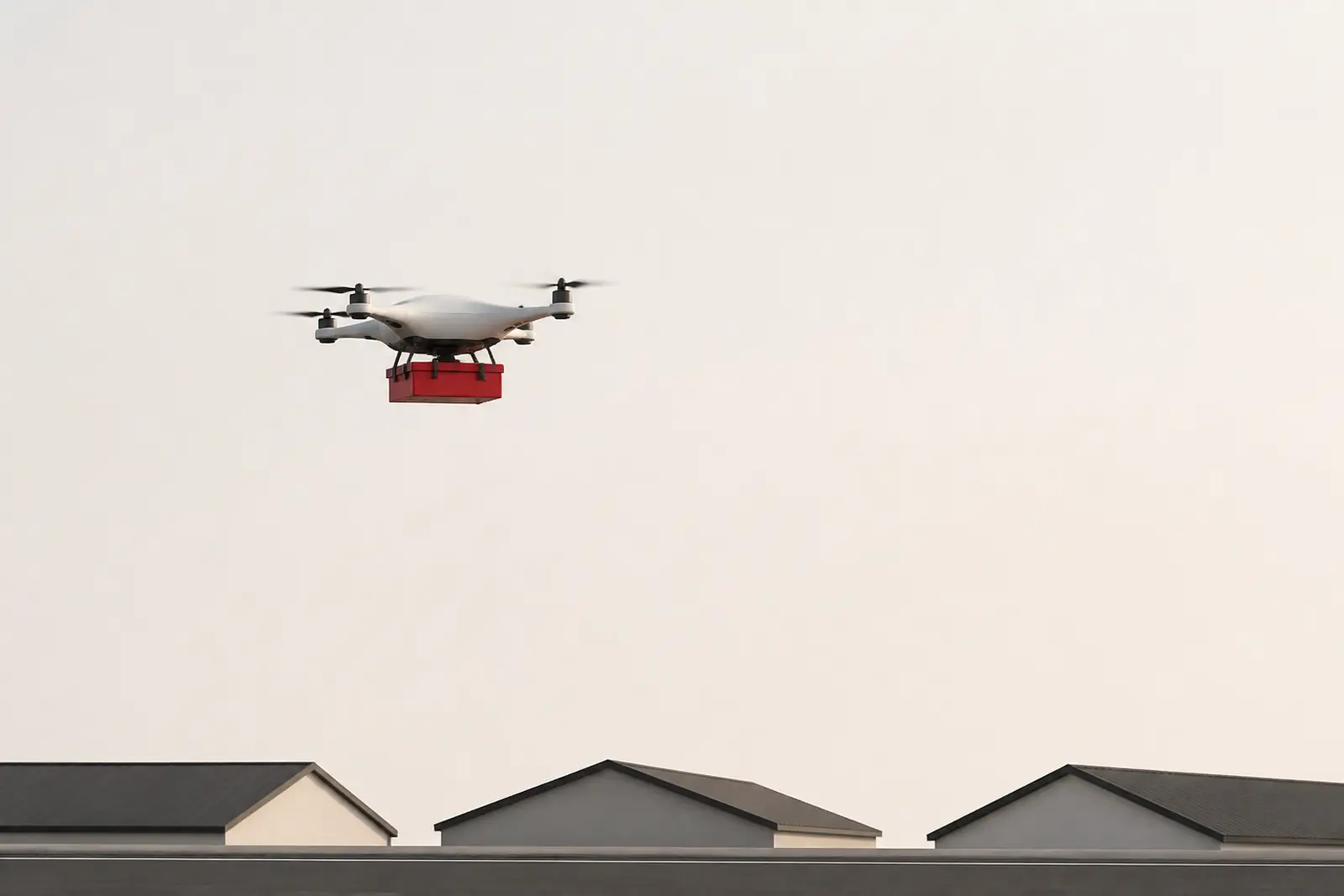
A doctor in rural Rwanda requests blood. The order is packed at a central store, placed inside a small autonomous aircraft and launched into the sky. The drone flies past the roads, reaches the hospital and releases its cargo by parachute. The blood arrives while a vehicle making the same journey would still be climbing through traffic and mountain bends.
This is not a demonstration. Rwanda began commercial medical delivery by drone in 2016. The scientific record now includes thousands of real orders, faster treatment, less expired blood and reductions in mortality associated with conditions in which every minute matters.
In the United States, Amazon has completed the other half of the invention. It persuaded the Federal Aviation Administration to treat an autonomous delivery network as a legitimate air carrier, approved to carry customers' property beyond the operator's sight. Six other American drone-delivery companies have followed it through the same legal architecture.
The aircraft exist. The economics work where speed and inventory matter. The regulatory path is open. What remains is multiplication.
ParallaxSee forecasts that by the end of 2028, commercial drone operators in the United States will complete at least five million autonomous deliveries in a single year, operating from at least 25 hubs across five metropolitan regions without visual observers positioned along individual routes. House confidence: 78%.
The first mass market will not be Manhattan. It will be the broad suburban America surrounding warehouses, hospitals and shopping centres: enough customers to keep the aircraft busy, enough open ground to receive a package and enough distance for flight to defeat the road.
01 — Nothing important remains to be invented.
A delivery drone needs to know where it is, detect other aircraft, avoid buildings, judge whether the ground below is clear and return safely when weather or equipment misbehaves. Every one of those abilities now operates in commercial or military service.
Amazon's MK30 carries packages weighing up to five pounds. It takes off vertically, changes into efficient forward flight and navigates with an onboard detect-and-avoid system rather than relying upon a human staring at it from the ground. Before commercial introduction, Amazon says the design completed 6,300 test flights, accumulated 1,070 flight hours and spent 360 hours in flights supporting FAA certification. It can travel twice as far as Amazon's previous aircraft, produces half the perceived noise and can operate in light rain. Amazon launches the MK30
The battlefield has pushed the machinery further. The US Marine Corps has demonstrated an autonomous tactical resupply aircraft capable of carrying 150 pounds for approximately nine miles, delivering ammunition, food, medical supplies and batteries to dispersed units. Tactical Resupply Unmanned Aircraft System
A battlefield flight does not satisfy civilian requirements for noise, privacy or safety over uninvolved people. It proves something narrower and decisive: autonomous aircraft can already move useful cargo without a road or a pilot aboard.
Amazon's five-pound parcel is not waiting for a battery miracle. It is waiting for more authorised places to fly.
02 — Medicine has already proved the economic machine.
Medical delivery is usually described as a humanitarian use of drones. It is also a severe test of logistics economics.
Blood, vaccines, antivenom and laboratory samples combine four qualities that make ordinary distribution expensive: they are light, valuable, perishable and required unpredictably. A hospital can protect itself from uncertainty by storing every possible product. It then ties up money in refrigerators and watches rarely used stock expire. Or it can store less and send a vehicle whenever an emergency arrives. That turns a small package into a long, urgent and expensive road journey.
A drone network changes the equation. Rare products remain pooled at a central facility, where they are easier to monitor and less likely to expire. The aircraft moves only the item that has actually been requested.
Researchers examined 12,733 drone orders delivered to 20 Rwandan health facilities between March 2017 and December 2019. The average flight delivered its order 79 minutes faster than the existing road estimate and 98 minutes faster than a Google Maps estimate. Across those orders, that represents approximately 16,800 to 20,800 transport-hours removed—roughly 500 to 620 hours every month. Forty-three per cent of the orders were emergencies. Rwanda blood-delivery study
The drones also reduced expirations by 7.1 blood units a month, a 67% fall after a year. Rwanda's collection, testing and storage cost was reported at about $80 per unit. On that narrow accounting alone, 20 facilities stopped destroying approximately $6,800 of prepared blood each year. Medical drone delivery in Rwanda
That figure is only the waste visible on a blood-bank ledger. It assigns no value to a vehicle and driver released from an emergency trip, smaller hospital inventories, earlier surgery or a patient surviving. A 2026 causal study found that hospitals served by drones held less blood, discarded less of it and experienced large reductions in in-hospital mortality from postpartum haemorrhage and trauma when they were close enough to receive clinically timely delivery. Last-mile blood delivery in Rwanda
The drone is not merely a faster vehicle. It permits the entire medical inventory system to carry less while supplying more.
03 — At scale, small savings become an economic verdict.
A vaccine-distribution model compared drones with a conventional land-based transport system. The drone network raised vaccine availability from 94% to 96% while lowering logistics cost by $0.08 for every dose administered. Economic value of drone vaccine transport
Eight cents sounds modest until the denominator becomes a national programme. Applied to ten million administered doses, it becomes $800,000 in annual logistics savings. The two-percentage-point gain in availability corresponds to another 200,000 doses available out of ten million required. The same system both spends less and reaches further.
This is the economic lesson medicine hands to retail. The winning comparison is not always one drone against one van. It is one responsive aerial network against the hidden cost of scattered inventory, emergency journeys, delays and discarded products.
Drones will not replace a full van following a dense route. They do not need to. They take the small, urgent and geographically awkward orders that make the van network inefficient. Medical systems supply value through urgency. Amazon supplies it through density. Combine the two and a specialised aircraft can remain busy throughout the day.
The first profitable delivery networks therefore resemble a layered transport system. Vans move heavy baskets and consolidated routes. Drones remove the light parcel that would otherwise demand a detour, a separate courier or a long wait. The sky wins precisely where the road is carrying too much vehicle for too little object.
04 — Amazon has built the factory beneath the flight path.
The aircraft is only the visible tip of Prime Air. Amazon's larger advantage sits on the ground.
The company has built more than 85 Same-Day Delivery facilities in the United States, each carrying approximately 90,000 popular products close to customers. Prime Air will use these facilities both as its source of inventory and as its launch point. A customer's order can be selected inside the building, assigned to a drone and dispatched without visiting a separate experimental depot. Amazon's 2025 shareholder letter
This is how medical economics becomes consumer economics. A hospital network centralises rare blood because holding every type at every clinic creates waste. Amazon places a broad but carefully chosen catalogue near a dense customer population because moving every item from a distant warehouse creates time and road miles. Both systems use a central pool and fast dispatch to substitute motion for inventory.
Amazon now says Prime Air is live from 11 U.S. sites across 10 metropolitan areas, has delivered hundreds of thousands of packages in 2026 and plans to reach nearly 500 cities and towns by year-end—a sixfold expansion. Those are company-reported results and plans, not an audited delivery count or a completed rollout. The Associated Press noted that many named places may be small towns clustered around a few metropolitan sites and that launching service does not prove meaningful repeat demand. Amazon's August 2026 expansion announcement Associated Press assessment
The distinction makes the milestone useful rather than magical. Eleven operating sites and hundreds of thousands of deliveries show that Prime Air has moved beyond isolated certification flights; nearly 500 communities remains a timetable to test, not a deployment already achieved. The physical network beneath it already handles hundreds of millions of same-day orders.
Drone delivery was once a spectacular aircraft looking for a business. Amazon has placed it on top of a business that already receives the orders, owns the inventory, predicts local demand and operates the buildings.
05 — Amazon has also found the legal door.
American aviation law did not contain a convenient category for an autonomous machine carrying somebody else's toothpaste. Amazon's solution was to stop presenting the drone as a gadget and certify the operation as aviation.
Prime Air became a standard Part 135 air carrier. It then obtained an exemption and operating specifications allowing its aircraft to carry customers' property beyond the operator's visual line of sight. The FAA approved the aircraft, the procedures, the operating area and the conditions under which the system must stop flying. FAA package delivery by drone
No competitor can copy and paste Amazon's certificate. Every operator remains responsible for its aircraft, training, maintenance, safety record and proposed geography. But the legal construction is repeatable. The FAA now lists seven Part 135 drone-delivery carriers: Wing, UPS Flight Forward, Amazon Prime Air, Zipline, Causey Aviation Unmanned, DroneUp and Drone Express.
That list is the regulatory breakthrough. The first approval asked whether autonomous delivery could belong in American airspace at all. The seventh asks whether another applicant has supplied the familiar evidence.
Amazon's real legal achievement is precedent expressed as paperwork: a safety-management system, flight history, detect-and-avoid performance, maintenance rules, emergency procedures, noise measurements and a defined map. The next operator still has to prove its case. It no longer has to invent the meaning of the case.
06 — Regulation is learning how to reproduce itself.
The clearest sign of acceleration appears in North Carolina. Instead of starting a new environmental study for every company and every delivery centre, the FAA completed a programmatic environmental assessment describing the kinds of operations expected across selected metropolitan areas. A later proposal that remains inside those assumptions can be checked against the programme and approved without repeating the entire analysis.
Ameriflight, Wing and Drone Express have already submitted operations that the FAA determined required no further environmental documentation because they fell within that established envelope. FAA environmental reviews for drone operations
The same public register shows how large the intended networks have become. Wing has proposed as many as 75 launch nests around Dallas–Fort Worth, with a ceiling of 400 deliveries per nest per day. Causey Aviation proposed up to 30 distribution centres, each designed for as many as 500 daily deliveries. DroneUp proposed as many as 30 hubs, also with ceilings of 500 flights per day. Amazon's Tolleson operation was assessed for roughly 171,000 annual deliveries from one centre.
These are regulatory ceilings, not completed flights. Their arithmetic nevertheless exposes the available runway. Wing's proposed network alone has a theoretical capacity approaching 11 million deliveries a year. Thirty hubs completing 500 daily deliveries would supply another 5.5 million.
On 18 August 2026, the FAA signed a finding of no significant impact and record of decision for Wing's proposed Atlanta network: up to 43 nest locations, each able to house as many as 24 aircraft and proposed for a ceiling of 400 daily delivery flights. That is an environmental decision, not a final operating authorization, a constructed network or proof of demand. It nevertheless clears one regulatory gate. FAA environmental reviews for drone operations
The five-million-delivery threshold in this forecast does not require an unforeseen industrial mobilisation. It requires operators to begin using a fraction of the capacity already described in their applications.
07 — Part 108 will turn the legal door into a corridor.
Part 135 made commercial delivery possible, but it was written for conventional air carriers. Drone companies must request exemptions from requirements that make sense for piloted aircraft and none for a small autonomous machine. The proposed Part 108 replaces that improvisation with a rule designed around routine flight beyond visual range.
The proposal creates an operating permit for smaller fleets and lower-risk delivery areas, and a fuller operating certificate for large fleets, heavier aircraft and denser populations. It also establishes regulated traffic-management services through which machines can announce routes and avoid conflicts before take-off. Existing Part 135 drone operations are expected eventually to migrate to the new framework. Proposed BVLOS rule
As of August 2026, Part 108 is not yet final. The important fact for a 2028 forecast is that delivery does not have to wait for it. Part 135 already works, while the newer Section 927 waiver process offers another route for suitable operations. Part 108 will make entry repeatable; it is not the invention that makes flight possible. FAA Section 927 waiver process
The FAA's current strategy explicitly calls for issuing and implementing the BVLOS rule, training a specialist drone-inspector workforce and moving from drone integration to drone normalisation. FAA Drone Normalization Strategy
The remaining disputes—local land use, operating hours, noise and acceptable routes over homes—will determine where networks open first. They will not return the technology to the laboratory.
08 — By 2028, the revolution will look almost boring.
A small aircraft descends above a marked patch of ground. It checks that the area is empty, releases a package and climbs away. No pilot stands nearby. No crowd gathers. The customer carries the box inside.
That ordinariness will be the achievement.
The military has proved that autonomous aircraft can resupply people when roads become dangerous. Medical networks have proved that rapid aerial movement can reduce inventory, waste and fatal delay. Amazon has proved that an American company can certify a large autonomous aircraft, carry customers' property for payment and receive approval to fly beyond human sight. Competitors have proved that its legal route is repeatable.
The progress no longer depends upon a single breakthrough arriving on schedule. It depends upon hubs opening, approvals being repeated and daily volume rising through networks whose aircraft and rules already exist.
Dense city centres will come later. Apartment towers offer poor delivery surfaces, streets concentrate people and every flight competes with a thick layer of public concern. Suburbs are different. Warehouses already sit beside them. Gardens and driveways offer controlled delivery spaces. The parcel is often light, while the road route is long.
By 2028, delivery drones will not carry most American packages. They will have crossed the more important threshold: millions of customers will live inside an authorised service area, and looking upward for an urgent medicine or a small Amazon order will no longer feel like looking into the future.
The technology is here. Medicine has paid its first invoices. Amazon has opened the legal door. The next two years belong to multiplication.