
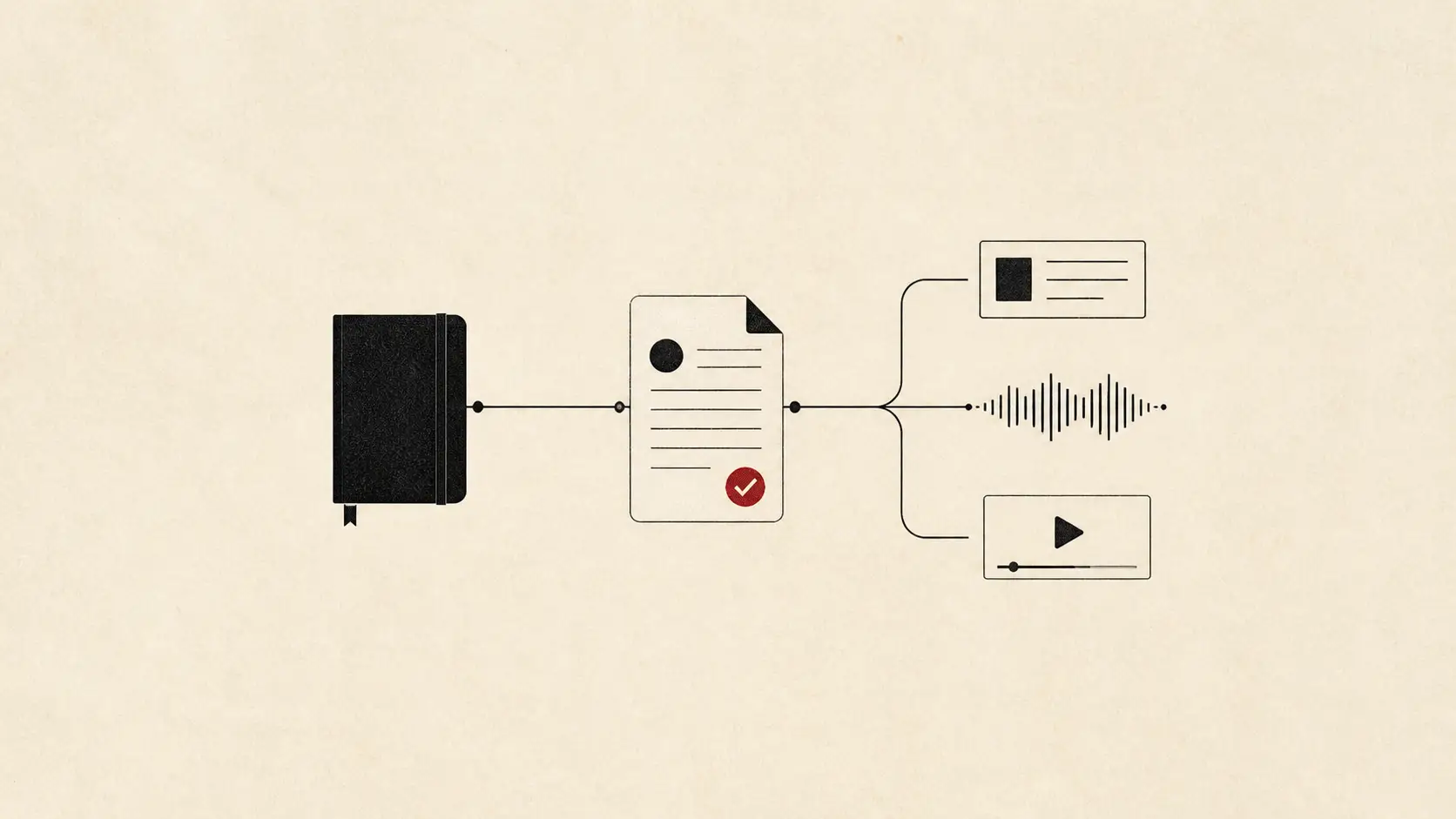
By the time a minister finishes speaking, software can already have transcribed the address, extracted its promises, compared them with the previous speech, translated the result and produced versions for radio, mobile and social video. Writing the news is becoming an operation measured in seconds.
The valuable event happened earlier. A reporter obtained the unpublished budget. Another persuaded an official to explain which programme would be cut. A photographer established where an image was captured. An editor decided that two independent sources were sufficient to publish and accepted responsibility for being wrong. Artificial intelligence can multiply this work. It cannot multiply the fact that the work occurred.
The market is beginning to recognise the distinction. In a 2026 survey of 280 media leaders, publishers said they would sharply increase original investigations, reporting from the scene, explanation and verification while reducing general news, evergreen material and service journalism. The same publishers expect search traffic to fall by 43% within three years as answer engines complete more of the reader's journey themselves. Reuters Institute's 2026 industry report
ParallaxSee forecasts that by the end of 2030, leading news organisations will treat machine-readable evidence as the canonical product of original reporting. House confidence: 74%. A serious investigation will increasingly carry a structured layer connecting its claims to documents, transcript passages, datasets, authenticated media, methodology and corrections. The article will remain, but it will become one presentation of that record. An assistant may turn the same reporting into a five-sentence briefing, a Spanish podcast or a sequence of follow-up answers.
The future journalist will still write. Writing simply ceases to be the expensive miracle. The scarce work will be finding out what happened, proving it and placing an accountable institution behind the proof.
01 — The article is becoming the cheapest object in the newsroom.
The first wave of automated journalism filled templates. Sports scores, election results and company earnings entered a database; software converted the fields into conventional sentences. Large language models have removed the template's walls. The same system can now summarise a council document, translate an interview, propose a headline, write a mobile alert, shorten a video script and explain a technical finding to a school pupil.
The Associated Press's July 2026 standards capture the emerging division of labour. AP permits AI to assist with early research, document summaries, transcription, translation, headlines, summaries, grammar and search optimisation. It places sourcing, verification, editorial judgement and final accountability with its journalists. AP's newsroom standards for artificial intelligence
This is already broader than a writing tool. Reuters Institute found that 97% of surveyed publishers considered back-end automation important for 2026 and 82% said the same of AI in newsgathering. Yet 67% reported no jobs saved so far, 16% had made slight staff reductions and 9% had added roles or costs. Reuters Institute's 2026 industry report The technology is entering every stage before its final organisational form has settled.
The direction is clearer than the current savings. Any publisher can purchase capable prose. Every competitor can generate another explainer from the same public documents. Once a paragraph can be made again for almost nothing, ownership of that paragraph offers little defence. What remains costly is exclusive access, knowledgeable questioning, the physical witness, the freedom-of-information fight, the data cleaning, the second source and the lawyer willing to examine the evidence before publication.
Newsrooms built around article production will shrink. Newsrooms built around information acquisition will discover that AI has made each difficult fact more productive.
02 — The reader is leaving the publisher without leaving the news.
The old digital bargain was simple. A publisher supplied information to search and social platforms; those platforms returned a stream of visitors. Advertising, subscriptions and donations waited at the destination. The bargain weakened when social networks deprioritised links. AI answer engines now remove the journey itself.
In March 2025, Pew Research Center followed the browsing behaviour of 900 American adults across 68,879 Google searches. People clicked a conventional result after 15% of searches without an AI summary and only 8% when a summary appeared. A citation inside the summary received a click in just 1% of visits. Pew's AI-summary click study
The behaviour is spreading beyond search. Reuters Institute's 2026 Digital News Report found weekly use of standalone AI chatbots for news rising from 7% to 10% globally. Among those users, the leading activity was asking follow-up questions. Others wanted the latest news, summaries, simpler explanations, reliability assessments and translations. Only 1% of the public called AI its main source of news, so the transition remains young. Its appeal is nevertheless precise: the reader can interrogate the news rather than accept the fixed page an editor prepared for everybody. Reuters Institute on emerging chatbot news use
A publisher cannot restore the click by making its summary slightly better than the assistant's summary. The assistant is faster, personalised and already open. Nor can the publisher make a lasting business from formatting the same known fact into ten articles; the machine can perform that expansion at the moment of demand.
The durable position lies earlier in the chain. The assistant needs fresh, reliable facts. The newsroom able to supply those facts quickly, with rights and provenance attached, owns something the interface cannot infer from fluency. The web page stops being the wholesale product. It becomes the showroom for a deeper reporting asset.
03 — Fluent machines have made the original source more valuable.
An answer engine sounds most authoritative at the moment its sourcing becomes hardest to see. The Tow Center for Digital Journalism tested eight generative search products with 1,600 queries built from direct excerpts of news articles. More than 60% of responses were incorrect under the study's combined test for article, publisher and URL. The systems fabricated links, preferred copied or syndicated versions and sometimes returned confident guesses instead of declining to answer. Existing licensing agreements did not guarantee accurate attribution. Tow Center's AI-search citation audit
Models will improve, and this particular test will age. Its deeper lesson survives better models: a polished answer requires an auditable route back to the reporting from which it was composed. When ten sites repeat the same disclosure, a retrieval system must know which newsroom discovered it, which document supports it and whether a later correction changed it. Similarity between sentences cannot supply that chain of custody.
The economic value of original local information is already measurable outside the media business. A peer-reviewed study of 26 newspaper closures and 6,842 corporate loans found that losing a nearby paper was associated with a 30.24-basis-point increase in borrowing spreads. For the average loan in the sample, that represented about $1.2 million in additional interest. The authors found evidence that lenders lost unique local information and an independent monitor. Study of newspaper closures and bank loans
The newspaper's prose did not lower those rates by literary force. Reporters spoke to employees, followed local policy, noticed misconduct and published information that distant lenders could not cheaply gather. AI can analyse that reporting more efficiently. It cannot retroactively create the interview nobody conducted or the violation nobody inspected.
The next newsroom product will make that scarce act legible to both people and machines.
04 — News organisations already know how to package information for machines.
The evidence newsroom requires an evolution of existing infrastructure rather than a new internet built from nothing. News agencies have distributed structured feeds for decades. The International Press Telecommunications Council's NewsML-G2 standard can carry text, photographs, video and audio together with persistent identifiers, versions, rights, workflow history and finely described information sources. It deliberately separates content from presentation so customers can reuse the same reporting in different products. IPTC's NewsML-G2 guidelines
The Associated Press already exposes a taxonomy containing people, organisations, companies, places and subjects through machine-readable formats including JSON-LD and RDF. Its API can return identifiers, relationships and change logs rather than a pile of unlabelled words. AP Metadata Services
By 2030, these systems will move one level deeper. Instead of treating the entire article as the smallest meaningful unit, a newsroom will assign stable identifiers to individual factual claims and to the evidence objects supporting them. A single investigation might contain:
Claim: The ministry awarded the contract on 14 May.
Evidence: Contract 24-881, page 17.
Acquisition: Obtained by the named reporter through a records request.
Corroboration: Entry in the public procurement database.
Status: Confirmed; no correction recorded.
Rights: Quotation permitted; full document restricted.
A machine can retrieve this unit without guessing which sentence in a 3,000-word story supplied it. A reader can open the relevant page. An editor can change the status once and allow every derived edition to inherit the correction. A lawyer can distinguish the public document from the confidential interview. The newsroom acquires a database of accountable knowledge, while the article becomes its finest public interpretation.
05 — Provenance will connect the camera, the document and the claim.
The Coalition for Content Provenance and Authenticity has built the most mature technical component of this future. A C2PA Content Credential binds signed assertions to an asset. It can record who created a photograph, which edits followed, which earlier files were used and whether the recorded manifest has been altered. The chain remains cryptographically testable even when the image travels beyond the newsroom. C2PA technical specification
C2PA proves provenance, not truth. A properly signed photograph can still show a staged event. A trusted camera can belong to a dishonest witness. A newsroom can sign an incorrect caption. The credential establishes who made which assertion and whether the record was changed; journalism supplies corroboration and accepts responsibility for the conclusion.
The practical workflow will combine several proofs. A camera signs the raw image at capture. The assignment system records when the photographer received the job. Location, weather and visible landmarks are checked independently. The published crop retains its relationship with the original. The article's claim points to the verified image object and to the editor who approved its use.
AP Verify shows the complementary human process becoming a product of its own. The platform brings geolocation, landmark detection, transcription, reverse-image search, frame inspection and social monitoring into one workspace, while AP journalists define and review the verification workflow. AP Verify
Confidential sources will prevent total openness, and they should. An evidence layer can expose the class of support without exposing the person: two independently placed sources, identities checked by an editor, documents held by counsel, specific conflicts disclosed. Public records can be linked directly; protected material can carry access controls, hashes and internal review history. The system does not abolish trust in the newsroom. It gives that trust inspectable structure.
06 — One act of reporting will produce a thousand editions.
Today a completed investigation passes through separate production lines. A reporter writes the article. A producer makes the podcast. A social editor creates a thread. A translator prepares another language. An audience team extracts a newsletter. Repetition consumes time while every version risks introducing a new error.
The evidence layer reverses the order. The canonical record contains the verified claims, source relationships, permitted quotations, chronology, uncertainty and corrections. AI then renders that record for the situation in front of it: a two-minute briefing during a commute, an illustrated explanation for a novice, a detailed chronology for a specialist, an accessible audio edition or an answer to one narrow follow-up question. Each version points back to the same claim identifiers.
Investigative journalists who participated in a 2025 research study already identified monitoring, web collection, filtering, documentation, storage and preliminary exploration as promising targets for automation. Their interest was practical: repetitive collection could fall from months to hours while the journalist retained control of the investigation. Study of AI and automation in investigative journalism
The reporter of 2030 becomes the editor of an investigative system. Agents watch court dockets, procurement portals, satellite changes, company registries and scientific papers. They cluster names, compare versions and flag anomalies. The journalist decides which anomaly matters, obtains material beyond the public web, confronts the subject and determines what the evidence permits the newsroom to say.
This does not reduce the reporter to a fact collector. Framing remains consequential. Selecting which institution deserves scrutiny, recognising a euphemism, hearing fear in a source's voice and asking the question that changes an interview are forms of judgement. AI makes those judgements more productive because every verified discovery can travel through more languages, formats and audiences than one reporter could personally serve.
07 — The newsroom will have a human business and a machine business.
Licensing has already established a market for journalism inside AI products. OpenAI's 2026 agreement with Folha de S.Paulo and UOL followed partnerships with publishers in the United States, Britain, France and Germany, allowing ChatGPT to draw on current reporting with attribution and links. OpenAI, Folha and UOL partnership Earlier agreements involving Axel Springer and the Financial Times explicitly included real-time material, revealing that current reporting carries more value than a static archive alone. Tow Center's study of platforms and publishers
The present agreements mostly licence articles. Evidence feeds will become the more valuable tier because they lower an assistant's cost of retrieval and verification. A model provider can buy a known publication time, a stable claim identifier, the original source class, correction notifications and explicit usage rights. Financial terminals, legal research systems, insurers, political-risk services and specialised professional agents may value that reliability more than a consumer chatbot does.
The human business will remain direct. Readers will pay for investigations, trusted correspondents, judgement, community, live events and the pleasure of a well-told story. The 2026 Digital News Report found that only 17% paid for online news across its established group of 20 markets, but 46% of payers cited values-based reasons alongside the content they received. Overview of the 2026 Digital News Report A smaller loyal public can support the institution while machine customers pay for the reporting infrastructure.
This will resemble the wire-service model widened for the age of agents. The newspaper once bought a dispatch and wrote its own headline. The assistant will buy a verified claim and compose its own explanation. Each use can carry licence terms, attribution and a correction channel because the source is a structured object rather than a paragraph copied from the open web.
08 — The evidence against this forecast is substantial.
The first objection is technical. AI systems will gather more primary material themselves. Public meetings can be transcribed automatically. Sensors, satellites, company filings and government databases already publish machine-readable facts. Voice agents will request routine comments, and inexpensive cameras will document events without a professional photographer. A platform could purchase data directly from governments, markets and witnesses, leaving the newsroom with no exclusive input. Better retrieval will also improve the citation failures measured in 2025.
The second objection is behavioural. Most readers will never inspect an evidence graph. Experiments with journalistic transparency have produced mixed results because people often fail to notice methodology boxes and source explanations. One controlled study found that transparency could improve credibility and engagement, but later work showed that placement and visibility were decisive. Experiment on journalistic transparency An elegant proof system that remains hidden behind an icon may add cost without changing trust or revenue.
The third objection is economic. Publishers are negotiating separately with platforms far larger than themselves. In Reuters Institute's 2026 publisher survey, only 20% expected AI licensing to become a substantial source of revenue, 49% expected a minor contribution and another 20% expected none. Reuters Institute's 2026 industry report Large agencies and prestige newspapers may sell evidence feeds while local and independent outlets supply uncompensated facts or disappear. The result could be concentration rather than renewal.
The fourth objection comes from audiences' attitudes towards automation. A preregistered German experiment with 1,261 participants found lower trust in fictional outlets described as using AI-generated news, especially for politics. It found no corresponding increase in willingness to pay for the human-produced outlet. Study of trust and payment for automated journalism Human involvement can protect credibility without automatically producing a commercial premium.
Finally, provenance can authenticate a lie. A corrupt institution can sign false evidence perfectly. Metadata can be stripped. A confidential-source claim cannot be publicly reproduced. Political distrust may simply move from “that image is fake” to “that newsroom signed the fake.”
Together, these objections support a plausible counter-forecast: evidence layers remain a specialist feature of wires and investigations; platforms obtain facts from public feeds and a small supplier class; most publishers cut reporting alongside production; readers accept convenient summaries without examining their origin. This path is credible enough to hold the forecast at 74%. It is not the leading path because the platform still needs someone to originate contested facts, accept legal responsibility and maintain corrections—and the standards and commercial relationships required to sell that service already exist.
09 — Journalism employment will divide around access.
The old newsroom bundled many kinds of labour inside one occupation. Reporting, transcription, rewriting, translation, page production, headline testing, archive search and distribution all contributed to an article. AI separates them. The tasks closest to language transformation become software functions; the tasks closest to access and accountability become the professional core.
Routine aggregation, commodity explainers, basic production and repetitive rewriting will contract. A newsroom can publish more formats with fewer people devoted solely to conversion. Reporter value will rise with source networks, beat knowledge, records expertise, field access, data analysis, open-source intelligence, verification and the ability to direct investigative agents. Editors, lawyers and provenance engineers will maintain the rules governing which claims the system may generate.
There is no guarantee that publishers reinvest the savings. Owners can use AI to extract the same output from a smaller staff. The early data show both choices: some organisations have reduced roles, while others have added product and AI costs, and most have yet to record labour savings at all. The decisive managerial question is whether automation buys more reporting or merely less payroll.
The strongest newsrooms will choose more reporting because distinctive information becomes their only durable input. Ten automated rewrites of a competitor's disclosure create no asset. One reporter who discovers the next disclosure creates material that can be sold to every language, format and machine customer. Salary and status will follow that asymmetry.
By 2030, the prestigious journalist will look less like a rapid typist and more like a combination of correspondent, investigator, data auditor and source institution. The byline will signify who found and vouched for the evidence, even when a machine performed much of the final composition.
10 — AI can describe the whole world while leaving whole towns unobserved.
The great danger is absence rather than fabrication. Medill's 2025 census found that almost 40% of American local newspapers had vanished since 2005. It identified 212 counties with no locally based news source and calculated that 50 million people lived with limited or no local news. Newspaper employment had lost more than three-quarters of its jobs over twenty years, including another 7% in the latest year. Medill State of Local News 2025
A national assistant can still answer a resident's question. It can summarise the mayor's press release, the police feed and the school district's minutes. Its fluency conceals the missing acts: nobody attended the zoning meeting, called the dismissed employee, checked the landlord's properties or compared the promised bridge with the invoices. The system produces a complete-sounding account from an incomplete world.
Evidence products offer a route to financing this invisible work. A small newsroom using agents for monitoring, transcription and document analysis can give each reporter far greater reach. Its local claims can be pooled into a regional evidence exchange and sold to banks, insurers, researchers, national publishers and general-purpose assistants. Philanthropic and public funders can purchase open access to the same feed instead of paying only for a website that few residents visit.
This model will not save every paper or recreate the advertising monopoly. It values the function society actually loses when a newsroom closes: the continuous production of information that interested institutions cannot obtain independently at the same cost.
Without such a market, AI will manufacture the most polished silence in history. With it, the smallest courthouse reporter can supply a fact to millions of personalised answers without writing millions of articles.
11 — By 2030, evidence will sit beneath the story.
ParallaxSee will resolve this forecast as true if, by 31 December 2030, at least five major general-news organisations routinely publish machine-readable evidence layers for original investigations and at least three make those evidence objects available to external AI systems through a paid, collectively financed or public-interest feed.
A qualifying evidence layer must connect discrete factual claims to at least one inspectable or access-controlled evidence object, such as a source document, time-coded transcript segment, dataset, authenticated photograph or verification record. It must preserve a version or correction history and expose stable machine-readable identifiers. “Routinely” means the feature appears on at least half of the organisation's original investigative packages during a publicly inspectable three-month period. AP, Reuters, AFP, the BBC, The New York Times, The Washington Post, the Guardian, the Financial Times, Le Monde, Axel Springer, NPR and CBC form the initial comparison set; direct successor organisations qualify.
A list of ordinary hyperlinks will not qualify. A C2PA badge attached only to photographs will not qualify. An article archive licensed for model training will not qualify. Neither will a private experiment, a one-off transparency project or an internal research database unavailable to an external machine customer.
The estimate models three successive requirements: a 95% probability that composition, translation and format conversion become commodity newsroom capabilities by the deadline; a conditional 86% probability that at least five leading organisations respond by making claim-level evidence a routine product; and a conditional 91% probability that at least three then distribute those evidence objects to outside AI systems. Their product is 74% after rounding. These are editorial estimates informed by current adoption, rather than frequencies measured from a settled historical reference class.
The newspaper article will survive because a fine story remains one of the best instruments ever made for understanding another person's world. It will lose its position as journalism's indivisible commercial atom. Underneath it will sit the more permanent object: what was observed, who said it, which record supports it, what remains uncertain and who answers for the conclusion.
AI will write an immeasurable quantity of news. Journalism will own the part that had to be discovered.