
The phone battery of 2030 is already visible in China. One handset supplies its size. Another supplies its speed. University laboratories supply the chemistry that will join them.
Honor's Power2 carries a 10,080mAh silicon–carbon battery inside a body 7.98 millimetres thick. Its anode contains 15% silicon and reaches a reported energy density of 926Wh per litre. The battery offers the electrical reserve that once required a power bank. Honor's Chinese announcement of the Power2
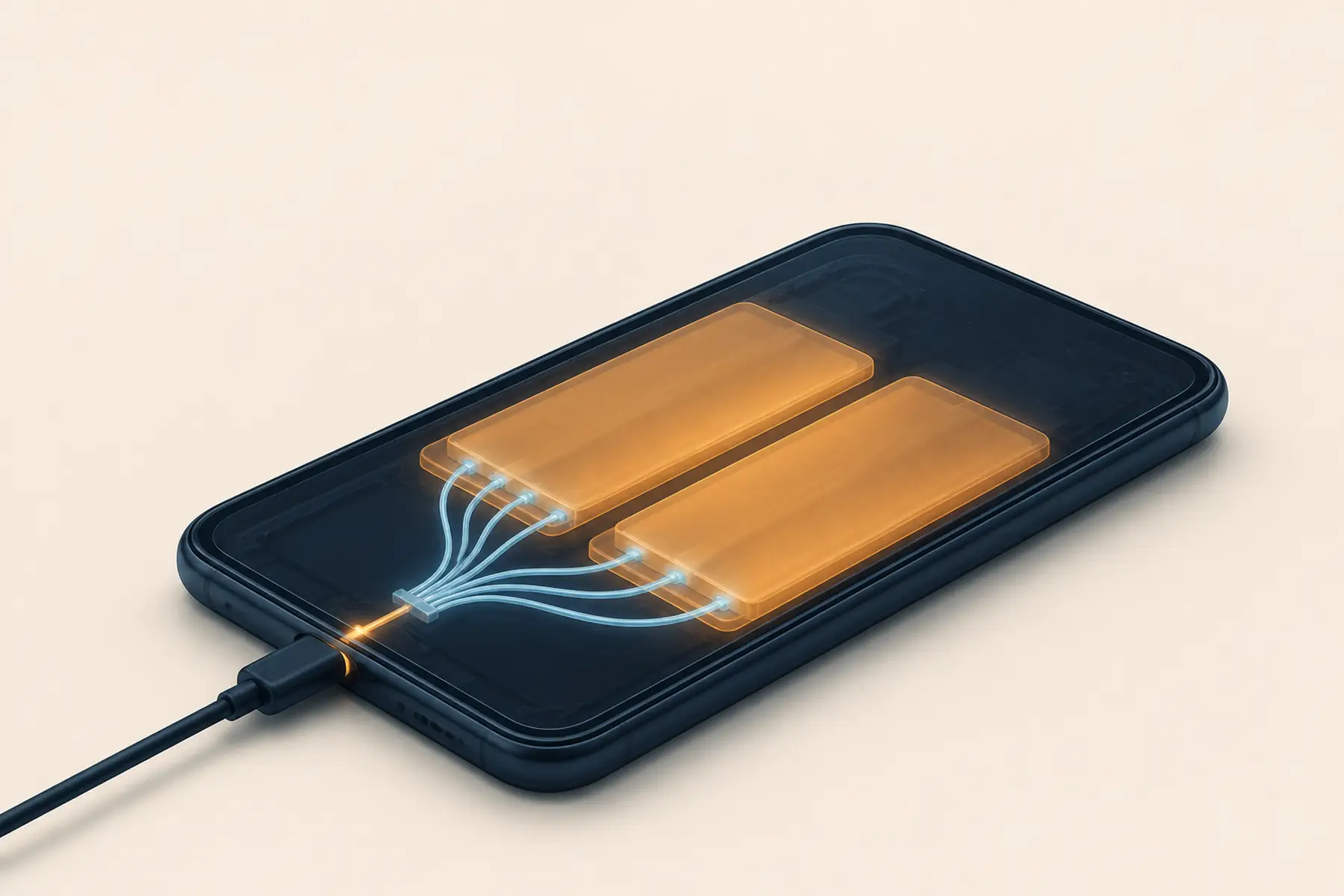
Realme has demonstrated the other half of the future: a four-cell phone battery charged at 320 watts, reaching 95% in four minutes and full charge in four and a half. Xiaomi has patented a 300-watt architecture built from two cells and five parallel charge pumps. Chinese engineers have established the power range. Realme's 320W charging demonstration Xiaomi's 300W multi-pump charging patent
The coming breakthrough will unite those achievements in one durable consumer phone. Silicon held inside carefully shaped carbon will provide the capacity. Several cells and several charge pumps will divide the electrical load. A chemistry-aware controller will continually move the current to the fastest safe level. Wired charging will deliver the great refill; a China-shaped 50-watt Qi standard will make rapid wireless top-ups ordinary.
ParallaxSee forecasts that by the end of 2030, commercially available phones from at least two major manufacturers will add at least 70 percentage points to a battery of 9,000mAh or more in ten minutes. That refill will exceed 6,300mAh—enough stored charge to carry an ordinary user through roughly two days. House confidence: 78%.
Ten minutes will become a meaningful unit of mobile energy. A shower, a breakfast or the final minutes before leaving home will place days inside the phone.
01 — China has already stretched the phone battery beyond 10,000mAh.
For most of the smartphone era, manufacturers improved endurance through efficient processors and larger bodies while the battery chemistry moved gradually. Graphite remained the standard negative electrode. Each carbon atom stores lithium reliably, though the structure has a firm capacity ceiling.
Silicon changes that arithmetic. Fully lithiated silicon has a theoretical capacity of approximately 3,579mAh per gram, compared with about 372mAh per gram for graphite. A modest quantity can therefore lift the energy stored in the same physical space. The successful design gives silicon room to expand, preserves electrical contact and controls its interface with the electrolyte.
Honor brought that strategy into a flagship in 2023. Its first Qinghai Lake battery used a silicon–carbon anode to place 5,450mAh inside the Magic5 Pro. Honor's Chinese launch announcement for the Magic5 series The company then increased silicon content and energy density through successive generations. In 2025, the Magic V5 foldable used a mass-produced battery containing 25% silicon, with 901Wh per litre and a cell stack only 0.18 millimetres thick. Honor's account of the high-silicon Magic V5 battery
In January 2026, the Power2 crossed the five-digit boundary. Its 10,080mAh battery uses 15% silicon, fits into a conventional 7.98-millimetre handset and supports 80-watt charging. In June, Honor announced an 11,000mAh successor. Honor's Chinese announcement of the X80 Pro Max The capacity side of the 2030 forecast has entered ordinary retail hardware.
These products reveal the direction of travel. A future flagship can hold close to 40 watt-hours while retaining the familiar dimensions of a phone. The winning charging system will fill most of that reserve during one short pause.
02 — A carbon bottle will give silicon room to breathe.
Silicon expands by more than 300% as it absorbs lithium. The movement can crack particles, break electrical paths and repeatedly expose fresh material to the electrolyte. Every newly exposed surface consumes lithium while rebuilding the solid-electrolyte interphase, the protective film known as the SEI. Capacity then fades through a sequence of tiny mechanical injuries.
A Tianjin University team has developed a structure that manages movement and ion transport together. Its carbon particle resembles a molecular bottle: a larger internal pore holds the silicon and leaves space for expansion, while an entrance only fractions of a nanometre wide controls what enters. Lithium ions shed part of their solvent shell at this narrow mouth and move rapidly inside. Much of the surrounding solvent remains outside.
That separation changes the protective layer. The silicon forms an inorganic-rich SEI that conducts lithium, confines the expanding material and suppresses the most damaging crystalline phase. The electrode achieved 93.6% initial Coulombic efficiency, low capacity decay and substantially controlled swelling.
The decisive result came from an Ah-scale pouch cell combining the sieving-pore silicon composite with graphite and an NCM811 cathode. It retained 80% of its capacity after 1,700 cycles at two amperes and demonstrated ten-minute charging. The researchers also describe a scalable two-step chemical-vapour-deposition process: silane places silicon inside porous carbon, then acetylene narrows the entrances with a second carbon layer. The Tianjin University silicon–carbon pouch-cell study
This is the material architecture that will carry high-silicon batteries into fast-charging phones. Carbon will provide a flexible container, a conductive network and a carefully gated entrance. Silicon will provide the energy.
03 — Gradient silicon will guide lithium safely through a fast charge.
Fast charging asks billions of lithium ions to cross the electrolyte, pass through the SEI and find storage sites inside the negative electrode within minutes. When arrival outruns absorption, metallic lithium can form on the surface. That plated lithium wastes capacity and can grow into dangerous structures.
Researchers at Beijing University of Chemical Technology found that silicon can improve this process. Compared with graphite, their silicon electrode required less energy to shed the lithium ion's solvent shell, transported ions more quickly through the SEI and moved lithium faster across the lithiated surface. Deposited lithium also showed a distinctive self-dissolving behaviour during later stages of charging.
The team turned the mechanism into an industrially plausible electrode. Silicon concentration changes gradually through its thickness, creating a silicon–graphite gradient. Lithium deposits from the current-collector side upwards, preserving a conductive route and restraining dendrite growth. An LFP full cell retained 84.3% capacity after 500 cycles at 4C. The university reports that an Ah-scale pouch configuration retained 97.9% after 300 fast-charge cycles. The gradient-silicon paper in Energy Storage Materials The Chinese university explanation of the result
Lishen has pushed related chemistry into a commercial-size 4695 cylindrical cell. A chemical-vapour-deposited silicon–carbon composite expanded the lithium-plating boundary and enabled a 10–80% charge in nine minutes. The optimized cell retained 85.4% after 1,200 severe fast-charge cycles; added contact cooling carried repeated nine-minute charging through 700 cycles with 91% retention. The format belongs to electric vehicles, while its material and degradation evidence apply across lithium-ion manufacturing. Lishen's nine-minute silicon–carbon cell study
By 2030, the phone anode will be engineered as a route. Pore entrances will prepare each ion, the SEI will conduct it, a silicon gradient will guide it and reserved carbon space will receive the expansion.
04 — Five charge pumps will turn one powerful cable into controlled streams.
A charger marked 300W begins with a basic electrical problem. Sending immense current through a single phone connector, circuit path and battery cell produces heat according to the square of the current. Doubling current can quadruple resistive heating. The practical design therefore raises voltage across the cable, divides the battery and distributes conversion across several circuits.
Xiaomi's patent CN118157252A describes this architecture in unusually concrete terms. A phone contains two series-connected cells and five parallel charge pumps. Each pump converts voltage at a ratio of 3:1. With a 30-volt, 2-ampere input, the five pumps supply a combined 10 volts and 30 amperes to the battery assembly: 300 watts.
The pumps start sequentially as input voltage, current or power crosses defined thresholds. That staged activation reduces electrical ripple and lets the controller match the number of active conversion paths to the available power. At lower input, fewer pumps operate. At the highest mode, all five share the work. Xiaomi's 300W multi-pump charging patent
Realme's public 320W demonstration supplies the companion hardware evidence. Its folded battery contains four cells that charge simultaneously. The company reported a charger power density of 3.3 watts per cubic centimetre and a full 4,420mAh charge in four minutes and thirty seconds. Realme's 320W charging demonstration
The 2030 architecture will make high power modular. Several cells will divide voltage. Several tabs will shorten the current path through each cell. Several charge pumps will divide conversion losses. Temperature sensors will govern every module. The cable will carry one large flow; the phone will transform it into many smaller, manageable flows.
05 — The phone will charge at chemistry's moving frontier.
A battery's fastest safe current changes throughout every charge. Temperature, state of charge, age, internal resistance and electrode expansion continually move the boundary. A cool, nearly empty cell can accept energy rapidly. A warm or nearly full cell needs a gentler current. A fixed charging curve leaves useful speed unused in one condition and applies unnecessary stress in another.
OPPO's patent CN116137447A turns the invisible negative-electrode potential into a control signal. A phone measures accessible quantities such as voltage, current, charge level, open-circuit voltage, resistance and temperature. A stored model maps those measurements to the negative electrode's internal potential. The controller then raises current when chemical headroom is available and lowers it as the plating boundary approaches. OPPO's negative-electrode-potential charging patent
OPPO describes the commercial version as its Battery Health Engine. The system follows negative-electrode potential in real time, maximizes current inside the safe range and reduces the formation of inactive lithium. The wider SUPERVOOC design uses bidirectional communication, path-resistance recognition, load-voltage tracking, dual cells and multiple tabs. OPPO's Chinese technical account of SUPERVOOC
Honor's 2026 patent adds another adaptive layer. Its controller stores mappings between charge-pump temperature, electrical load, switching frequency and conversion efficiency. During charging, the phone selects the switching frequency that produces the highest efficiency under the current conditions. Less wasted conversion energy means more charger power reaches the battery and less becomes heat beside it. Honor's temperature-aware charge-pump patent
Shanghai Jiao Tong University has tested the same principle at cell level. Researchers combined an electrothermal model with online measurements of temperature and battery thickness, then optimized charging time and maximum temperature rise together in commercial 4.02Ah silicon–carbon cells. The resulting strategy reduced expansion and heat while improving cycle life. Shanghai Jiao Tong University's silicon–carbon charging research
The charging curve of 2030 will become a live negotiation between charger, power electronics and chemistry. Every second will receive the highest current the cell can productively absorb.
06 — Two days can fit inside ten minutes.
The energy calculation places the forecast within reach. A 10,080mAh phone battery operating around 3.85 volts stores approximately 39 watt-hours. Raising it by 70 percentage points adds about 27 watt-hours. Delivered over ten minutes, that requires an average of roughly 164 watts at the cells. Allowing for conversion and charging losses places the necessary average input around 185–205 watts. Peak capability must be higher because the current tapers as the battery fills.
Chinese hardware already occupies that range. Realme has sent 320 watts through a four-cell phone prototype. Xiaomi's patent specifies a 300-watt five-pump circuit. OPPO has commercialized 150-watt charging with custom 6C dual cells, multiple tabs, charge pumps and an integrated controller. The next generation will apply those power systems to much larger silicon–carbon batteries.
A 70-point refill in a 9,000mAh battery equals at least 6,300mAh of nominal charge. In a 10,080mAh battery it equals 7,056mAh. That ten-minute refill carries more charge than the entire battery of many recent premium phones. Combined with efficient displays, processors and radios, it supplies a practical two-day reserve for ordinary mixed use.
The last portion of a charge will remain deliberately slower because voltage rises and chemical headroom narrows near full capacity. The consumer transformation arrives earlier in the curve. A phone beginning near empty will collect the energy that matters most during the first ten minutes, then finish gently whenever time permits.
The percentage displayed on screen will become secondary. The useful measurement will be time purchased. Three minutes will cover the evening. Five will cover tomorrow. Ten will cover the journey and the day after it.
07 — China will also make 50-watt wireless charging universal.
Proprietary Chinese wireless systems have already reached and exceeded the power of many wired chargers. Their next achievement will be interoperability.
In June 2026, Xiaomi hosted the Wireless Power Consortium's first Qi technical meeting in China. More than 90 engineers from over 20 companies—including Apple, Huawei, OPPO, vivo, Google and Honor—tested prototypes and interoperability for a proposed Qi2 50W standard. The consortium says a Chinese-backed low-inductance, low-voltage, high-power architecture will enter the next Qi release in 2027. The Wireless Power Consortium's Beijing technical meeting
Low inductance allows the system to change current quickly with smaller voltage penalties. Lower receiver voltage suits direct battery charging and reduces conversion stages inside the phone. Magnetic alignment, communications and foreign-object detection keep transmitter and receiver operating as one controlled system.
The two charging modes will acquire distinct jobs. A 200–300W cable will deliver the ten-minute refill before travel or after a heavy day. A 50W Qi2 surface will quietly restore energy at desks, cafés, cars and bedside tables. The phone will spend more of its life near full charge because ordinary surfaces will provide meaningful power.
China's influence on the standard matters because its manufacturers have accumulated years of experience with high-power coils, active cooling, charge pumps and thermal control. Their proprietary lead will become global infrastructure.
08 — Thermal science will define the winning silicon particle.
Higher silicon content raises the value of precise material design. Southeast University researchers identified a particularly important safety variable: floating silicon, particles deposited outside the protective carbon host. Exposed silicon reacts intensely with electrolyte after lithiation. Its quantity depends on pore size, carbon-coating thickness and state of charge.
In accelerating-rate calorimetry, a pouch cell containing more floating silicon reached a maximum of 875.2°C during thermal runaway, compared with 532.1°C for a lower-floating-silicon sample. The result gives manufacturers a direct design rule: deposit silicon inside appropriately sized pores, keep the external carbon layer intact and match silicon loading to the host's available expansion volume. The Chinese summary of Southeast University's silicon–carbon safety study
Huawei's patent portfolio follows that route. Granted patent CN115312726B distributes silicon through amorphous carbon held in a graphite skeleton and limits internal pores to 50 nanometres or less. The structure reduces electrolyte contact, restrains expansion and preserves conductivity. Huawei's granted silicon–carbon composite patent
A newer Huawei and Liyang Zichen application, CN121460520A, controls the ratio between deposited silicon mass and porous-carbon volume. Its claims specify small pore mouths, low surface area and a coating around the silicon–carbon core, targeting high capacity, low expansion and high conductivity together. Huawei and Zichen's porous silicon–carbon patent
These studies turn safety into geometry. The successful cell will place silicon where carbon can contain it, build a stable interface around it and monitor its expansion throughout the charge. Each generation will carry more energy because its internal architecture becomes more exact.
09 — By 2030, charging will become an integrated Chinese system.
The necessary advances now form a complete chain. Honor has commercialized five-digit battery capacity. Tianjin University has combined ten-minute charging with long pouch-cell life. Beijing researchers have shown how gradient silicon improves fast-charge behaviour. Lishen has carried silicon–carbon to nine-minute charging in an industrial cell. Realme has demonstrated the required phone-scale power. Xiaomi, OPPO, Honor and Huawei have patented the circuitry, control logic and material structures that connect those achievements. The Wireless Power Consortium is turning the Chinese wireless architecture into a global standard.
Manufacturing will pull the pieces together. Silicon will be deposited into porous carbon by controlled chemical vapour deposition. Electrode coatings will vary material concentration through their thickness. Cell factories will measure expansion, impedance and thermal behaviour as quality variables. Phones will divide the pack into several cells, shorten current paths with multiple tabs and spread conversion across parallel charge pumps. Battery-management software will continually estimate the chemical state and select the fastest productive current.
This integration will reach premium Chinese phones first. Competition will carry it rapidly through the market because endurance and charging time remain immediately visible advantages. A camera improvement needs demonstration; two days of energy arriving over breakfast explains itself.
ParallaxSee will resolve the forecast as true if, by 31 December 2030, at least two manufacturers ranked among the ten largest global smartphone vendors commercially offer qualifying phones to the general public for at least 90 consecutive days. Each phone must have a rated battery capacity of at least 9,000mAh, a body no thicker than 9.5 millimetres excluding the camera projection, and an official wired mode that an independent instrumented review reproduces from 10% charge or lower to at least 80% charge within ten minutes and 59 seconds.
The two models must come from different manufacturers. Limited laboratory prototypes, external battery cases and devices requiring an active refrigerated enclosure fall outside the definition. Ordinary internal vapour chambers, graphite sheets, phase-change materials and charger fans qualify. Preferred resolution evidence will be manufacturer specifications combined with measurements from accredited laboratories or established technical reviewers; regulatory filings and multiple independent instrumented reviews will serve as fallbacks.
The headline's two days is operationalized through the minimum refill: 70% of a 9,000mAh battery adds at least 6,300mAh. Actual endurance will vary with signal strength, display use, applications and processor load. The electrical reserve will be real and measurable.
By 2030, the fastest phone charger will act less like a fire hose and more like a conductor. It will direct hundreds of watts through many coordinated paths, listen to the chemistry and fill every available space at the right speed.
Ten minutes will place two days in the hand.