
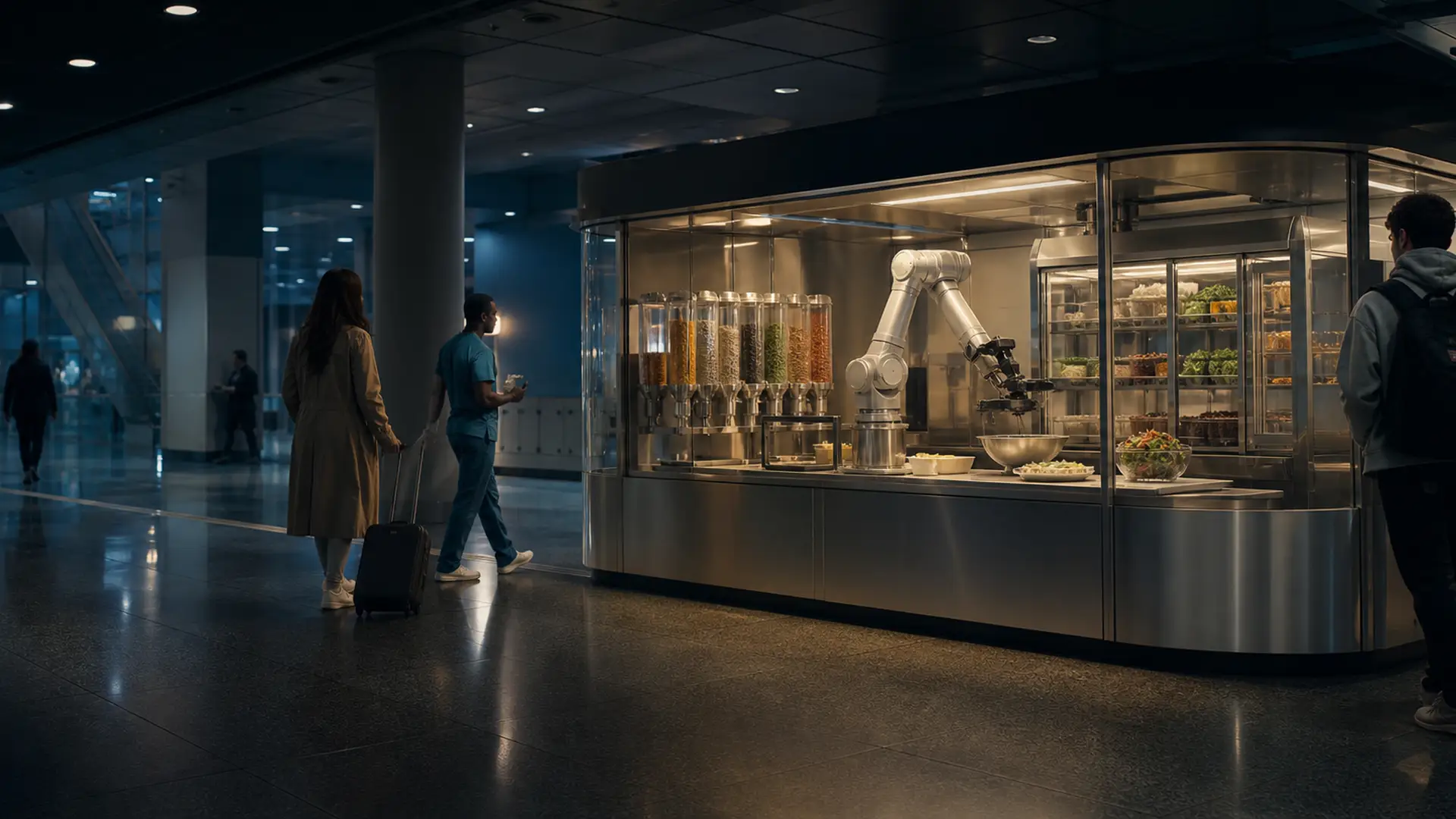
At two in the morning, the conventional kitchen is dark. The robotic one is waiting for an order.
That difference will put food-preparation robots into airport terminals, hospital corridors and university buildings before they become common in ordinary restaurants. These institutions never fully close, but their demand is too uneven to justify staffing every counter through the night.
House forecast: 72%. The winning machines will not resemble humanoid chefs. They will be compact, specialized production cells: an arm behind glass, a bank of ingredient dispensers, integrated refrigeration and software that knows exactly how much banana, protein powder or salad dressing entered an order.
By 2029, watching one prepare a meal will no longer feel like encountering an exhibition. It will be part of waiting for a flight, finishing a night shift or leaving a late class.
01 - The robot kitchen will enter through the hours nobody wants.
Restaurant robotics is usually presented as a replacement for cooks. That framing misses its first serious market.
The immediate opportunity is not automating a busy restaurant at lunchtime. It is serving food at locations where demand continues after staffing the kitchen stops making financial sense.
Airports have passengers stranded between flights. Hospitals have employees, visitors and patients at every hour. Residential campuses have thousands of customers whose schedules ignore conventional meal periods.
A machine does not need to replace a complete kitchen to win these locations. It needs to keep one profitable menu available for six additional hours.
Coffee, smoothies, salads, grain bowls, noodles and burgers are crossing first because their preparation can be reduced to controlled operations: dispense, weigh, blend, heat, stir, grill and package. The robot does not need culinary judgment. It needs to repeat a narrow sequence hundreds of times without losing temperature, portion control or sanitation.
02 - Airports already contain the working prototype.
San Francisco International Airport currently lists Cafe X as a 24-hour robotic coffee bar in Terminal 3. The mechanical arm is not hidden in a production room. It is the counter, the worker and part of the attraction. San Francisco International Airport
At Incheon International Airport, the automation has moved from drinks to heat. Aniai's Alpha Grill presses, cooks and transfers hamburger patties in less than a minute each, with capacity exceeding 200 patties an hour. Aniai
Airport economics favor this machinery unusually strongly. Every food-service employee must be recruited, scheduled and frequently cleared to work inside secure areas. Passenger volume arrives in waves, producing sudden queues followed by long quiet periods.
A National Academies study of airport food and beverage operations identified burger and french-fry robots as particularly well suited to this repetitive, high-volume environment. It also noted that requiring fewer security-badged workers lowers a barrier unique to airport concessions. National Academies
The airport robot does not have to outperform the best barista or cook. It has to outperform an unopened counter.
03 - Hospitals turn portion control into a clinical feature.
Hospitals offer a more demanding test. Their food systems must handle allergies, therapeutic diets, ingredient tracking, sanitation requirements and patients who cannot consume conventional meals.
In 2026, Morrison Healthcare and Blendid placed an automated smoothie system in the production kitchen at Mayo Clinic's Methodist Campus in Rochester, Minnesota. This is not simply a retail smoothie kiosk relocated to a hospital.
Blendid Pro uses three robotic arms and can work on six orders simultaneously. Integrated scales measure ingredients to one-tenth of a gram. Its software manages approved recipes, allergens, clinical recommendations and different drink thicknesses for patients with swallowing difficulties. A customized drink can be completed in three minutes. Kiosk Marketplace
The system still depends on people. Staff prepare and replenish ingredients, inspect quality and sanitize the equipment. But the machine converts a dietitian's specification into a repeatable physical product.
Morrison Healthcare chef Michael Raub described the real engineering standard: "Long-term success depends on reliable equipment performance, consistent ingredient quality, standardized recipes and seamless integration into daily culinary operations."
This is where hospital adoption becomes commercially important. If a machine can satisfy clinical kitchens, ordinary institutional food service becomes the easier problem.
04 - Campuses supply the customers most willing to watch.
University campuses are the cultural proving ground.
At UCLA, a Jamba by Blendid kiosk uses a robotic arm, three blenders, refrigeration and 20 ingredient dispensers. It can work on nine smoothies simultaneously and produce as many as 45 an hour. Students can alter ingredients, order through an app and schedule collection. UCLA
University College London pushed the performance further in June 2026 with a trial of a six-axis, dual-arm robot barista. The machine prepares hot and iced coffee, produces latte art and uses action models trained from professional baristas' movements. University College London
That theatricality matters. The visible arm reassures customers that a fresh order is being prepared, while turning the wait into a small performance. The enclosure is simultaneously a kitchen, a safety barrier and an advertisement.
The National Restaurant Association found that 30% of limited-service customers would order food prepared by automated systems. Among Gen Z adults, the figure was 43%. Campuses concentrate exactly the customers most ready to try the machine. National Restaurant Association
The habit formed there will travel with graduates into workplaces, transit hubs and hospitals.
05 - The first generation proved demand and failed the maintenance test.
The industry has already experienced one false dawn.
Chowbotics placed its Sally salad robot in hospitals, universities and offices. At the beginning of 2020, Sally operated in 16 hospitals. Within months, the company planned to reach 70 hospital locations. The machine stored as many as 22 ingredients inside a sealed, refrigerated enclosure and assembled customized salads around the clock.
At the University of Arkansas for Medical Sciences, nutrition-services director Tonya Johnson found that the robots filled the gap left when conventional salad bars closed. "I wish we had more robotic equipment like Sally in our food service areas." Chowbotics
Yet DoorDash closed Chowbotics in 2022 after acquiring it only 18 months earlier. The machines had reached real customers, but the business failed to satisfy the company's internal performance and economic benchmarks. Restaurant Dive
That failure did not disprove institutional food robotics. It exposed the difference between selling a robot and operating a food-service network.
A viable machine needs remote diagnostics, dependable refrigeration, quick cleaning, inexpensive ingredient cartridges, standardized replacement parts and technicians who can restore service before the breakfast rush. The second generation is being engineered around those unglamorous requirements.
06 - The hardware is becoming an appliance.
Blendid's M2 shows how the installation problem is shrinking.
The machine is approximately seven feet wide, costs $100,000 and produces as many as 45 smoothies per hour. It uses a standard 20-amp electrical outlet and requires neither a water line nor a floor drain. Remote monitoring, software upgrades and hardware service are included for five years. Blendid
Those specifications matter more than another dexterous robot demonstration.
A hospital or university can place this machine into existing floor space without constructing a complete kitchen. An airport concessionaire can add capacity without securing a large preparation area. The operator receives an appliance with a service agreement rather than a robotics research project.
Once robotic food preparation reaches this form, adoption becomes a procurement decision. Facilities departments already know how to purchase refrigerators, coffee machines and vending systems. The robot enters through the same budget.
07 - The forecast.
By 2029, robotic preparation will be established across all three institutional markets.
Airports will lead with coffee, noodles and automated grilling. Campuses will add smoothies, bowls and highly visible robot baristas. Hospitals will adopt the technology more quietly, using it first for overnight service and precisely controlled nutrition.
The machines will not eliminate institutional kitchens. Humans will still design menus, prepare ingredients, inspect food, clean equipment and handle exceptions. But a growing portion of the actual measuring, mixing, cooking and packaging will happen inside sealed robotic stations.
The decisive shift will be visual. People will stop photographing every mechanical arm they encounter. The robot preparing a cappuccino or protein smoothie will become no more remarkable than the self-checkout screen beside it.
The future of robotic food will not begin in a futuristic restaurant. It will begin in the terminal after the restaurants have closed.