
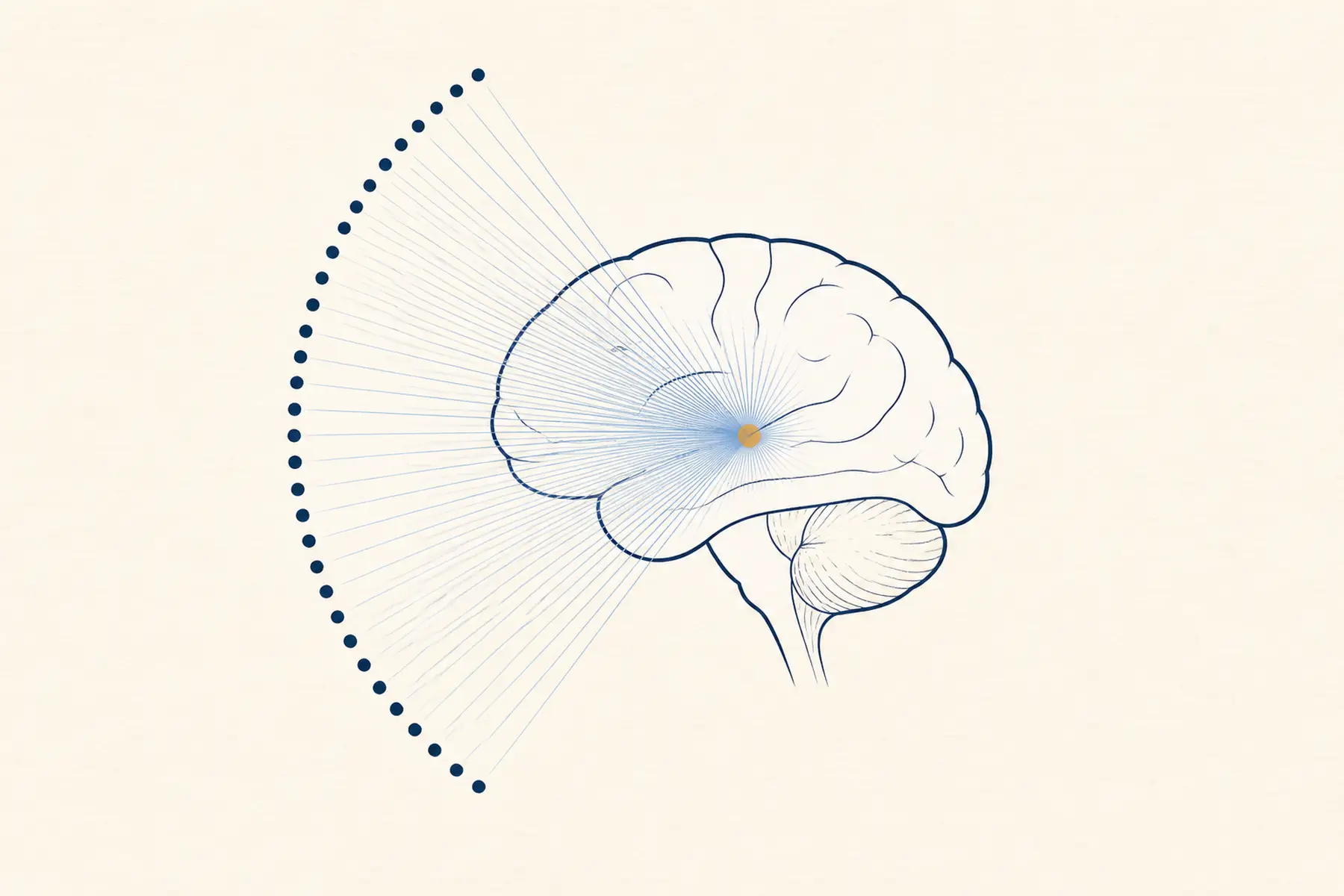
The first phase of the ultrasound revolution stopped a hand from shaking. The next will turn sound into a general instrument for treating the brain.
A modern focused-ultrasound system can already arrange more than a thousand emitters around a patient's head, alter the timing of each wave to undo the distortion caused by bone, aim at a target measured in millimetres and watch the temperature change on MRI. Change the pulse pattern and the same physical platform performs a different job. It can heat a faulty circuit until it falls silent. It can make injected microbubbles oscillate and briefly open the blood–brain barrier. It can activate a drug inside a tumour. At lower intensity, it can change the activity of a deep neural target without destroying it. A 2026 review of transcranial focused ultrasound in the human brain
This is no longer a promise assembled from company demonstrations. A randomised sham-controlled trial produced lasting tremor relief. A second trial proved the principle in Parkinson's disease. Repeated blood–brain-barrier opening has succeeded in people with glioma, and a small Alzheimer's study made treated and untreated regions of the same brain serve as a direct comparison. In 2025, the first human sonodynamic trial found the biological signature of ultrasound-activated tumour destruction.
The patent record explains why these successes arrived in sequence. One generation corrected the skull's phase errors. Another expanded the usable angles and frequencies. A third listened to bubbles and adjusted pressure in real time. The newest filings use machine learning to predict corrections and cavitation to destroy tissue mechanically. A patent is evidence of an engineering claim, not evidence that a treatment works. These patents matter because the claimed mechanisms were followed by working arrays, animal experiments, controlled trials and regulatory approvals.
ParallaxSee forecasts that by the end of 2035, transcranial focused ultrasound will be a standard neurological treatment platform: more than 50,000 procedures a year worldwide, regulatory clearance for at least five brain indications and at least one approved non-thermal application. House confidence: 82%.
The ultrasound revolution will be built from a simple idea with extraordinary consequences. Sound can carry energy through the skull. Software can decide where that energy meets. Biology changes only at the meeting point.
01 — The skull turned a clean wave into noise.
The brain was an obvious target for therapeutic ultrasound and a terrible place to deliver it. Bone reflects part of an acoustic wave, absorbs another part as heat and accelerates what remains. A beam crossing a thin patch of skull arrives at a different time from one crossing a thick patch. Add hundreds of paths together without correction and the intended focus blurs into weak, misplaced energy.
The solution was borrowed from radar and radio astronomy: stop treating the emitter as one loud source. Divide it into many individually controlled elements. If the skull makes one wave arrive early, delay that element. If another path loses more energy, change its amplitude. When all the corrected waves reach the target in phase, they reinforce one another there and remain comparatively harmless along their separate routes.
A 2000 InSightec patent, later granted as US6666833B1, described the problem in unusually direct physical terms. The speed of sound is faster in bone than in soft tissue; differences in thickness therefore produce phase errors and incomplete constructive interference. The patent proposed controlling the phase and amplitude of individual elements and using reflected acoustic information to sharpen the focus. The foundational trans-skull focusing patent
Four years later, the claim became an experiment that could be seen on an MRI. Kullervo Hynynen and colleagues built a hemispherical 500-element array operating at 700–800 kHz. They placed excised human skull bone in the acoustic path and targeted living rabbit brain behind it. CT data supplied the skull geometry; each channel received its own phase correction; MRI thermometry watched the result. The system produced sharply localised temperatures as high as 55°C and focal lesions consistent with thermal damage. It had passed energy through human bone, reunited the wave and changed tissue at the intended point. The 2004 500-element phased-array experiment
That test contains the architecture of the clinical machines now treating people: a patient-specific skull map, a many-element bowl, electronic phase correction and imaging that shows where the energy lands. The revolution began when ultrasound ceased to be a beam and became a computation.
02 — MRI gave sound a dashboard.
Correct focus was only half the invention. A treatment also had to prove, moment by moment, that the target was warming while neighbouring tissue was not. MRI supplied both the map and the thermometer.
The patient lies with the head coupled to a water-filled transducer helmet. A pre-treatment CT describes the density and thickness of the skull along every acoustic route. MRI identifies the anatomical target. The system first performs low-energy test sonications: enough heat to make the focal point visible on a temperature map, below the level that permanently changes tissue. The operator can move the focus electronically by changing relative timing, test again and only then deliver the therapeutic sonications.
The therapeutic temperature is produced by convergence. No single element needs to drive destructive energy through one patch of skull. Hundreds or more than a thousand paths contribute small amounts that add at the focus. MRI thermometry then turns temperature into a live dose map. The physician is not firing blind and checking the damage later. The physician watches the focal spot emerge, measures its heating and stops or redirects the next sonication.
The importance of this feedback appeared in the 2004 experiment. Applied power alone correlated poorly with lesion size because skull attenuation and blood flow varied by location. Measured peak temperature correlated far better. The machine became dependable when it monitored the biological effect rather than trusting the electrical input.
A later Insightec patent, US8617073B2, widened the acoustic geometry by calculating how both longitudinal and shear components travel through bone. It described CT- or MRI-derived skull models, corrections for thickness, density and incidence angle, and lower frequencies that could extend the treatment envelope. The longitudinal-and-shear-wave patent This is the pattern that will define the field through 2035: model the patient, deliver a small dose, measure what happened and correct the next pulse.
03 — The first controlled trial made the platform real.
Essential tremor supplied the decisive human test because its effect is visible immediately. The target is a small relay in the thalamus. Heat it precisely enough and the pathological rhythm driving the tremor is interrupted. Miss the target and the hand still shakes—or speech, sensation and balance can suffer.
In 2016, investigators randomly assigned 76 people with medication-resistant essential tremor to active MRI-guided focused-ultrasound thalamotomy or a sham procedure. Three months later, mean hand-tremor scores in the treated group had fallen from 18.1 to 9.6; the sham group barely changed, from 16.0 to 15.8. Disability and quality-of-life measures also favoured treatment. Gait disturbance and numbness were important adverse effects, some persistent, but the trial established that the focused energy produced a therapeutic result beyond expectation or placebo. The randomised essential-tremor trial
The five-year follow-up answered the next question. Among the 40 participants assessed at year five, treated-hand postural tremor remained 73.1% below baseline. No new delayed complications appeared. The five-year essential-tremor results The focal lesion was not merely accurate; its clinical effect endured.
The treatment then crossed the midline. A 2024 multicentre trial treated the second side in 51 people who had previously received a successful first-sided procedure. Their combined tremor and motor score improved by 66% at three months. At twelve months, persistent effects included mild ataxia in six participants, dysarthria in seven and numbness or tingling in eight—real trade-offs, but no return to the historical assumption that bilateral lesioning was automatically unacceptable. The staged bilateral essential-tremor trial
This was the revolution's first complete chain: physics patent, phased-array test, randomised human evidence, durable follow-up and regulatory expansion. It gave every later application a machine, an operating discipline and a route through clinical review.
04 — Parkinson's disease proved that one target would become many.
A platform becomes important when it moves beyond the indication that first justified it. Parkinson's disease required a different target and a different clinical question: could a carefully placed lesion improve motor function or dyskinesia in a disorder affecting distributed brain circuits?
A 2023 sham-controlled trial enrolled 94 people with Parkinson's disease. Among those completing the three-month primary assessment, 69% of the active-treatment group met the response criterion, compared with 32% of the sham group. Thirty of the 39 responders assessed at twelve months remained responders. Dysarthria, gait disturbance, loss of taste, visual disturbance and facial weakness were among the treatment-related risks, but the efficacy signal survived a blinded comparison. The randomised Parkinson's trial
In July 2025, the US Food and Drug Administration approved staged focused-ultrasound pallidothalamic tractotomy for eligible people with advanced idiopathic Parkinson's disease, allowing the contralateral side to be treated after at least six months. The regulatory history is revealing: essential tremor in 2016, tremor-dominant Parkinson's disease in 2018, unilateral pallidotomy in 2021, staged bilateral essential-tremor treatment in 2022 and staged Parkinson's treatment in 2025. The FDA's 2025 safety and effectiveness summary
Each approval is narrower than the phrase ultrasound revolution. Together they show the revolution's mechanism. Once the platform can reach a deep target, test its position and monitor its dose, expansion depends increasingly on choosing the right circuit and proving the right endpoint. The expensive physical infrastructure does not have to be reinvented for every disorder. The anatomical plan, acoustic parameters and evidence package do.
By 2035, movement disorders will look like the opening market, not the final identity of focused ultrasound.
05 — The new focusing patents teach the machine to learn a skull.
Clinical systems still exclude or struggle with some patients because skulls differ. A low ratio between dense cortical bone and porous marrow can make heating less efficient. Targets near the skull base present awkward incidence angles. Movement shifts geometry. A fixed correction calculated once from CT is powerful, but the next generation will be adaptive.
The engineering is already moving in that direction. A 2021 research system used a patient-specific, 3D-printed helmet holding 4,096 elements. Simulations calculated corrections for an excised human skullcap; measurements confirmed that the array could focus through it, and preliminary animal work demonstrated blood–brain-barrier opening through the human bone sample. The skull-conformal 4,096-element array study More elements create more independent paths, a wider steering vocabulary and the possibility of lighter arrays shaped around the patient rather than one universal bowl.
In March 2026, another InSightec patent was granted as US12582386B2. Its adjustment mechanism uses a trained machine-learning model to predict compensating parameter values for individual transducer elements from relationships among their measurements. The machine-learning aberration-correction patent The conceptual move is important. Early systems asked: What correction should this CT image imply? The new systems can also ask: What corrections have worked across comparable elements, skull paths and measured responses?
The patent does not establish clinical superiority, and a neural network cannot repeal acoustic physics. Its value is that it encodes the next engineering target: faster calibration, broader treatment envelopes and correction that improves from data rather than remaining a static lookup. Combined with acoustic receivers and MRI feedback, learned prediction can propose the focus while measurements verify it.
By 2035, the best focused-ultrasound systems will behave less like fixed instruments and more like autopilots. They will begin with a patient-specific model, send harmless test energy, compare prediction with response and retune hundreds of channels before the therapeutic pulse. More skulls will become acoustically ordinary.
06 — The most important patent taught the machine to listen to bubbles.
Thermal ablation demonstrated that sound could destroy a selected target. The second revolution uses far less energy to make a reversible change. Inject microscopic gas-filled bubbles into the bloodstream and expose them to pulsed ultrasound. At a controlled pressure, the bubbles expand and contract. Their mechanical motion briefly loosens the tight junctions between cells lining brain vessels, allowing molecules to cross the blood–brain barrier in the focal region. The barrier then closes.
Control is everything. Stable oscillation is useful; violent bubble collapse can injure vessels and produce microhaemorrhage. Pressure measured outside the skull is an unreliable guide because every skull changes the field. The machine therefore needs to hear what the bubbles themselves are doing.
Meaghan O'Reilly and Kullervo Hynynen's patent family, which claimed priority in 2011 and was granted in 2024 as US12064287B2, describes a feedback controller that analyses subharmonic and ultraharmonic emissions from microbubbles. If those signals appear, the system reduces pressure for later bursts; if they do not, it can increase pressure. The therapy becomes a conversation: pulse, listen, adjust. The acoustic-emissions control patent
The patent's control logic was tested long before grant. In a 2012 rat study covering 86 brain locations, the controller increased pressure until it detected ultraharmonic emissions, then stepped down. At the selected scaling level, MRI showed barrier opening without tissue damage on imaging or histology eight days later. The first real-time feedback-control experiment A macaque study then reported successful barrier opening in 96% of targeted locations while detecting the broadband emissions associated with dangerous cavitation in fewer than 0.2% of bursts. The primate acoustic-monitoring study
The same feedback principle has reached patients. An analysis of 38 monthly sessions in nine people with glioblastoma used a 220-kHz hemispherical array and controlled exposure from subharmonic emissions. The evolving protocol produced opening across the treatment volume with minimal petechiae. The clinical cavitation-monitoring study
This is the breakthrough that makes non-thermal focused ultrasound scalable. MRI shows where the barrier opened after a sonication. Bubble emissions report what is happening during it. The therapy can regulate itself at the moment biology begins to change.
07 — Once the gate opens, old drugs acquire new geography.
The blood–brain barrier is excellent biology and frustrating pharmacology. It protects neural tissue from toxins and fluctuations in the blood, but it also excludes many antibodies, gene vectors and chemotherapy molecules. Focused ultrasound does not need to invent a new drug to transform treatment. It can change where an existing drug reaches a useful concentration.
The largest recent brain-tumour test brought that idea into a repeatable multicentre protocol. A phase 1/2 trial enrolled 34 people with high-grade glioma and combined temozolomide with MRI-guided, 220-kHz focused ultrasound and microbubbles for as many as six monthly cycles. Blood–brain-barrier opening was visible in every treatment. The study recorded no treatment-related deaths; most events attributed to the ultrasound procedure were grade 1 or 2, with one grade 3 event. The survival analysis was exploratory rather than a randomised efficacy verdict, but the primary engineering objective succeeded: a delicate biological gate was opened repeatedly around infiltrative tumour regions in living patients. The 34-patient glioma trial
A three-person Alzheimer's experiment supplied an unusually elegant comparison. Participants received six monthly infusions of aducanumab, while focused ultrasound opened the barrier in selected regions of only one hemisphere. At 26 weeks, amyloid reduction was greater in every ultrasound-treated region than in the homologous region on the untreated side. The barrier opened at each targeted site and closed within 24 to 48 hours. This was a proof of concept, not evidence of cognitive benefit, but it showed that the acoustic procedure could amplify the local biological effect of a large antibody. The focused-ultrasound and aducanumab study
The strategic consequence is larger than either drug. A pharmaceutical company developing an antibody, nanoparticle, viral vector or RNA therapy no longer has to treat the entire blood–brain barrier as immovable. It can design a therapy and a delivery session together. The acoustic focus supplies location; microbubble feedback supplies control; MRI confirms closure.
By 2035, drug delivery will be the first approved non-thermal use of the platform. The machine that began by making a permanent thermal dot will routinely create a temporary molecular doorway.
08 — Ultrasound has begun switching medicines on inside tumours.
Opening a barrier helps a drug arrive. Sonodynamic therapy goes further: it uses sound to activate a drug after arrival.
The molecule 5-aminolevulinic acid, or 5-ALA, is metabolised into protoporphyrin IX, which accumulates preferentially in high-grade glioma cells. Neurosurgeons already use its fluorescence to distinguish tumour during an operation. Under focused ultrasound, the same compound can act as a sonosensitiser. Acoustic energy activates it, producing reactive oxygen species that damage the tumour cell. The sound is neither imaging the cancer nor simply cooking it. It is providing the trigger for a chemical reaction.
In 2025, a first-in-human study treated nine people with recurrent high-grade glioma using intravenous 5-ALA and ascending doses of MRI-guided focused ultrasound. Investigators exposed one half of each tumour region and left the other half untreated before tissue analysis. They reported no drug-related or device-related toxicities. The treated tissue showed dose-related changes in markers of oxidative stress and cell death. The first human 5-ALA sonodynamic trial
Nine patients cannot establish survival benefit. The breakthrough is technical and biological: a non-thermal acoustic exposure produced the intended molecular reaction inside a human brain tumour, and the untreated half supplied an internal comparison. Future sonosensitisers can be designed for different tumours, immune effects or release mechanisms. The hardware becomes a remote control for chemistry.
This is why focused ultrasound will become a platform rather than a single treatment. Thermal dose, bubble dose and sonodynamic dose use different pulse patterns, frequencies and monitoring signals, but share the central invention: energy converges only where software commands it to converge.
09 — Low-intensity pulses are beginning to move circuits.
The same focusing machinery can operate below the threshold for a lesion or blood–brain-barrier opening. Short, low-intensity pulses deposit mechanical energy in neural tissue and can change the excitability of the targeted circuit. The precise cellular mechanism remains an active research question; the measurable breakthrough is that a deep or cortical target can be modulated without leaving an ablation behind.
A 2024 double-blind, sham-controlled study supplied the first psychiatric efficacy signal. Twenty-three people with major depressive disorder completed six sessions aimed at the left dorsolateral prefrontal cortex. Mean depression scores in the active group fell from 28.5 to 16.8 after treatment and 14.8 at two-week follow-up; the sham group moved from 29.2 to 25.7 and 24.8. Six of eleven treated participants met the response threshold, compared with one of twelve receiving sham stimulation, and the sessions produced no reported undesirable effects. The focused-ultrasound depression trial
A different team aimed a single 20-minute, 220-kHz session at both sides of the nucleus accumbens in eight people with severe opioid-use disorder. Mean cue-induced opioid craving was 91% lower at day 90, and five participants remained abstinent throughout the 90-day follow-up. The study was open-label and small, so the behavioural effect needs a randomised replication. The technical result is already important: energy reached a deep reward-system target, participants tolerated it, MRI found no serious device-related abnormality and functional connectivity changed after treatment. The eight-person opioid-use neuromodulation study
Neuromodulation gives focused ultrasound something lesioning cannot provide: reversibility and repetition. A circuit can be tested before it is permanently altered. A treatment course can steer activity over days or weeks. Researchers can probe deep structures that magnetic stimulation reaches only indirectly.
By 2035, low-intensity ultrasound will occupy the space between an implanted electrode and an external magnetic coil. It will let clinicians address a deep target with software-defined pulses, measure the network response and return for another session without committing the patient to a permanent lesion.
10 — The next patent wave replaces heat with a controlled cloud.
Histotripsy is the boldest branch of the ultrasound revolution. Instead of sustaining a beam long enough to heat tissue, it delivers extremely short, high-pressure pulses. Where the negative pressure crosses a threshold, a dense cloud of bubbles forms, expands and collapses. The mechanical action breaks tissue into a homogenised suspension while the surrounding paths avoid a thermal dose.
A University of Michigan patent with priority dating to 2015, granted in 2025 as US12220602B2, describes brain-treatment systems that generate these cavitation clouds, correct skull aberration and liquefy a clot or tumour for drainage. The patent stresses the decisive distinction: histotripsy is mechanical, not thermal. The bubble cloud can also act as its own bright acoustic marker, allowing the system to see where tissue is being fractionated. The granted brain-histotripsy patent
The group then filed a separate MRI-guided transcranial system covering treatment planning, targeting and monitoring. That application remains pending, so it should be read as a map of intended engineering rather than a regulatory milestone. The transcranial MRI-guided histotripsy application
The corresponding test is already substantial. Researchers built a 700-kHz, 128-element MRI-compatible array and fired through an excised human skull into living pig brain. Phase correction raised the measured peak negative pressure through the skull from 48.4 to 72 megapascals, above the approximately 26-megapascal cavitation threshold. MRI confirmed targeted treatment in two pigs without excessive bleeding or oedema around the target at the time of examination. The transcranial MRI-guided histotripsy system test A larger preclinical investigation then produced sharply bounded tissue homogenisation in all eight treated pigs. The eight-pig histotripsy study
Transcranial histotripsy has not yet completed the human trial sequence that thermal focused ultrasound has. It nevertheless shows where the patent stack is heading. Sound will not merely heat, open or stimulate. It will create a steerable mechanical tool whose action can be localised from the bubbles it produces. By 2035, thermal ablation and blood–brain-barrier opening will be routine; histotripsy will be the breakthrough entering specialist brain-tumour and haemorrhage care.
11 — By 2035, hospitals will buy a platform, not a procedure.
The adoption curve has already left the laboratory. The Focused Ultrasound Foundation's 2025 snapshot counted 24,808 cumulative brain treatments worldwide: 20,210 for essential tremor, 2,796 for Parkinson's disease, 948 for brain tumours and smaller but real cohorts across pain, Alzheimer's disease and psychiatric conditions. The 2025 State of the Field report The field reported 7,161 brain treatments in 2024 alone. Sustaining 20% annual growth from that base would produce roughly 53,000 procedures in 2035.
Growth will accelerate because every successful indication improves the economics of the next. An MRI suite and phased array devoted to one rare procedure are difficult to justify. The same installation treating tremor and Parkinson's disease, opening the barrier for oncology and neurodegeneration, activating tumour drugs and performing investigational neuromodulation becomes a service line. Training, treatment planning, acoustic simulation and safety monitoring can be shared.
The forecast resolves true if all three conditions are met by 31 December 2035. First, providers worldwide perform at least 50,000 transcranial focused-ultrasound treatment sessions in one calendar year. Second, major regulators have authorised clinical use for at least five distinct neurological or neuro-oncological indications. Third, at least one authorisation is non-thermal: blood–brain-barrier opening, sonodynamic therapy, neuromodulation, histotripsy or another mechanism that does not depend principally on thermal ablation. Implanted emitters that require an open-skull procedure do not count.
Essential tremor and Parkinson's disease have already satisfied the hardest test: thousands of precise acoustic paths can be corrected through living human skulls, joined at a deep target and translated into durable benefit. Microbubble control has passed from patent logic to repeated patient sessions. Sonodynamic therapy has produced its intended molecular signal in human tumours. Histotripsy has crossed human skull bone in a preclinical system and left sharply confined targets behind.
The remaining decade is an expansion problem. Better correction will admit more skulls. Feedback will make bubble dosing repeatable. New drugs will be paired with local acoustic delivery. Regulators will evaluate modes that share hardware but produce entirely different biological effects.
By 2035, the phrase focused ultrasound will describe a family of brain treatments in the way endoscopy or radiotherapy describes a platform today. The machine will aim heat, open gates, activate chemistry and move circuits. Its instrument is sound; its precision comes from computation; its revolution has already survived the first human tests.