
Correction — 7 September 2026: An earlier version said YouTube was still building the second platform workflow for AI presenters. YouTube already offered channel owners a self-service avatar tool in YouTube and YouTube Create that generates short videos from a face-and-voice model and a text prompt. This completes the forecast's two-platform product condition alongside TikTok; the 25% advertising-use threshold remains unresolved, so the thesis and 78% probability are unchanged.
She stands in front of a ring light and performs fifteen seconds of happiness. A dance, a lip-sync, a new dress, a bottle held beside an untroubled face. The scene looks casual because making labour look effortless is part of the labour. Behind it sit the rehearsals, discarded takes, editing, comments, messages, negotiations and the daily obligation to remain visible.
For roughly a decade, a young and conventionally attractive person—most often a woman—could turn that performance into an occupation. The smartphone removed the studio. TikTok and Instagram supplied distribution. Advertisers supplied the money. An entire layer of the creator economy grew around the useful commercial fact that brands continually needed another human face.
That fact is ending.
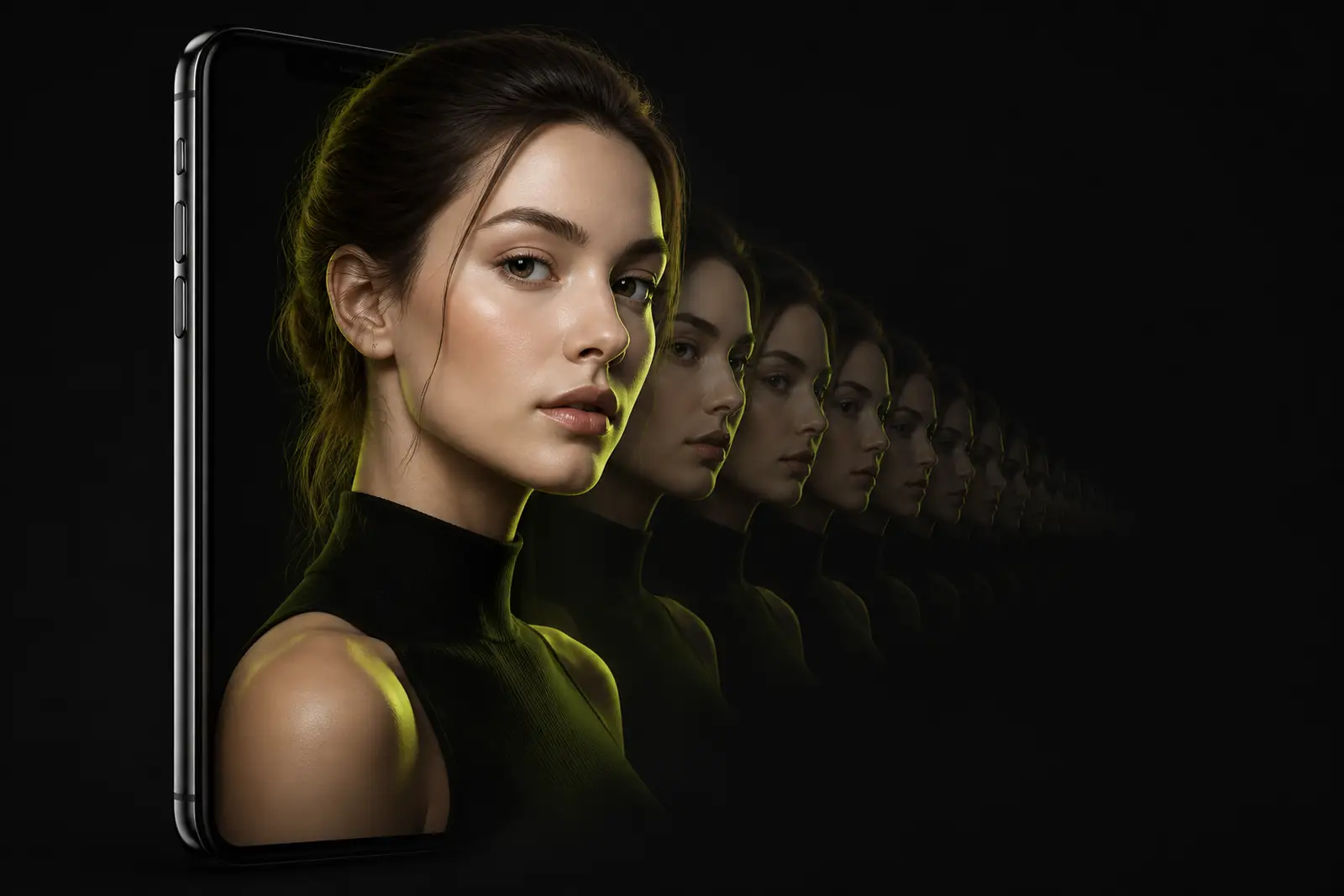
The first virtual influencers proved that an invented woman could attract attention and sell a product. Generative video is now removing the expensive artists and studios that kept those characters exceptional. A marketer can begin with a face, add a voice, request a movement and produce another version for every language, audience and product. The synthetic performer does not merely imitate the influencer. It inherits the economic function that created her job.
ParallaxSee forecasts that by the end of 2028, synthetic or materially AI-generated performers will appear in at least one quarter of newly produced, non-celebrity, presenter-led short-form video advertisements shown in the United States and United Kingdom. At least two of TikTok, Meta and YouTube will offer advertisers a self-service workflow for generating such presenters inside their advertising or creation products. House confidence: 78%.
The pretty influencer will not disappear in 2028. She will discover that much of her job has disappeared.
01 — The job began when the camera became cheap and attention became measurable.
The influencer did not replace the fashion model. She disassembled the studio around her.
A phone supplied the camera, bedroom and editing suite. A platform supplied an audience without requiring a publisher. The creator supplied everything else: face, body, voice, personality, wardrobe, location and an apparently private relationship with strangers. The resulting video was inexpensive enough to produce every day and intimate enough to feel like a recommendation rather than an advertisement.
Media scholar Crystal Abidin calls part of this work visibility labour: the continuous, often unseen effort required to be noticed, interpreted correctly and returned to the feed. Her study of TikTok describes a platform already becoming commercial and professionalised, with creators learning its attention economy while appearing merely to play inside it. Mapping Internet Celebrity on TikTok
The money followed the attention. Goldman Sachs estimated that approximately 50 million people participated in the creator economy, while only about 4% earned more than $100,000 a year. Brand deals supplied roughly 70% of creator revenue. The creator economy could approach half a trillion dollars by 2027
That last number reveals the vulnerability. The creator economy looks like an audience business from the outside. For most people trying to live inside it, it is an advertising labour market. Change the way advertisements acquire a face and the livelihood changes with it.
02 — The first artificial women were expensive rehearsals.
Lil Miquela appeared before the current generative-AI boom. She was a carefully designed CGI character, maintained by human artists, writers and brand strategists. That distinction matters: she was not an autonomous machine producing herself. But advertisers used her to conduct an extraordinarily valuable experiment.
Could an unreal woman carry real desire?
Samsung placed her in Team Galaxy. Calvin Klein put her beside Bella Hadid in a campaign built around the collision of a real supermodel and a virtual one. BMW later sent her into the world of a premium car for the launch of the iX2.
In Tokyo, IKEA went further. The virtual model imma appeared to live inside a furnished room in the window of its Harajuku store, joining physical architecture to a life performed on screens. IKEA Harajuku with imma
Then Noonoouri carried an entire pop video. The credits for Dominoes explicitly insist that she is CGI, not AI, and list the humans responsible for constructing the performance. That is precisely why these early characters belong in the story. They were expensive, handmade prototypes of a commercial proposition that audiences nevertheless accepted: the woman on screen did not have to exist.
The first generation proved permission. The second generation removes the payroll.
03 — In 2024, the commercial stopped needing every moment to be photographed.
The transition arrived in public through several different doors.
Under Armour produced Forever Is Made Now around boxer Anthony Joshua, combining the athlete's approved identity with generative techniques and existing assets. The company openly called it an AI commercial, while the finished Anthony Joshua film looked like the sort of intense sports montage that would once have required a larger shoot. This was not a fictional influencer. It was evidence that a real person's commercial performance could be extended beyond what a camera had captured.
Virgin Voyages pursued the same logic through personality. Its Jen AI campaign allowed people to generate personalised invitations delivered through Jennifer Lopez's licensed likeness. A celebrity had performed once; software multiplied the greeting.
Toys“R”Us crossed another line. Its Sora-generated brand-film teaser depicted a young Charles Lazarus and an imagined origin story using generated human characters and environments. The faces did not belong to a durable virtual celebrity. They existed because that particular film required them.
These campaigns were imperfect and conspicuously experimental. Their historical importance lies elsewhere. The commercial image had separated from the photographed event. Once a performance can be manufactured after the performer leaves—or without a performer ever arriving—the cost curve belongs to software.
04 — The machine is learning the grammar of the human body.
A short influencer video is technically difficult because viewers know bodies with merciless precision. We may forgive an impossible landscape. We immediately notice a mouth arriving late to a syllable, a hand changing shape around a bottle or a shoulder moving without the weight beneath it.
Generative-video research is attacking those failures one by one.
The basic system does not store a finished puppet and move its joints. It learns the visual patterns connecting faces, bodies, speech and motion across enormous collections of video. Give it a reference image and an audio track, and it repeatedly predicts how the scene should change from one moment to the next while trying to preserve the person's identity.
OmniAvatar extends audio-driven generation from a talking head to a moving body and supports speech and song. HunyuanVideo-Avatar concentrates on emotion, dynamic scenes and interaction between multiple people. InfinityHuman targets the old weaknesses of long videos: a face that drifts, hands that decay and motion that forgets where it began. WildActor pursues identity persistence as the body and viewpoint change.
The papers will be superseded; the direction will not. The field is moving from a face that speaks to a person who can perform. Lip-syncing, holding a product, turning towards the camera and delivering three emotional versions of the same sentence are not distant research goals. They are becoming controllable parameters.
05 — The decisive invention is not the avatar. It is the copy button.
An advertiser does not require a perfect artificial actress. It requires a performer good enough to survive a small phone screen between two swipes.
That performer becomes economically extraordinary when she can be copied. Change the dress for a second audience. Move the product into the first three seconds. Make the voice older. Translate the script and preserve the lip movement. Turn one enthusiastic delivery into ten. Retain the version that produces the cheapest sale and discard the rest without explaining the decision to anyone.
TikTok has already converted this idea into an advertising product. Its Symphony creative suite offers marketers product avatars that demonstrate an item and voiceover avatars capable of delivering scripts in more than 30 languages. The platform automatically labels the result as AI-generated. The synthetic presenter is no longer a special-effects commission. It is a feature available to an advertiser.
YouTube had already crossed the same product threshold before this article was published. Its official avatar workflow lets an adult channel owner record a face and voice once, then generate short, labelled AI videos from text prompts inside YouTube or YouTube Create. Contemporaneous launch reporting documented the rollout beginning on 8 April 2026. Because the forecast's platform test permits a workflow inside a creation product, TikTok and YouTube now satisfy that two-platform condition. This does not establish that synthetic presenters appear in 25% of the relevant new US and UK short-form advertisements; that separate adoption threshold remains unresolved.
The raw generation price is already almost absurd. Runway lists several video operations, including Gen-4 Turbo and Act-Two, at five credits per second, with credits priced at one cent. At that rate, a fifteen-second attempt consumes 75 cents of generation. Runway API pricing A finished advertisement costs more because scripts, failed attempts, editing, rights and human judgment remain. But the marginal performer can now be rerun for less than the price of the coffee beside the editor.
In 2028, advertisers will not ask whether the artificial woman is as talented as the human creator. They will ask whether version 347 converted better than version 346.
06 — The audience will not rescue generic authenticity.
The defence of the human influencer usually rests on authenticity. People want a real person, the argument says, and will reject the synthetic substitute.
The research offers no such guarantee.
Experiments reported in the Journal of Advertising found that people did not always recognise virtual influencers and that response depended heavily on novelty and the fit between character and product. The human advantage was conditional, not sacred. Consumers' Responses to Virtual Influencers as Advertising Endorsers
Research in the European Journal of Marketing likewise found that virtual influencers were not uniformly rejected: their effects varied across trust, word of mouth, personalisation and the consumer's belief about what kind of entity was speaking. Unreal influence A later experiment found that people inclined to use machine-related cues could even perceive a virtual influencer as more authentic, with perceived authenticity feeding trust and purchase intention. Virtual Influencers vs. Human Influencers
None of this means audiences love every digital face. Bad avatars are uncanny. Deceptive campaigns invite anger. Labels and provenance will become normal. But an advertisement does not need the relationship of a lifelong friend. It needs a few seconds of attention, a legible product and an action.
Human authenticity remains powerful where a specific life matters. It is a weak moat around a generic dance.
07 — Replacement will begin with the people whose individuality advertisers valued least.
The creator economy will divide into two markets.
At the top, recognisable humans become more valuable. A celebrated athlete, comedian, critic or beauty creator owns history that cannot be generated retrospectively: victories, mistakes, expertise, relationships and an audience that came for that particular person. Some will licence their faces and voices, turning themselves into controlled synthetic franchises. Jen AI points directly towards that bargain.
Below them sits a much larger market for replaceable presence. The brief does not require this woman. It requires a young woman who can smile, move with the music, hold the bottle correctly and deliver the sentence before the viewer swipes. Her beauty matters precisely because her biography does not.
That is the market generative video will consume.
The displacement will be gendered because the opportunity was gendered. Young women were unusually able to monetise appearance, fashion, dance and simulated intimacy, while also carrying the harassment, compulsory self-presentation and emotional work attached to them. AI will not remove those burdens as an act of liberation. It will remove the invoice.
Agencies will retain human directors, editors, prompt designers, rights specialists and brand managers. The face at the centre—the person whose body once had to complete the performance—will become optional.
08 — By 2028, beauty will become inventory.
The change will not announce itself with the arrival of one globally famous AI supermodel. That was the old, handcrafted model of synthetic celebrity.
The new system will generate a woman for a skincare advertisement in Manchester, another for sportswear in Atlanta and twelve more for the audiences between them. Some will exist across a campaign. Most will live for one clip. Their faces will be chosen as fonts are chosen: warm, youthful, credible, expensive, familiar. Their performances will be adjusted with the calm brutality of a spreadsheet.
Platforms may restrict the worst mass-produced material. Audiences may migrate towards smaller human communities. Premium brands will still place extraordinary people inside extraordinary campaigns. None of those reactions will save the interchangeable presenter, because advertising does not need to flood the public feed with every generated version. It needs to test them privately and purchase distribution for the winner.
For ten bright years, the phone created a peculiar livelihood. It allowed a young person to turn the face she woke up with into a tiny global studio. The next phone will contain the studio, the face and the performance.
By the end of 2028, the prettiest person in millions of advertisements will not be famous, tired or underpaid. She will never have been born.